
Choosing the right exterior surface for a workplace, retail development, hospitality venue or public-facing property is a practical decision as much as an aesthetic one. Commercial...
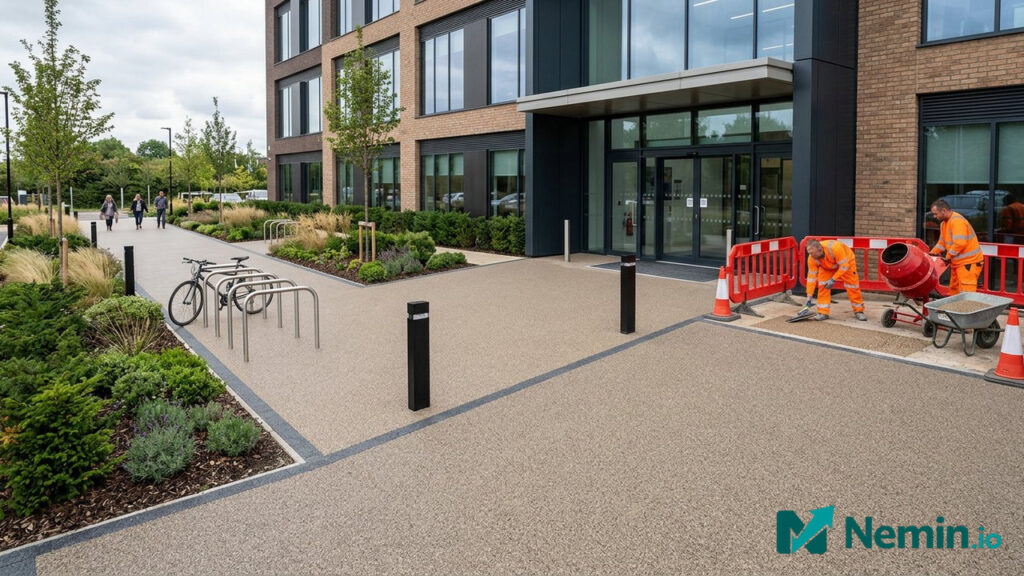
Choosing the right exterior surface for a workplace, retail development, hospitality venue or public-facing property is a practical decision as much as an aesthetic one. Commercial resin bound surfacing combines graded aggregate with a resin binder before the mixture is laid and hand or mechanically finished into a smooth, continuous surface. When the complete system is correctly specified and installed on a suitable base, it can provide an attractive, relatively low-maintenance finish for paths, courtyards, entrances, pedestrian areas and certain vehicle applications. Its performance, however, depends on drainage design, substrate condition, loading, resin quality, aggregate selection, installation depth and workmanship rather than the decorative surface alone.
Resin-bound surfacing has become increasingly visible around British homes and commercial properties because it offers an alternative to conventional paving, loose gravel and some impermeable hard surfaces. Its natural aggregate appearance can complement both traditional and contemporary architecture, while the absence of loose stones can make everyday cleaning and movement more manageable than ordinary gravel.
Commercial projects create additional demands. A small residential footpath and a busy business entrance may use similar-looking aggregate but require different design considerations. Delivery vehicles, service traffic, accessibility, drainage, utility access and public footfall all influence specification.
This guide explains how commercial resin bound surfacing works, where it can be used, how it differs from resin bonded surfacing and what businesses should examine before commissioning an installation.
What Is Commercial Resin Bound Surfacing?
Commercial resin bound surfacing is a system in which clean, appropriately graded aggregate is mixed thoroughly with a resin binder before being applied to a prepared base. The mixed material is then spread and finished to create a continuous aggregate surface.
Because resin coats the individual stones within the mixture, appropriately designed systems contain interconnected voids through which water can pass. This permeability is one of the characteristics most strongly associated with resin-bound surfaces.
The finished system should not be confused with a decorative scatter treatment in which loose aggregate is spread over resin already applied to a surface. That is usually described as resin bonded rather than resin bound.
How Commercial Resin Bound Surfacing Is Made
The installation process begins long before the decorative mixture reaches the ground.
A contractor first needs to assess the existing surface, drainage, levels and intended use. A suitable base is then prepared or confirmed, after which measured resin components and aggregate are mixed according to the system specification.
The mixture is laid within the permitted working time and finished evenly. Curing conditions and reopening times depend on the specific resin system, weather and manufacturer guidance.
Resin Bound Versus Resin Bonded Surfacing
The names are similar enough to cause frequent confusion, but the construction and surface characteristics differ.
| Feature | Resin Bound Surfacing | Resin Bonded Surfacing |
|---|---|---|
| Installation | Aggregate mixed with resin before laying | Resin applied first, aggregate scattered over it |
| Finished texture | Relatively smooth aggregate matrix | Rougher, gravel-like texture |
| Loose aggregate | Minimal when correctly installed | Some excess aggregate may shed |
| Permeability | Can be permeable as part of a suitable system | Typically treated as impermeable |
| Common uses | Paths, entrances, driveways and public areas | Decorative or high-friction finishes |
| Appearance | Continuous and uniform | Resembles bonded loose gravel |
| Accessibility | Smooth finish can be advantageous | Rougher texture may be less suitable in some areas |
| Drainage design | Can form part of a permeable system | Requires separate drainage approach |
Businesses should make sure quotations identify the exact system being offered.
9 Benefits of Commercial Resin Bound Surfacing
The appeal of resin-bound systems comes from a combination of design flexibility and practical surface characteristics. Benefits depend on correct specification and competent installation, so none should be treated as automatic for every project.
Nine advantages stand out for commercial settings: strong visual presentation, permeability potential, smooth pedestrian movement, colour choice, reduced loose stone, flexible detailing, straightforward maintenance, broad application possibilities and the ability to complement different architectural styles.
1. Commercial Resin Bound Surfacing Creates a Professional Entrance
The entrance to a commercial property forms part of a visitor’s first impression.
A continuous resin-bound finish can create a clean transition between car parks, paths and entrance areas. Aggregate colour can also be coordinated with brick, stone, cladding or landscape design.
The surface does not need to be highly decorative to make an impact. Consistency and clean detailing often create a stronger professional appearance than complicated patterns.
2. A Permeable System Can Support Drainage Strategy
Resin-bound material can allow surface water to pass through the aggregate matrix.
To achieve meaningful permeability, the layers beneath the decorative surface must also be designed appropriately. Installing permeable resin on top of an impermeable base does not magically create a fully permeable construction.
Drainage should therefore be considered as part of the entire pavement design.
3. The Smooth Finish Can Support Pedestrian Use
Compared with loose gravel, commercial resin bound surfacing can provide a more stable, relatively smooth walking surface when correctly installed.
This can be advantageous around offices, shops, hotels, schools and other areas with regular pedestrian movement.
Accessibility depends on more than material choice, however. Gradients, crossfalls, edges, thresholds and maintenance all need appropriate design.
4. There Are Numerous Aggregate Colours
Natural and manufactured aggregate blends are available in many tones.
Warm golden mixes can complement brick and traditional buildings, while grey, silver or darker aggregates may suit contemporary architecture. Contrasting colours can also define pathways or selected zones.
Samples should be viewed outdoors because lighting and wet conditions can change their appearance.
5. Commercial Resin Bound Surfacing Avoids Loose Gravel Movement
Loose gravel can migrate into doorways, drains, landscaped beds and pedestrian areas.
Because the aggregate in a resin-bound surface is held within a cured matrix, normal loose-stone migration is substantially reduced.
Localised particle loss can still occur if the material is damaged, incorrectly installed or degraded.
6. Curves and Detailed Shapes Can Be Created
Resin-bound surfacing is laid in place, making it adaptable to curved paths, irregular boundaries and landscaped spaces.
This can reduce the visual need for numerous small cut paving units around complex shapes.
The installer still needs proper edge restraints and carefully planned termination details.
7. Routine Maintenance Is Relatively Straightforward
Regular sweeping and appropriate washing can help keep the surface clean.
There are no conventional paving joints across the main resin-bound field for weeds to establish in, although organic growth can still appear where debris accumulates or along edges.
Low maintenance does not mean no maintenance.
8. Commercial Resin Bound Surfacing Has Broad Design Applications
The material can be considered for pedestrian routes, courtyards, retail entrances, plazas, certain parking areas and vehicle surfaces where the complete build-up is appropriately designed for the load.
One specification should not automatically be copied between all these uses.
Vehicle load and frequency need particular engineering attention.
9. It Can Work With Both Modern and Traditional Architecture
Natural aggregate creates a material connection with conventional stone surfaces while resin construction produces a more seamless finish.
This allows the same broad technology to suit very different visual environments.
Careful aggregate selection is what determines whether the surface feels sympathetic to the building.
Commercial Resin Bound Surfacing for Business Entrances
Entrance areas need to handle pedestrian traffic while remaining presentable in different weather conditions.
The surface should connect logically with parking, drop-off areas, steps, ramps and door thresholds.
Drainage around the building must also prevent water from being directed where it can create problems.
Make the Arrival Route Obvious
Contrasting aggregate can be used to identify pedestrian routes without relying entirely on painted lines.
Borders and directional details can also create visual structure.
Where formal accessibility or wayfinding requirements apply, design should follow relevant standards rather than relying on colour contrast alone.
Consider Dirt at Doorways
Any exterior surface close to an entrance collects environmental dirt.
Suitable entrance matting and routine cleaning can reduce the amount transferred inside.
Resin-bound surfacing should slope and drain appropriately so that water does not collect close to thresholds.
Commercial Resin Bound Surfacing for Car Parks
Car parks place substantially greater demands on paving than ordinary footpaths.
Vehicle weight, turning forces, oil contamination, delivery traffic and point loads need consideration. A decorative resin surface is only the upper part of a pavement system.
The base beneath it must be appropriate for the intended loading.
Vehicle Use Requires the Correct Specification
A contractor should know what vehicles use the area.
Ordinary cars create different demands from refuse vehicles, delivery lorries or heavy commercial traffic. Loading frequency also matters.
Engineering advice may be appropriate for substantial commercial sites rather than relying on a domestic driveway specification.
Parking Bay Design
Different aggregate colours can potentially distinguish bays, pathways or restricted zones.
However, legally or operationally important road markings may require specialised products and compliance with relevant design requirements.
Do not assume decorative aggregate alone is sufficient for every traffic-management purpose.
Commercial Resin Bound Surfacing for Retail Properties
Retail properties need surfaces that support frequent pedestrian use, deliveries and cleaning.
Shopping environments also benefit from clear routes between parking and entrances.
A continuous aggregate finish can contribute to landscape design without competing visually with storefronts.
Plan Around Deliveries
Service vehicles can create much higher stresses than customer footfall.
If deliveries cross the resin surface, tell the designer exactly what vehicle types are expected.
The strongest-looking decorative finish cannot compensate for an inadequate structural base.
Commercial Resin Bound Surfacing for Hotels and Hospitality
Hospitality venues often place unusual emphasis on arrival experience.
Driveways, courtyards, terraces and paths may form part of the guest’s perception before they enter the building.
Resin-bound aggregate can provide a decorative surface without relying on loose stone.
Coordinate With Landscape Design
Aggregate colour can connect building stone, planting and outdoor furniture.
Avoid choosing a blend in isolation from the wider property.
Large samples or a completed reference area can be more useful than tiny aggregate swatches when making a major specification decision.
Commercial Resin Bound Surfacing for Offices
Office developments often require a balance between pedestrian routes, parking and landscaped areas.
A resin-bound path can provide a clear visual transition through the site.
For larger developments, the material can be included within a broader landscape architect or civil engineer’s specification.
Design for Real Foot Traffic
Look at where people actually walk rather than where plans assume they will.
If the shortest route from parking to the entrance cuts across landscaping, users may create an informal path regardless of the intended layout.
Commercial resin bound surfacing works best when circulation planning reflects human behaviour.
Commercial Resin Bound Surfacing for Schools
Educational environments require careful design around accessibility, slip risk, maintenance and safeguarding.
Resin-bound surfacing may be considered for selected paths, courtyards and landscape areas when properly specified.
Play surfaces can have separate impact and safety requirements, so ordinary resin-bound paving should not automatically be treated as playground safety surfacing.
Different Areas Need Different Systems
A pedestrian courtyard and an impact-absorbing play area perform different functions.
Similarly, a service road crossing school grounds needs a stronger pavement construction than a footpath.
Specify by application, not visual appearance.
Commercial Resin Bound Surfacing for Healthcare Environments
Healthcare properties can benefit from smooth, clearly defined exterior routes.
Wheelchairs, mobility aids and walking frames make surface consistency important. Gradients and thresholds are equally significant.
Clinical and accessibility requirements should guide the overall route design.
Cleaning and Winter Safety
Facilities need a planned approach to leaves, moss, ice and contamination.
A surface should never be described as completely slip-proof.
Slip resistance changes with contamination, wear and conditions, making maintenance essential.
How Permeable Is Commercial Resin Bound Surfacing?
A properly designed resin-bound layer contains voids that allow water to move through it.
The overall rate and effectiveness depend on aggregate grading, binder content, installation and the layers beneath.
A clogged or impermeable substrate can undermine the drainage objective.
Permeable Surface Versus Permeable System
This distinction is critical.
| Construction | Surface Layer | Base | Overall Drainage Behaviour |
|---|---|---|---|
| Fully permeable design | Permeable resin bound | Permeable base | Water can infiltrate through complete build-up |
| Resin on impermeable asphalt | Permeable resin bound | Impermeable | Water cannot continue vertically through base |
| Resin on suitable concrete | Permeable upper layer | Impermeable concrete | Separate drainage strategy required |
| Poorly compacted unsuitable base | Resin bound | Inadequate foundation | Risk of structural failure regardless of drainage |
Site drainage should be designed, not assumed.
Commercial Resin Bound Surfacing and SuDS
Sustainable drainage systems, commonly called SuDS, seek to manage surface water in more sustainable ways than rapidly directing all runoff into conventional drainage.
Permeable paving can form part of a SuDS strategy when the complete design meets relevant requirements.
A resin-bound surface alone does not automatically make a development SuDS compliant.
Planning and Drainage Advice
Commercial developments can involve planning conditions, drainage approvals and site-specific requirements.
Consult the relevant planning authority, drainage professional or civil engineer as appropriate.
Do not rely on a contractor’s marketing statement as proof of regulatory compliance.
Base Preparation for Commercial Resin Bound Surfacing
Base quality is one of the strongest determinants of long-term performance.
Resin-bound surfacing is not intended to hide a structurally failing substrate. Movement and cracking underneath can affect the finished surface.
A contractor should inspect existing paving before recommending an overlay.
Common Base Considerations
Suitable bases depend on the resin system, loading and drainage design.
A new permeable construction may use appropriately specified aggregate and porous asphalt layers, while some overlays may be installed onto sound existing asphalt or concrete under suitable conditions.
Manufacturer specifications and project engineering should determine the build-up.
Commercial Resin Bound Surfacing Cannot Repair a Failed Base
If existing concrete is breaking apart or asphalt is badly deformed, covering it with a decorative resin layer does not address the structural cause.
Necessary repairs or reconstruction should happen first.
This may increase initial cost but can prevent expensive surface failure later.
Installation Depth and Commercial Resin Bound Surfacing
Resin-bound layer depth varies according to aggregate size, application, system specification and expected traffic.
It is not responsible to give one universal depth for every commercial project.
Heavy or frequent traffic can require a different pavement construction from pedestrian use.
Follow the System Specification
Contractors should work with the resin and aggregate supplier’s technical requirements.
Arbitrarily reducing thickness to lower costs can compromise performance.
Quotations should identify the proposed system rather than describing only a coloured aggregate finish.
UV-Stable Resin and Commercial Surfaces
Some resin binders can change colour under ultraviolet exposure more significantly than others.
UV-stable systems are often selected where maintaining aggregate colour is especially important.
Ask the manufacturer what resin technology is proposed and how colour change is addressed.
Why Resin Choice Matters
Light-coloured aggregates can make binder discolouration more noticeable.
A less colour-stable system might be less visually significant under certain darker blends, but the decision should be intentional.
Compare material specifications, not simply aggregate names.
Aggregate Selection for Commercial Resin Bound Surfacing
Aggregate affects appearance, texture, void structure and performance.
Materials should be suitable for resin-bound application, clean, dry and graded appropriately according to the system.
Ordinary wet landscaping gravel should not simply be mixed into resin.
Choosing Aggregate Colour
| Colour Family | Typical Visual Effect | Common Design Pairing |
|---|---|---|
| Golden | Warm and traditional | Brick and stone buildings |
| Buff | Soft and understated | Heritage or residential-style architecture |
| Silver grey | Clean and contemporary | Glass and metal façades |
| Dark grey | Strong and modern | Light architecture |
| Mixed natural | Informal aggregate appearance | Landscaped settings |
| Red-brown | Warm and distinctive | Brick developments |
| Light neutral | Bright appearance | Contemporary courtyards |
Colour names vary between suppliers, so request physical samples.
Borders and Edging
Resin-bound surfaces need clean boundaries.
Aluminium, block paving, stone or other suitable edge details may be used depending on design and system requirements.
Edges also provide an opportunity to introduce subtle contrast.
Commercial Resin Bound Surfacing With Contrasting Borders
A dark border around a pale aggregate can create architectural definition.
Use contrast selectively. Too many colours and dividing lines can undermine the continuous character that makes resin bound visually appealing.
Functional requirements such as wayfinding should be coordinated with the decorative plan.
Accessibility and Commercial Resin Bound Surfacing
A relatively smooth, firm surface can be useful for accessible routes when correctly designed and maintained.
Material choice alone cannot establish accessibility.
Route width, gradient, crossfall, drainage, thresholds, tactile features and connections to entrances all require consideration.
Follow Applicable Standards
Commercial and public-access projects should be designed according to relevant accessibility and building requirements.
A qualified designer or access consultant can advise where necessary.
Do not describe any surface as automatically wheelchair compliant without considering the complete route.
Slip Resistance
Resin-bound surfaces can be designed to provide appropriate slip characteristics, but no exterior paving remains slip-free in every condition.
Leaves, algae, oil, frost and standing contamination can reduce traction.
Maintenance therefore plays a major role in safety.
Anti-Slip Measures
Certain systems may incorporate surface treatments or aggregate intended to enhance slip resistance.
These measures should follow manufacturer specifications and project requirements.
Adding random materials during installation can alter appearance and performance.
Commercial Resin Bound Surfacing Around Trees
Permeable surfaces can be attractive around landscaped areas, but tree health requires more than providing a porous top layer.
Root zones, soil conditions, oxygen and construction impact all matter.
Tree specialists may need to advise on work around valuable or mature trees.
Allow for Growth
Tree roots and trunks change over time.
Rigidly surfacing too close to trunks can create future maintenance problems.
Landscape design should coordinate resin surfacing with appropriate tree pits and root protection.
Commercial Resin Bound Surfacing and Utility Covers
Commercial sites contain drainage covers, inspection chambers and utility access points.
These must remain accessible.
The installer should detail the resin neatly around frames without permanently obstructing infrastructure.
Plan Covers Into the Design
Recessed covers can sometimes be used where technically appropriate to reduce visual disruption.
They still need to remain identifiable and serviceable.
Never cover a required access point simply to create an uninterrupted decorative surface.
How Long Does Commercial Resin Bound Surfacing Last?
There is no responsible universal lifespan.
Durability depends on system quality, base condition, load, installation, weather, maintenance and exposure to contamination.
Warranty periods can provide some information but should be read carefully.
Ask What the Warranty Covers
A warranty may distinguish between material defects, workmanship and damage caused by substrate movement or inappropriate traffic.
Obtain written terms before installation.
Long headline warranties are less useful when exclusions make common failure modes the customer’s responsibility.
Commercial Resin Bound Surfacing Maintenance
Routine cleaning can help preserve appearance and drainage performance.
Sweeping removes leaves and debris before organic material decomposes into the surface texture. Appropriate pressure or mechanical washing may be recommended depending on system and manufacturer.
Avoid aggressive equipment or chemicals not approved for the surface.
Maintenance Schedule
| Maintenance Area | Purpose |
|---|---|
| Regular sweeping | Remove leaves and loose dirt |
| Spill response | Reduce staining and surface contamination |
| Periodic washing | Remove embedded surface dirt |
| Drainage inspection | Ensure outlets and edges remain functional |
| Weed removal | Address occasional growth promptly |
| Moss or algae control | Maintain appearance and traction |
| Edge inspection | Identify local movement or damage |
| Crack inspection | Detect substrate or surface problems |
| Winter care | Manage ice and snow appropriately |
| Professional review | Assess significant defects |
Actual maintenance frequency should reflect site conditions.
Can Weeds Grow Through Resin Bound Surfacing?
A correctly installed resin-bound system does not contain normal open soil joints like many block-paved surfaces.
However, wind-blown seeds can germinate in organic debris that accumulates on top, particularly around edges or neglected areas.
Vegetation can also exploit existing cracks if underlying structural problems develop.
Prevention Is Better Than Aggressive Treatment
Routine sweeping reduces the organic material available for seeds.
When weeds appear, follow the resin manufacturer’s recommended treatment method.
Avoid applying harsh herbicides or chemicals without checking compatibility.
Snow, Frost and Winter Maintenance
Commercial properties need safe winter access.
Snow can be removed using methods appropriate to the surface, while de-icing products should be selected according to manufacturer guidance.
Metal tools with sharp edges can damage many decorative surfaces if used aggressively.
Freeze-Thaw Conditions
Drainage is important in freezing weather because trapped water can contribute to pavement problems.
The full base design should suit local environmental conditions.
Professional specification is especially important for exposed commercial sites.
Oil and Chemical Spills
Car parks and service areas can experience oil, fuel or chemical contamination.
Prompt cleaning can reduce staining, but appropriate methods depend on the substance and resin system.
Some chemicals can damage resin surfaces.
Commercial Resin Bound Surfacing in Service Areas
If regular chemical or fuel exposure is expected, tell the designer before specifying the surface.
A different industrial paving material may be more suitable for severe environments.
Decorative appearance should not override chemical-resistance requirements.
Repairs to Commercial Resin Bound Surfacing
Localised damaged areas can sometimes be cut out and repaired.
A repair may remain visually noticeable because aggregate colour, weathering and batch variation can make an exact match difficult.
Keeping records of the original aggregate blend can help.
Address the Cause Before Repairing
If cracking comes from movement in the base, patching only the resin surface is unlikely to provide a durable solution.
Investigate substrate failure, vehicle overloading or drainage issues first.
Repairs should solve the underlying problem where possible.
Commercial Resin Bound Surfacing Cost
Commercial pricing depends on more than square metre area.
Base preparation, site access, excavation, drainage, resin specification, aggregate, project size and detailing can all affect cost.
Large uncomplicated areas may have different unit economics from small sites with numerous edges and utility covers.
Commercial Resin Bound Surfacing Cost Factors
| Cost Factor | Why It Matters |
|---|---|
| Surface area | Determines material and labour quantity |
| Existing base | May require repair or complete reconstruction |
| Traffic loading | Influences pavement specification |
| Drainage | Additional infrastructure may be needed |
| Resin type | Material specifications vary |
| Aggregate | Blend and sourcing affect price |
| Edging | Detailed borders add materials and labour |
| Access | Restricted sites can slow installation |
| Utility covers | Require additional detailing |
| Site preparation | Excavation and disposal can be substantial |
| Project phasing | Maintaining business access can add complexity |
| Location | Labour and transport costs vary |
Obtain site-specific written quotations rather than relying on universal online rates.
Commercial Resin Bound Surfacing Versus Block Paving
Block paving offers individual units, familiar installation methods and the possibility of local lifting and replacement.
Resin bound creates a more continuous surface with minimal joints across the main field.
Both can work successfully when correctly designed.
Comparison
| Feature | Resin Bound | Block Paving |
|---|---|---|
| Appearance | Continuous aggregate | Repeating individual blocks |
| Joints | Minimal across main surface | Numerous joints |
| Permeable options | Available with full suitable system | Permeable block systems available |
| Curves | Flexible finish | Requires cutting and detailing |
| Repairs | Patches may be visible | Individual blocks can often be lifted |
| Weed potential | Mainly surface debris and edges | Joints require maintenance |
| Installation | Specialist resin process | Established paving method |
| Base importance | Critical | Equally important |
| Colour choice | Aggregate blends | Block colours and patterns |
The correct choice depends on design, loading, maintenance and budget.
Commercial Resin Bound Surfacing Versus Asphalt
Asphalt is widely used for roads and car parks because it can provide robust, economical coverage for substantial areas when correctly designed.
Resin bound typically offers greater decorative flexibility.
Commercial developments may use asphalt for main traffic areas and resin bound for pedestrian or prestige zones.
Combining Materials
Mixing materials can be highly effective when transitions are detailed properly.
A resin-bound entrance path can create a premium arrival while asphalt handles heavy vehicle circulation.
The project does not need to use one surface everywhere.
Commercial Resin Bound Surfacing Versus Loose Gravel
Loose gravel is visually traditional and can be relatively inexpensive in suitable applications.
Its main practical difference is movement. Stones can migrate under feet and tyres, while resin bound holds aggregate in a fixed matrix.
Gravel may remain preferable where easy reversibility and a loose natural appearance are priorities.
Accessibility Considerations
Deep loose gravel can be difficult for certain wheelchairs, pushchairs and mobility aids.
A firm resin-bound route may provide easier movement when the complete path is appropriately designed.
Again, accessible design involves the entire route rather than material alone.
Choosing a Commercial Resin Bound Surfacing Contractor
Installation quality is central to performance.
Resin systems involve precise mixing, timing and environmental conditions. Poor workmanship can produce uneven finishes, weak areas or visible inconsistencies.
Choose a contractor based on relevant commercial experience rather than price alone.
Questions to Ask Contractors
Ask:
- Which resin system do you propose?
- Why is it suitable for our traffic?
- What base construction is required?
- Will the completed pavement be permeable?
- How will drainage work?
- What aggregate blend is specified?
- What depth will be installed?
- How will utility covers and edges be detailed?
- What weather conditions are required for installation?
- How will business access be maintained?
- What insurance do you carry?
- Can we see comparable completed commercial work?
- What warranty applies?
- What maintenance is required?
Detailed answers make quotations easier to compare.
Commercial Resin Bound Surfacing Installation Process
Professional installation follows a planned sequence.
Existing-site conditions can change the exact process, especially where excavation or new drainage is required.
The resin finish should come only after the groundwork is correct.
Typical Installation Stages
| Stage | Main Purpose |
|---|---|
| Site survey | Assess use, access and drainage |
| Design | Establish pavement construction |
| Excavation | Remove unsuitable materials where necessary |
| Base preparation | Create stable structural support |
| Edging | Establish boundaries |
| Drainage work | Manage water appropriately |
| Surface preparation | Ensure suitable laying conditions |
| Mixing | Combine measured aggregate and resin |
| Laying | Spread material at specified depth |
| Finishing | Create consistent surface texture |
| Curing | Allow system to develop required properties |
| Handover | Provide maintenance and warranty information |
Reopening times should follow the specific product and contractor guidance.
Weather During Installation
Resin-bound installation is sensitive to environmental conditions.
Rain, temperature and moisture can affect some resin systems and working procedures.
Responsible contractors monitor forecasts and postpone work when conditions fall outside product requirements.
Do Not Pressure Installers to Lay in Unsuitable Weather
A commercial opening deadline can create pressure to proceed.
However, compromising installation conditions can create defects that last much longer than a short project delay.
Build weather contingency into the programme.
Commercial Resin Bound Surfacing Project Planning
Businesses need to maintain access while work takes place.
Large sites may need phased installation so employees, customers and deliveries can use alternative routes.
Plan temporary signage and safe pedestrian diversions where necessary.
Project Planning Framework
| Stage | Main Decision |
|---|---|
| 1. Define use | Pedestrian, cars or commercial vehicles |
| 2. Survey site | Base, drainage, levels and access |
| 3. Choose system | Resin, aggregate and pavement construction |
| 4. Check compliance | Planning, drainage and accessibility |
| 5. Compare contractors | Experience, specification and warranty |
| 6. Approve samples | Confirm aggregate and detailing |
| 7. Plan phasing | Maintain safe business access |
| 8. Install | Follow technical and weather requirements |
| 9. Cure | Prevent premature use |
| 10. Maintain | Establish routine inspection and cleaning |
Treating the surface as infrastructure rather than decoration leads to better project decisions.
Is Commercial Resin Bound Surfacing Worth It?
Commercial resin bound surfacing can be worthwhile where businesses value a seamless aggregate appearance, permeability potential, controlled pedestrian movement and flexible design.
It is particularly effective in public-facing entrances and landscaped settings where both presentation and function matter.
It is not necessarily the best option for every heavy industrial environment or badly failing substrate.
Focus on Whole-Life Value
Purchase price is only one consideration.
Maintenance, drainage, expected service life, repairability and the value of presentation should also enter the decision.
A properly specified surface may cost more initially than a minimal cosmetic overlay but provide better long-term value.
FAQ’s
What is commercial resin bound surfacing?
Commercial resin bound surfacing is created by mixing graded aggregate with resin before laying the mixture onto a suitably prepared base, producing a continuous decorative surface for appropriate commercial applications.
Is commercial resin bound surfacing permeable?
The resin-bound layer can be permeable, but the complete pavement is only fully permeable when the underlying construction is also designed to allow water to pass or drain appropriately.
Can commercial resin bound surfacing handle vehicles?
Yes, in appropriately designed applications. Vehicle type, frequency, resin system, installation depth and especially the structural base must be specified for the expected loading.
How long does commercial resin bound surfacing last?
There is no universal lifespan. Performance depends on substrate quality, installation, traffic, resin and aggregate specification, drainage, environment and maintenance.
Is commercial resin bound surfacing easy to maintain?
Routine sweeping and suitable cleaning are generally straightforward, but leaves, organic growth, spills, winter conditions and local damage still require attention according to manufacturer guidance.
How much does commercial resin bound surfacing cost?
Costs vary according to area, base preparation, drainage, traffic loading, resin type, aggregate, access and detailing. Commercial projects should obtain site-specific written quotations.
Conclusion
Commercial resin bound surfacing can provide businesses with a distinctive combination of smooth aggregate appearance, design flexibility and potentially permeable construction. It works particularly well for entrances, pathways, courtyards, selected parking areas and landscaped commercial environments when the system is designed around actual pedestrian or vehicle demands.
The success of commercial resin bound surfacing depends far more on what sits beneath the visible aggregate than appearance alone. A stable base, appropriate drainage, correct resin and aggregate specification, suitable installation conditions and experienced workmanship are essential. By treating the project as a complete pavement system rather than a decorative coating, businesses can create an attractive surface designed for practical long-term use.