
A free boiler grant can potentially help an eligible UK household improve an inadequate or inefficient heating system without meeting the entire cost privately, but the phrase...
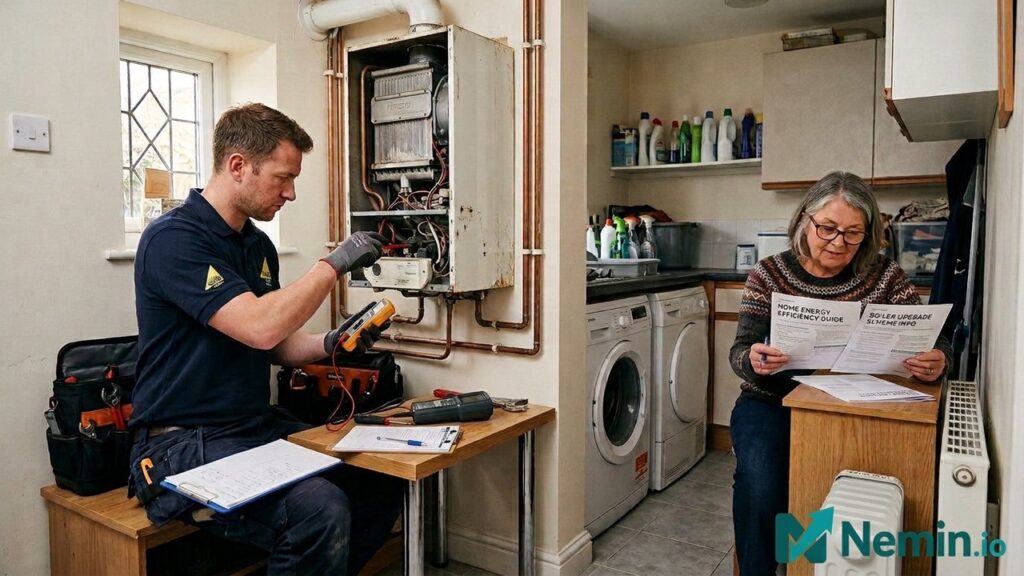
A free boiler grant can potentially help an eligible UK household improve an inadequate or inefficient heating system without meeting the entire cost privately, but the phrase needs careful explanation. There is no permanent universal programme giving every UK resident a free replacement boiler simply because their existing boiler is old. Assistance has instead been available through targeted energy-efficiency obligations, local eligibility pathways and other schemes whose rules depend on household circumstances, property energy performance, tenure, heating type and technical assessment. Because major UK energy-efficiency programmes change over time, anyone applying in 2026 should check current GOV.UK, Ofgem, local authority and devolved-government information before relying on an older article or online eligibility calculator.
The attraction is obvious. Replacing a boiler can represent a substantial household expense, and families already struggling with heating costs may find that expenditure particularly difficult. Government and supplier-backed energy policies have therefore historically targeted certain low-income and vulnerable households for efficiency improvements.
However, the free boiler grant market also contains confusing advertising. Phrases such as government-backed, 100 percent funded and instant approval can make the process sound far simpler than it is. An initial questionnaire does not establish final eligibility, and an eligible household is not necessarily entitled specifically to a boiler.
A property survey normally matters because heating is only one part of energy performance. Insulation, controls, ventilation and the existing building fabric can affect which improvements are appropriate. This guide explains how free boiler grant eligibility works, what happened under ECO4, what applicants should check after its scheduled end date, and how to protect yourself from misleading offers.
What Is a Free Boiler Grant?
A free boiler grant is a common marketing term for financial support that may cover some or all of an eligible boiler replacement through an energy-efficiency programme. It is not the name of one permanent UK-wide entitlement that operates identically for every household.
Historically, the Energy Company Obligation has been one of the most important routes associated with energy-efficiency improvements for eligible households in Great Britain. ECO4, the fourth phase, was scheduled to run from April 2022 until 31 March 2026. Since the current date is August 2026, households should verify what programme or transitional arrangements are currently available rather than submitting an application based on expired ECO4 information.
The distinction matters because many websites can remain visible in search results after the underlying scheme has changed. A legitimate free boiler grant enquiry should always identify the current funding mechanism clearly.
Is the Free Boiler Grant Really Free?
Sometimes eligible work can be fully funded, but “free” should never be assumed merely from an advertisement. The amount of support can depend on the scheme, household, property, measures being installed and available funding.
Some applicants may be asked for a contribution, while others may receive a package of measures rather than one standalone replacement boiler. Before agreeing to work, request written confirmation of the complete scope and any amount you are expected to pay.
A genuine funding opportunity should be explainable without hiding costs behind vague phrases such as administration charge or mandatory upgrade contribution.
What a Free Boiler Grant Does Not Guarantee
A free boiler grant does not normally guarantee that every old boiler will be replaced. Age, efficiency, condition, repairability and the wider property assessment can all influence the recommended measure.
| Common Claim | What It Really Requires |
|---|---|
| Everyone can get a free boiler | Eligibility is normally targeted |
| An old boiler automatically qualifies | Age alone may not satisfy scheme rules |
| Benefits guarantee a new boiler | Property and technical criteria can still apply |
| No benefits are needed | An alternative eligibility route must exist |
| Approval takes minutes | Initial screening is not final approval |
| Tenants can apply independently | Landlord involvement may be required |
| The government installs the boiler | Delivery is generally through authorised commercial arrangements |
| A new boiler guarantees lower bills | Actual costs depend on energy prices, property and usage |
Treat guaranteed approval language cautiously unless the provider can explain exactly how eligibility has already been verified.
7 Factors That Can Affect Free Boiler Grant Eligibility
Free boiler grant eligibility should be viewed as a combination of household circumstances and property suitability. Meeting one criterion does not necessarily mean the application is complete.
Seven factors frequently matter: qualifying benefits or income, vulnerability pathways, property energy performance, existing heating condition, tenure, local eligibility arrangements and the result of a technical assessment. Current rules should always be checked because policy changes can alter each factor.
1. Free Boiler Grant Eligibility May Depend on Benefits
Previous energy-efficiency schemes have used certain means-tested benefits as a route to identifying eligible households. The qualifying list has changed between programme phases, so applicants should not rely on old lists copied across grant websites.
Receiving a benefit can establish part of an eligibility route without automatically guaranteeing a boiler replacement. The property and proposed measures still need to meet relevant programme requirements.
For current benefit-based eligibility, use official government, Ofgem or scheme-administrator information.
2. Low Household Income Can Be Relevant
Some flexibility routes have allowed households to be considered without receiving the traditional qualifying benefits. Income thresholds and definitions depend on the specific policy.
Applicants may need to supply legitimate evidence of income. Because these documents contain sensitive information, verify the identity of the organisation collecting them before uploading payslips, tax records or benefit documents.
Never alter financial information in an attempt to secure a free boiler grant.
3. Health and Vulnerability Can Matter Under Some Routes
Certain locally administered flexibility arrangements have historically considered circumstances in which living in a cold home may worsen particular health vulnerabilities. This does not mean any medical condition automatically creates eligibility.
Criteria and evidence requirements depend on the applicable route. Applicants should use official local-authority or programme guidance rather than disclosing medical information indiscriminately to an advertising website.
Where health data is required, understand why it is being collected and how it will be handled.
4. Your Property’s Energy Performance Matters
Targeted energy-efficiency programmes frequently take the building’s energy performance into account. An Energy Performance Certificate, commonly called an EPC, may therefore be relevant.
The programme may prioritise properties with lower energy efficiency, subject to current rules. A low EPC does not automatically create entitlement to a free boiler grant because household and technical requirements can still apply.
Available EPC records can be checked through official government services for relevant properties.
5. The Existing Boiler or Heating System Must Be Assessed
A boiler being old does not necessarily make it eligible for grant-funded replacement. The current condition, efficiency and heating arrangement may need to meet technical criteria.
An assessor may determine that another measure is more appropriate or that the existing system does not satisfy the particular scheme’s replacement rules. Do not damage, disconnect or deliberately misrepresent a functioning boiler in an attempt to become eligible.
The survey exists to identify what the property genuinely requires.
6. Property Tenure Can Change the Free Boiler Grant Process
Homeowners, private renters and social-housing residents do not always follow identical routes. An owner-occupier can generally authorise appropriate property improvements directly, while tenants normally require the landlord or housing provider to participate in major heating modifications.
Funding conditions for rented homes can also differ. Applicants should disclose the correct tenure during screening rather than applying as an owner when the property is rented.
Landlords should likewise avoid using a tenant’s circumstances without clear communication and appropriate consent.
7. Final Eligibility Requires More Than an Online Form
Online calculators are useful for initial screening, but they cannot inspect the boiler, insulation, property construction or installation conditions.
A legitimate free boiler grant process can require documentary verification and a property survey before final funding is confirmed. Applicants should therefore treat messages saying “you qualify” after three online questions as provisional unless formal verification has already taken place.
Final approval should identify the actual work being funded.
Free Boiler Grant and the ECO4 Scheme
ECO4 was established as the fourth phase of the Energy Company Obligation, requiring obligated energy suppliers to deliver qualifying energy-efficiency measures according to the scheme framework. It ran from April 2022 with a scheduled end date of 31 March 2026.
That date is critical for anyone researching a free boiler grant now. As of August 2026, an article presenting ECO4 as an automatically open current application route would risk misleading readers. Official sources should be used to identify the current scheme landscape, successor policy or any transitional arrangements.
The historical ECO4 framework remains useful for understanding why so many boiler-grant websites discuss benefits, EPC ratings, low-income households and whole-home improvements.
How ECO4 Changed the Free Boiler Grant Conversation
ECO4 emphasised improving the energy performance of eligible homes rather than simply replacing one appliance in isolation. This whole-house approach meant that insulation and related energy measures could become important parts of a project.
A household searching specifically for a free boiler grant could therefore be assessed for a broader improvement package. The policy logic is straightforward: reducing heat loss can sometimes improve a property’s overall efficiency more effectively than changing the heat source alone.
Any current successor programme may have different rules, which is why applicants should not assume ECO4 criteria continue unchanged.
What to Check After ECO4
When researching current funding, verify several points before providing personal details. Check the exact name of the live programme, its official dates, which households it targets, which heating measures it funds and who administers applications.
Also check whether previous ECO terminology is being used merely for marketing. A website describing an expired programme as though nothing has changed should not be your only source of information.
Free Boiler Grant and ECO Flex
Under ECO4, local authority flexibility, commonly referred to as ECO Flex, provided routes for identifying certain households that did not necessarily qualify through the standard benefits pathway. Local authorities worked within the relevant scheme framework and published statements explaining their approach.
ECO Flex was often the basis for advertisements saying a free boiler grant might be available without benefits. That wording was incomplete unless the advertiser also explained the alternative income, vulnerability or other criteria.
Because ECO4’s scheduled period has ended, applicants in 2026 should verify whether an equivalent flexibility mechanism currently exists and what rules now apply.
Free Boiler Grant Without Benefits
Not receiving benefits has not always meant automatic rejection from every efficiency programme. Alternative routes can potentially target low-income or vulnerable households where the applicable policy permits them.
However, “no benefits required” should never be interpreted as “no eligibility requirements.” The applicant still needs to meet the conditions of a legitimate funding route.
Ask the installer or marketer to name the precise scheme before sending financial or medical documents.
Verify a Free Boiler Grant Flex Application Locally
Where an application claims to depend on a local-authority route, identify which council is involved and check that council’s current published information. Councils do not necessarily install boilers themselves simply because they participate in an eligibility process.
A declaration of eligibility may also be distinct from funding approval. Make sure you understand who funds the work, who installs it and who is responsible if problems arise.
Benefits and the Free Boiler Grant
Older online articles frequently publish long benefit lists without dates. This creates an SEO problem as well as a consumer-protection problem because a list accurate under one ECO phase can become inaccurate under the next.
For a current free boiler grant application, use the live rules supplied by the relevant official programme. This is more trustworthy than assuming Universal Credit, Pension Credit or another benefit automatically qualifies every household under every funding route.
The benefit may form only one part of a wider assessment.
Evidence You Might Need for a Free Boiler Grant
The documents required depend on the programme and your circumstances, but legitimate verification may involve several categories.
| Evidence | Possible Reason |
|---|---|
| Identity documents | Confirm applicant identity |
| Address evidence | Establish residence |
| Benefit evidence | Verify an eligible benefit route |
| Income information | Assess an income-based route |
| EPC record | Review property energy efficiency |
| Ownership evidence | Confirm authority over the home |
| Tenancy information | Establish landlord and tenant status |
| Heating information | Assess existing system |
| Health evidence | Support a relevant vulnerability route |
| Landlord consent | Authorise work in rented property |
Only provide documents that are genuinely required, and use secure channels supplied by a verified organisation.
Can Pensioners Get a Free Boiler Grant?
Pensioners may qualify for relevant energy-efficiency support through their household circumstances, income, applicable benefits or another eligible route. Being above a certain age does not by itself guarantee a replacement boiler unless the current programme specifically says it does.
Older residents should also check whether they are receiving all benefits to which they are entitled. Benefit-entitlement advice is separate from the free boiler grant application and can be obtained through recognised government or independent advice services.
Avoid advertisements suggesting that every pensioner automatically receives a government-funded boiler.
Pension Credit and Boiler Support
Pension Credit has been relevant to various forms of household support, but its role in any specific boiler scheme should be verified against current criteria. Applicants should not assume eligibility solely because older ECO guidance included a particular benefit.
The same principle applies to other benefits. Current rules take priority over archived eligibility lists.
Free Boiler Grant for Homeowners
Owner-occupiers can be strong candidates for some targeted efficiency schemes when financial and property criteria align. Ownership makes authorising improvements more straightforward, but it does not remove eligibility requirements.
An assessor may review the EPC, existing heating, insulation and property construction before proposing improvements. The resulting package might contain a boiler, another heating technology or fabric measures depending on the programme.
Homeowners should obtain written confirmation before assuming the project is fully funded.
What Homeowners Should Verify
Confirm who owns the new equipment after installation, what warranty applies and whether any finance agreement, charge or repayment condition is attached. A genuine grant should not be quietly converted into credit without clear informed consent.
Read every document before signing. Where a contract contains unfamiliar financial terms, seek independent advice.
Free Boiler Grant for Private Tenants
Private tenants may be able to benefit from eligible energy-efficiency work, but they do not normally own the boiler or building. Landlord involvement is therefore important.
A tenant should not authorise structural heating work independently simply because an online form says they qualify. The installer needs appropriate permission, and the funding route may impose additional requirements for rented property.
Grant applications should also remain separate from a landlord’s existing legal responsibilities for providing safe, functioning heating.
A Broken Boiler in a Rental Home
If heating fails, report the fault through the landlord or managing agent’s proper repair procedure. Do not wait indefinitely for grant funding if the landlord has an obligation to make essential repairs.
Tenants who encounter unresolved serious heating problems can seek current advice from appropriate housing services, local authorities or recognised tenant-support organisations.
A free boiler grant is a funding opportunity, not a substitute for housing law.
Free Boiler Grant for Landlords
Landlords can sometimes participate in energy-efficiency schemes where the property and occupant circumstances meet programme requirements. Rules can differ from those applying to owner-occupiers.
A landlord should understand whether contributions are required and whether receiving support interacts with other property-energy obligations. Current legal and regulatory requirements should be checked independently.
Tenant data should also be handled appropriately throughout the process.
Tenant Circumstances Are Not a Marketing Resource
Benefit, income and health information belongs to the tenant and can be sensitive.
Landlords and contractors should collect and share only information legitimately necessary for the application and in accordance with applicable data-protection requirements.
Transparent communication benefits everyone involved.
Free Boiler Grant and EPC Ratings
An EPC provides a standardised estimate of a property’s energy performance based on its construction, heating and other characteristics. It can also identify potential improvement recommendations.
Funding programmes may use EPC bands when deciding which properties fall within their target group. The specific bands and exceptions can change between schemes.
Check whether the property has a valid EPC and whether a new assessment is needed for the application.
A Low EPC Does Not Automatically Mean a Free Boiler
A property may perform poorly because of insulation, windows, heating, controls or several factors combined.
Replacing the boiler alone might not produce the improvement required by a particular funding policy.
This is one reason whole-home assessment became important within previous ECO arrangements.
Does Your Boiler Need to Be Broken?
Some funding pathways distinguish between a boiler that is broken and one that is merely old or inefficient. Others may address heating differently.
Because these definitions can be technical, applicants should ask the assessor which specific rule makes their existing system eligible.
Do not rely on generic statements such as “boilers over X years old qualify automatically” unless that condition appears in current scheme guidance.
Repair Versus Free Boiler Grant Replacement
A qualified heating engineer may find that repair is practical and safe. In other situations, replacement could be more sensible because of condition, parts availability or programme requirements.
Grant funding should not turn every repairable fault into an automatic replacement decision.
The appropriate approach depends on the equipment and applicable rules.
Free Boiler Grant Versus the Boiler Upgrade Scheme
The names can cause substantial confusion. A generic free boiler grant is commonly associated with targeted support for eligible households, whereas the formally named Boiler Upgrade Scheme supports qualifying low-carbon heating technologies under its own conditions.
The Boiler Upgrade Scheme should not be interpreted as a programme that simply replaces an old gas boiler with a new gas boiler for free.
Comparing the Two Concepts
| Area | Free Boiler Grant Support | Boiler Upgrade Scheme |
|---|---|---|
| Typical objective | Support eligible households with efficiency improvements | Encourage eligible low-carbon heating |
| Household targeting | Often income, benefit or vulnerability related | Uses a different eligibility structure |
| Gas boiler replacement | May be possible under relevant targeted schemes | Not the scheme’s central purpose |
| Heat pumps | Depends on funding programme | Major supported technology |
| Property assessment | Usually required | Required |
| Funding | Depends on current scheme | Current grant amounts set under BUS rules |
| Application | Depends on programme | Uses the official BUS process |
| Eligibility source | Relevant scheme, Ofgem or government guidance | GOV.UK and Ofgem |
Check both routes if you are considering a major heating upgrade rather than assuming the names refer to the same programme.
Can a Free Boiler Grant Lower Heating Bills?
Replacing a poorly performing boiler with a more efficient and appropriately controlled heating system can reduce the energy required to provide a given amount of useful heat in some homes. That may translate into lower bills, but the result is not guaranteed.
Energy tariffs, building insulation, thermostat settings, household occupancy and weather all influence actual expenditure. A larger or warmer home can consume more energy even with efficient heating.
Any company promising an exact percentage reduction for every free boiler grant recipient should provide strong evidence for that claim.
Insulation Often Matters Just as Much
A heating system produces warmth while the building fabric determines how quickly some of that heat escapes.
Appropriate loft, wall or floor insulation can therefore complement heating improvements. The suitability of each measure depends on construction, moisture, ventilation and other technical factors.
Efficiency upgrades should be designed as a system rather than a collection of unrelated products.
Other Measures That May Accompany a Free Boiler Grant
Households applying for boiler assistance may encounter recommendations for additional energy-efficiency work. This is not necessarily a diversion from the application.
Whole-house programmes can target the combination of measures expected to deliver an appropriate improvement.
Possible Energy-Efficiency Measures
| Improvement | Main Purpose |
|---|---|
| Boiler or heating upgrade | Improve heat generation where eligible |
| Heating controls | Manage temperatures and schedules more effectively |
| Loft insulation | Reduce heat transfer through roof areas |
| Wall insulation | Improve suitable wall performance |
| Floor insulation | Reduce losses through appropriate floor constructions |
| Low-carbon heating | Reduce dependence on fossil fuels where suitable |
| Ventilation measures | Maintain appropriate airflow after fabric improvements |
| Renewable technologies | May form part of certain programmes |
Not every household should receive every measure. Technical suitability remains essential.
How to Apply for a Free Boiler Grant
Begin with official information rather than a sponsored social-media advertisement. Search GOV.UK, Ofgem, your local authority and relevant devolved-government resources for current household energy-efficiency support.
Once you identify a legitimate programme, determine how approved delivery works. Some schemes operate through energy suppliers or authorised installers rather than direct government installation.
Keep records of who you contact and what they promise.
Free Boiler Grant Application Process
| Stage | Main Action | What to Verify |
|---|---|---|
| Research | Identify current scheme | Official programme name and dates |
| Screening | Provide basic circumstances | Privacy and eligibility criteria |
| Evidence | Submit required documents | Secure legitimate recipient |
| Property survey | Inspect heating and efficiency | Assessor identity |
| Recommendation | Review proposed measures | Why each measure is included |
| Funding approval | Confirm financial support | Any applicant contribution |
| Contract | Review installation terms | Warranty and responsibilities |
| Installation | Complete approved work | Qualified installer |
| Commissioning | Test system and controls | Safe operation |
| Handover | Receive documents | Warranty, certificates and instructions |
Do not let an installer begin significant work before the approved scope is clear.
The Free Boiler Grant Home Survey
The survey provides the technical information that an online eligibility form cannot.
An assessor may inspect the boiler, heating controls, insulation, ventilation, flue arrangement and other relevant property features depending on the programme.
Provide safe access to necessary areas but verify the visitor’s identity before allowing entry.
Survey Does Not Always Equal Approval
A survey can still identify reasons why the proposed boiler work is unsuitable or ineligible.
Funding may also depend on final administrative checks.
Do not dispose of the existing boiler or make irreversible changes until the installation is formally authorised.
Choosing a Free Boiler Grant Installer
Grant-funded does not mean qualification standards become less important. Heating work involves combustion, gas, electricity and water and must be completed by appropriately competent professionals.
For relevant gas work in Great Britain, Gas Safe Register information can be used to verify an engineer’s registration and work categories. Other heating technologies have different competence requirements.
Check the company as well as the individual engineer where appropriate.
Questions to Ask the Installer
Before accepting a free boiler grant installation, ask:
- What exact scheme funds this work?
- Has my funding been finally approved?
- Do I have to contribute anything?
- Which boiler or heating technology is being supplied?
- Why is it appropriate for my property?
- Which controls are included?
- Who will carry out the installation?
- What professional registrations apply?
- What warranty comes with the equipment?
- Who handles future warranty claims?
- Will any additional efficiency work be undertaken?
- What disruption should I expect?
- Which certificates will I receive?
- What happens if the work develops a fault?
A professional provider should answer these without using pressure tactics.
Free Boiler Grant Scams and Misleading Advertising
The popularity of energy grants makes them attractive to lead-generation businesses and scammers.
Not every commercial grant website is fraudulent. Some legitimately connect eligible households with installers, but customers should understand who they are dealing with and where their information goes.
A professional-looking website does not prove government affiliation.
Free Boiler Grant Red Flags
Be cautious when a company:
- Says every household qualifies
- Guarantees approval without property checks
- Refuses to identify the actual funding programme
- Uses government imagery to imply official status inaccurately
- Requests a substantial fee only to check eligibility
- Asks for banking passwords or security codes
- Pressures you to sign immediately
- Encourages false declarations
- Suggests intentionally damaging your current boiler
- Cannot provide a verifiable company identity
- Promises guaranteed bill savings
- Requests unnecessary benefit or health documentation
If something appears suspicious, stop the application and verify independently.
Protecting Your Data During a Free Boiler Grant Application
Grant applications may involve enough personal information for identity fraud to become a genuine concern.
Before uploading documents, check the company’s privacy information and legal identity. Understand whether it is the installer, scheme participant or merely a marketing intermediary.
Whenever possible, begin contact through independently verified official information.
Be Careful With Unsolicited Contact
A telephone caller may already know your name and address without being connected to a legitimate government programme.
Do not assume familiarity proves authenticity. Ask for the organisation’s details, end the call if necessary and verify them separately.
Never disclose one-time banking codes or passwords during a free boiler grant enquiry.
What Happens After Free Boiler Grant Approval?
Once funding and technical suitability are confirmed, the installer should explain the scope, equipment and installation schedule.
The existing heating may be unavailable temporarily while work takes place. Ask how long this is expected to last and whether water services will also be affected.
Protect furniture and belongings around working areas according to installer guidance.
Boiler Handover
After installation, you should understand how to operate the heating and controls.
Keep manuals, warranty information, registration details and relevant certificates together. Ask questions while the engineer is present if the programmer, thermostat or controls are unfamiliar.
A free boiler grant is more useful when the household knows how to operate the resulting system efficiently.
Heating Controls After a Free Boiler Grant
Modern heating controls can provide more precise scheduling and temperature management than older arrangements.
The exact controls depend on the installed system.
Learn how to adjust heating periods rather than leaving unfamiliar factory settings unchanged indefinitely.
Avoid Overheating the Property
A more efficient boiler does not automatically reduce energy consumption if occupants substantially increase temperatures or operating hours.
At the same time, vulnerable household members may require particular warmth. Energy saving should never involve maintaining an unsafe indoor environment.
Use appropriate health guidance where medical conditions make temperature important.
Free Boiler Grant and Boiler Servicing
A newly installed boiler still requires appropriate maintenance.
Warranty conditions may specify servicing requirements, and gas appliances should be maintained safely according to manufacturer and professional guidance.
Keep service records because they may be relevant to warranty claims.
Who Pays for Future Servicing?
Grant funding for installation does not automatically mean servicing will remain free for the boiler’s entire life.
Ask whether any maintenance package is included and for how long.
Budget for normal future ownership costs once any included period ends.
What If You Cannot Get a Free Boiler Grant?
One rejected programme does not necessarily exhaust every option.
Check local authority assistance, supplier support, devolved-government programmes and current low-carbon heating grants. Eligibility can differ significantly.
If no funding applies, obtain several quotations before paying privately for replacement.
Consider an Independent Energy Assessment
If heating costs are high but the boiler is functioning, another improvement may provide greater value.
Insulation, controls, air leakage and building condition can all affect energy use.
A qualified assessment can help prioritise spending rather than replacing equipment simply because it is visible and familiar.
Ways to Reduce Heating Costs Without a Free Boiler Grant
Households unable to access grant funding can still consider sensible efficiency improvements.
Start with heating controls and obvious maintenance issues, then investigate appropriate insulation where the building is suitable.
Avoid generic measures that could create ventilation or moisture problems in a particular property.
Practical Heating Efficiency Checklist
Potential actions include:
- Use heating schedules that reflect actual occupancy.
- Keep radiators appropriately unobstructed.
- Address significant drafts with suitable measures.
- Maintain the boiler according to professional guidance.
- Check whether loft insulation is appropriate and adequate.
- Investigate wall and floor insulation professionally where suitable.
- Use curtains effectively without covering active radiators.
- Review energy tariffs and supplier options where relevant.
- Monitor consumption to identify unusual changes.
- Seek recognised energy advice if bills remain difficult to manage.
The best combination depends on the property and household.
Free Boiler Grant Rules Across the UK
Energy-efficiency schemes are not necessarily identical across England, Scotland, Wales and Northern Ireland.
Some policies operate across Great Britain, while devolved administrations and local authorities can provide additional or different programmes.
Applicants should use guidance specific to the location of the property.
Check Local Support
A homeowner in Bristol may have different supplementary options from someone in Glasgow, Cardiff or Belfast.
Local authority websites and recognised national energy-advice services can help identify current programmes.
Do not assume a grant advertised as UK-wide truly operates under identical rules in all four nations.
Free Boiler Grant Checklist for 2026
Because policy dates matter, households should verify both the scheme and themselves before proceeding.
The following checklist is designed for screening rather than declaring eligibility.
| Free Boiler Grant Check | What to Confirm |
|---|---|
| Current scheme | Is it officially operating in 2026? |
| Location | Does it cover your part of the UK? |
| Household criteria | Benefits, income or vulnerability route |
| Property efficiency | Relevant EPC or assessment requirement |
| Existing heating | Does it meet current technical criteria? |
| Tenure | Owner, private tenant or social tenant |
| Permission | Is landlord approval required? |
| Funding level | Fully funded or contribution required? |
| Survey | Has technical suitability been verified? |
| Installer | Is the provider appropriately authorised and qualified? |
| Warranty | What post-installation cover applies? |
| Data | Who receives your documents and why? |
A legitimate provider should be comfortable with you verifying each point.
Free Boiler Grant Mistakes to Avoid
The most common mistake is assuming an old ECO4 article still describes current eligibility after the scheme’s scheduled end. Another is handing sensitive information to the first website promising a free boiler.
Applicants can also confuse provisional online screening with actual grant approval.
Avoid These Application Errors
When researching a free boiler grant, avoid:
- Relying on undated eligibility information
- Assuming ECO4 is still open without checking current official guidance
- Treating an old boiler as automatic eligibility
- Assuming any benefit guarantees replacement
- Giving sensitive documents to unverified companies
- Paying unexplained application charges
- Allowing work before funding is confirmed
- Ignoring landlord permission
- Misrepresenting income or household circumstances
- Choosing an installer without checking qualifications
- Confusing the Boiler Upgrade Scheme with a free gas-boiler scheme
- Believing guaranteed energy-savings claims
Careful verification is more important than completing the application quickly.
Is a Free Boiler Grant Worth Applying For?
If your household struggles with heating costs and your home has an inefficient or inadequate heating system, checking current eligibility can be worthwhile. Initial research through official sources costs little and can reveal support you did not know existed.
The important point is to approach the free boiler grant as an energy-efficiency application rather than a guaranteed appliance giveaway. A proper assessment may identify a different combination of improvements.
If funding is available, understand exactly what the programme covers before accepting the work.
A Simple Free Boiler Grant Application Plan
A structured approach helps separate legitimate support from aggressive marketing.
Begin with official scheme research, then collect only the documents relevant to the identified route. Verify the installer after technical eligibility becomes clearer, and keep written copies of all significant commitments.
| Step | Action |
|---|---|
| 1 | Check GOV.UK, Ofgem and local official guidance |
| 2 | Identify the current funding scheme by name |
| 3 | Review household and property criteria |
| 4 | Verify the organisation handling your application |
| 5 | Submit only necessary eligibility evidence |
| 6 | Complete the required property assessment |
| 7 | Obtain written confirmation of funding |
| 8 | Review equipment and installation scope |
| 9 | Verify installer competence and registration |
| 10 | Keep certificates, warranties and handover documents |
Following this sequence reduces the risk of treating a marketing lead form as official approval.
FAQ’s
Who can get a free boiler grant in the UK?
Free boiler grant eligibility depends on the current scheme and can involve income, qualifying benefits, vulnerability, property efficiency, tenure and the condition of the existing heating system. Check current official rules before applying.
Can I get a free boiler grant without benefits?
Potentially, if a current scheme provides an income, vulnerability or local flexibility route. Not receiving benefits does not necessarily mean automatic rejection, but another specific eligibility pathway must apply.
Is the free boiler grant still available after ECO4?
ECO4 was scheduled to end on 31 March 2026. As of August 2026, applicants should check GOV.UK and Ofgem for the current successor, transitional or other energy-efficiency schemes rather than assuming ECO4 remains open.
Can tenants apply for a free boiler grant?
Private or social tenants may be able to benefit under eligible programmes, but property-owner or housing-provider involvement is usually necessary for major heating work. Current scheme conditions should be checked.
Does an old boiler guarantee a free boiler grant?
No. Boiler age alone does not establish eligibility. Household circumstances, property energy performance, system condition and technical programme rules can all influence whether replacement is approved.
Do I have to pay anything for a free boiler grant?
Some qualifying projects may be fully funded, while others can involve contributions or different packages of measures. Confirm all charges and funding terms in writing before authorising installation.
Conclusion
A free boiler grant can provide valuable support for an eligible household, but qualification depends on a real funding programme rather than the promise displayed on an advertising page. Household income or benefits, vulnerability, property efficiency, tenure and the existing heating system may all influence the assessment, and the final recommendation can include insulation or other measures alongside or instead of boiler replacement.
Because ECO4 was scheduled to finish on 31 March 2026, anyone seeking a free boiler grant now should begin with current GOV.UK, Ofgem, local authority or devolved-government guidance. Verify the scheme, protect sensitive information, confirm any personal contribution and check installer credentials before work starts. A properly assessed energy-efficiency upgrade can improve home comfort, but accurate eligibility information and competent installation should always come before promises of a free boiler.
Pingback: Free Boiler Scheme: 7 Powerful Ways to Get Heating Help
Pingback: Brass Door Handles: 9 Stunning Finishes for a Luxury Look