
Construction estimating is the invisible discipline that decides which contractors thrive and which quietly bleed out, one badly priced bid at a time. Every winning...
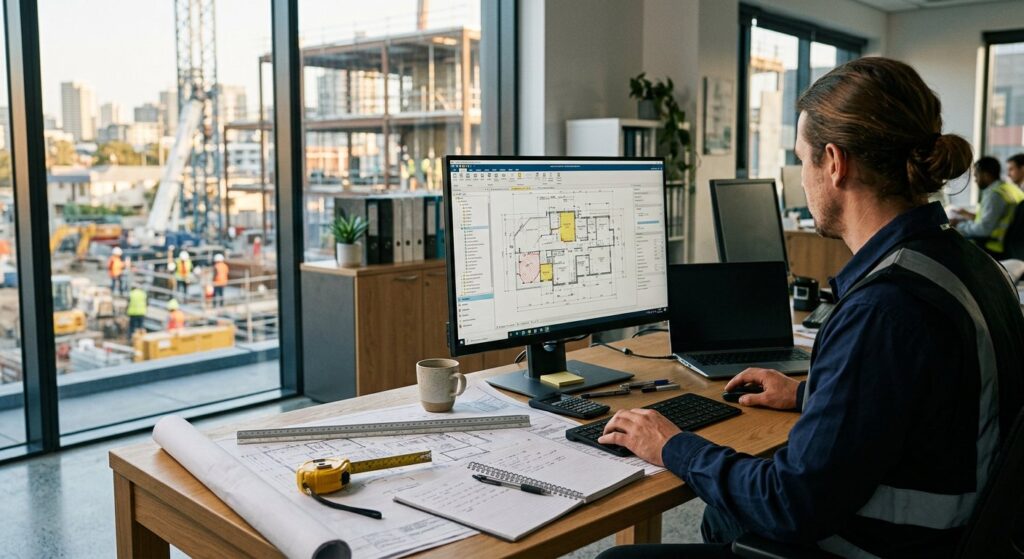
Construction estimating is the invisible discipline that decides which contractors thrive and which quietly bleed out, one badly priced bid at a time. Every winning project starts as a stack of drawings that has to be converted into quantities, labor hours, material costs, overhead, and a number you can defend at the table, and the contractors who do that conversion better than their competitors win more work at better margins without bidding more often. In Texas, where construction employment is growing at one of the fastest rates in the country and material costs are swinging with tariff announcements, the estimating function has never mattered more. This guide walks through nine practical ways to sharpen construction estimating for your business, whether you build in-house, freelance, or outsource, covering the software and cost data professionals use, what estimating services actually cost in 2026, how to read your own bid history like an analyst, and the presentation details that win the jobs your numbers deserve. Every benchmark cited comes from current published industry data, so you can build your estimating strategy on facts rather than shop-floor folklore.
Key Takeaways
- Industry win-rate benchmarks put general contractors at roughly 18 to 22 percent of bids won, with top performers above 30 percent, which means bid selection and estimating quality matter more than bid volume.
- In-house estimators cost $65,000 to $120,000 per year fully loaded, freelance estimators run $50 to $150 per hour, and outsourced estimating services charge roughly $15 to $45 per hour.
- A residential material takeoff typically costs $200 to $800 flat per plan set, while a complete commercial bid package runs $1,500 to $5,000 or more.
- Most contractors spend 1 to 2 percent of annual bid volume on estimating staff and tools combined, which is the benchmark to beat when comparing in-house versus outsourced.
- Digital takeoffs built in Bluebeam or PlanSwift and priced against RSMeans or local cost data consistently outperform square-foot guesswork, especially in a volatile Texas market.
Why Construction Estimating Decides Who Wins in Texas
Texas is simultaneously one of the best and one of the most dangerous markets in America for contractors. Demand is enormous: per the Associated General Contractors of Texas, TxDOT’s 2026 Unified Transportation Program added roughly $2 billion to congestion-relief funding, and statewide construction employment grew 2.3 percent in 2025, among the strongest rates in the country. At the same time, input costs are moving in ways that punish stale pricing, with federal tariff actions pushing steel and aluminum duties to 50 percent and softwood lumber and imported cabinetry duties to the 45 to 50 percent range. Contractors bidding into that volume with last quarter’s prices are not estimating, they are gambling, and the volatility is precisely why disciplined construction estimating has become a competitive weapon rather than back-office paperwork. The growth is not evenly spread, either: the Austin, Dallas-Fort Worth, and Houston metros absorb a huge share of the state’s commercial and residential activity, which means subcontractor pricing in those markets moves with workloads in ways a state-level average never captures. A concrete sub booked solid through the third quarter prices differently than one chasing work in a slower county, and your estimate should reflect which one you are actually buying.
The Cost of a Bad Estimate
A bad estimate loses money in one of two directions, and both hurt. Price too high because costs were padded with fear margins, and you lose winnable jobs without ever learning why. Price too low because quantities were guessed or labor was underbuilt, and you win the privilege of losing money for six months on a job you cannot escape. Industry benchmarks put average general contractor win rates at 18 to 22 percent, with top performers above 30 percent, and the winners are disproportionately the ones whose numbers reflect true project costs: real material pricing, fully burdened labor, allocated overhead, and documented scope.
Bid Math: Why Accuracy Beats Volume
Consider what estimating actually costs relative to what it protects. Most contractors spend 1 to 2 percent of annual bid volume on estimating staff and tools combined. A single mispriced $2 million job that runs 10 percent underbid erases the margin on many winning projects combined, so the return on estimation discipline is measured in survival, not cents. Bid smarter, not merely more often, is the operating principle behind everything below.
9 Powerful Ways to Estimate Better and Win More Work
1. Build Takeoffs From the Actual Drawings
The foundation of every reliable estimate is a quantity takeoff counted from the real plans, not estimated by area or rule of thumb. Every conduit run, framing member, square of roofing, and cubic yard of concrete should be measured on screen with digital takeoff software such as Bluebeam or PlanSwift, which has largely replaced paper plans and highlighters for good reason. Square-foot-based guessing fails exactly when projects diverge from the average, and Texas projects diverge constantly, from floodplain-driven sitework in Houston to tilt-wall warehouses in the Dallas metro. If your current process prices framing without counting studs, start there. The payoff is concrete: a line-item takeoff catches the forty extra sheets of drywall, the odd count of HVAC diffusers, and the slope-dependent roofing waste that area-based guesses miss, and those individual line items are exactly where thin margins disappear.
2. Price Against Current, Local Cost Data
Quantities are only half the estimate; the other half is what those quantities cost this month, in this county. Professional estimators anchor pricing to structured cost databases such as RSMeans, adjusted to local labor rates and current supplier quotes, because a national cost-per-square-foot table cannot tell you what skilled electrical labor costs in Austin this week. Material volatility makes the refresh cycle matter: with tariff-driven swings hitting steel, aluminum, and lumber, an estimate built on three-month-old pricing can be materially wrong before the bid even opens. Cultivate the supplier side of this discipline too, because trusted vendor quotes on long-lead items, locked pricing windows, and early input on substitutions are all estimating data that no national database carries. Date your cost data the way you would date perishable inventory.
3. Organize Every Estimate by CSI MasterFormat
How an estimate is structured determines how usable it is. Organizing line items by CSI MasterFormat divisions, the construction industry’s standard numbering system, means your electrical scope sits with electrical, sitework with sitework, and every subcontractor quote can be compared line against line without archaeology. This structure also exposes gaps: an estimate organized by division makes it obvious when Division 21 through 28 mechanical and electrical systems are missing real pricing, while a disorganized spreadsheet hides omissions until they surface as change orders you absorb.
4. Include the Invisible Costs, Not Just Materials
Novice estimates count materials and labor, then wonder where the money went. A complete construction estimate layers direct costs, materials, labor, equipment, and subcontractors, with indirect costs: general conditions, supervision, permits, insurance, bonding, temporary utilities, and waste disposal, followed by overhead and profit, which for general contractors typically runs in the 20 to 30 percent range on markup calculations. Contingency belongs in the open as well, sized to project type and drawing completeness. A bid that omits indirect costs is not cheaper than a competitor’s; it is simply a promise to work for free.
5. Know When to Outsource Versus Hire In-House
Every contractor eventually faces the estimating capacity question, and the 2026 market offers three distinct models with honest math behind each. An in-house estimator costs $65,000 to $120,000 per year fully loaded, which pencils out for contractors with steady bid volume and pays for consistency and institutional knowledge. Freelance estimators charge $50 to $150 per hour, with MEP specialists at the higher end. Outsourced estimating services run roughly $15 to $45 per hour, deliver residential takeoffs for $200 to $800 flat per plan set, and assemble complete commercial bid packages for $1,500 to $5,000 or more, with many firms turning around bid-ready estimates in 12 to 24 hours. For a mid-size commercial project between $2 million and $10 million, budgeting $800 to $2,500 for a full estimate from a service is typical, and for a typical mid-size contractor, outsourcing saves an estimated 40 to 60 percent annually against the in-house model. Overflow support during peak bid season is the middle path many growing firms choose. When evaluating an estimating service, ask five questions: who performs the takeoff and what are their credentials, which software and cost database will be used, can I see a redlined sample from a similar project, is there a second-review step before delivery, and how is my drawing confidentiality protected? A firm worth your plans answers every one without hesitation.
6. Match the Estimate Type to the Decision Being Made
Not every decision deserves the same estimating effort. Early feasibility and budgeting call for square-foot-based conceptual estimates, which are fast and appropriately rough. Subcontractor bidding and contract negotiation demand line-item unit estimates built from detailed takeoffs. Insurance restoration work is its own discipline entirely, with carrier-ready Xactimate estimates priced to local ZIP codes, and public infrastructure work, such as TxDOT projects, requires estimates formatted to public-bid standards with the schedule logic to match, typically built in Primavera P6. Matching the method to the moment keeps you from overpaying for precision you do not need, or underbuying it when the stakes are high.
7. Track Your Bid-to-Win Ratio Like an Analyst
Your bid history is data, and most contractors leave it unanalyzed. Track every bid: project type, bid amount, estimated margin, outcome, and reasons for the loss. Benchmarks give the numbers meaning: a win rate below roughly 15 percent usually signals bidding too selectively or pricing too high, while a rate above 40 percent often means you are winning so much that you are likely leaving money on the table. Run a post-mortem on completed projects comparing estimated margin to actual margin, and let the variances tell you which cost categories your estimates consistently miss: labor on demolition, concrete finishing, drywall hanging, whatever your pattern turns out to be. Six months of that discipline improves estimating accuracy more than any software purchase.
8. Present the Bid Like a Professional, Not a Spreadsheet
Numbers win or lose bids, but proposals win or lose trust. Industry research suggests that a well-organized proposal, with a clear scope narrative, explicit exclusions, stated assumptions, and clean payment terms, can improve win rates by 20 to 30 percent, sometimes against competitors whose numbers were technically comparable. General contractors reading three sub-bids will choose the one that makes their job easier: inclusions and exclusions listed, qualifications stated, and a scope letter that survives contact with the field. Write exclusions specifically rather than defensively, since a line reading “excludes rock excavation, permits, and design fees” prevents disputes far better than silence ever will. The estimate is the engine; the proposal is what the client actually sees.
9. Work With Professional Estimators and Texas Specialists
Estimating is a trained craft, and there are moments when bringing in specialists is simply the right call: peak-season overflow, a first bid into a new trade, a TxDOT-format submission, or an Xactimate claim your team has never priced. Firms offering professional construction estimating services bring credentialed estimators, recognized software, structured review processes, and current cost data to the table. For contractors who want estimating built on Texas pricing rather than national averages, Texas Construction Estimating delivers bid-ready estimates organized by CSI MasterFormat, built in Bluebeam and PlanSwift against RSMeans cost data, with ASPE and AACE credentialed estimators, a two-step takeoff review process, and turnaround in 12 to 24 hours across commercial, residential, industrial, MEP, civil, and Xactimate work. However you staff it, the test is the same: does the estimate you submit reflect this week’s pricing, this county’s labor rates, and this project’s actual drawings? If not, that is the gap to close.
How a Professional Estimate Is Built
Whether in-house or outsourced, a quality estimate follows the same sequence, and knowing it helps you evaluate any estimator:
- Plans received and reviewed for completeness, scale, and revisions
- Digital takeoff performed on screen, organized by CSI division
- Quantities priced against current local cost data and supplier quotes
- Labor built from production rates, fully burdened with payroll costs
- Indirect costs, contingency, and markup layered and checked
- Second review against the drawings, then delivery of an organized, bid-ready package
If the estimate you receive skips steps in this sequence, you have found the source of your margin leaks.
What Construction Estimating Services Cost in 2026
Fee structures vary by model, and knowing the ranges keeps you from overpaying or underbuying. Current 2026 industry figures:
| Service Model | Typical 2026 Range | Best For |
|---|---|---|
| In-house estimator | $65,000 to $120,000 per year | Steady bid volume, repeat project types |
| Freelance estimator | $50 to $150 per hour | Occasional complex estimates, MEP work at the top end |
| Outsourced estimating service | $15 to $45 per hour | Regular overflow, fast turnaround |
| Residential takeoff | $200 to $800 flat per plan set | Builders and remodelers, single trades |
| Commercial bid package | $1,500 to $5,000 or more | Full GC bids on commercial projects |
| Monthly retainer | $3,000 to $8,000 per month | Consistent outsourcing relationships |
What Drives the Price
Estimating quotes vary for understandable reasons:
- Project complexity and number of trades involved
- MEP scope, which commands premium rates for specialist knowledge
- Drawing quality and completeness, since legible plans take less time
- Turnaround speed, with rush work priced accordingly
- Location and local wage data requirements
- Whether quantities alone or a full priced estimate is needed
A mid-size commercial contractor budgeting $800 to $2,500 per full estimate from a service, against a $2 million to $10 million project value, is firmly within normal market range.
Frequently Asked Questions
What does a construction estimator actually do?
A construction estimator converts drawings into quantities through takeoffs, prices those quantities using current cost and labor data, adds indirect costs, overhead, and profit, and produces a defensible bid or budget, typically organized by trade or CSI division.
How much does a construction estimate cost in 2026?
Residential takeoffs commonly run $200 to $800 flat per plan set, complete commercial bid packages $1,500 to $5,000 or more, and hourly service rates range from $15 to $45 at firms to $50 to $150 for freelancers, with MEP estimates at the premium end.
How accurate can a professional estimate be?
Accuracy depends on drawing completeness and proximity to bid day. Detailed line-item estimates built from current takeoffs and dated cost data track final costs far more closely than square-foot conceptual numbers, which is why estimate type should match the decision at hand.
Is outsourcing estimating cheaper than hiring in-house?
For most mid-size contractors, yes. An in-house estimator runs $65,000 to $120,000 annually fully loaded, while outsourced services average $15 to $45 per hour, and industry estimates put the savings for a typical mid-size commercial contractor at 40 to 60 percent per year.
What software do professional estimators use?
The core stack is digital takeoff software such as Bluebeam or PlanSwift, structured cost databases such as RSMeans, Excel or estimating platforms for assembly, Primavera P6 for CPM scheduling, and Xactimate for insurance restoration estimates.
What is a good bid-to-win ratio in construction?
Industry averages run 18 to 22 percent for general contractors, with top performers above 30 percent, and by trade, plumbing and mechanical contractors often sit higher. Below about 15 percent, examine pricing or bid selection; above 40 percent, you may be underpricing.
Conclusion
Construction estimating is where profitable contracting is won or lost, long before a crew ever mobilizes. The nine habits above compound: takeoffs measured from real drawings, priced against current and local data, organized to industry standards, layered with every indirect cost, matched to the decision at hand, tracked and analyzed after every submission, and presented with the professionalism your numbers deserve. Know the honest cost of estimating capacity in 2026, in-house, freelance, or outsourced, and choose the model that fits your bid volume rather than the one that fits your habits. In a Texas market growing fast enough to reward precision and volatile enough to punish stale pricing, the contractors who treat estimating as a core competency rather than a chore will be the ones still winning, and still profiting, when this cycle of tariffs and growth shakes out. The plans are already on your desk; the only question is whether the number you attach to them will be built to win.