
Most growing e-commerce brands and SaaS companies pour aggressive budgets into Google Ads, Meta campaigns, and SEO hoping more clicks will fix flat revenue. Yet...
Most growing e-commerce brands and SaaS companies pour aggressive budgets into Google Ads, Meta campaigns, and SEO hoping more clicks will fix flat revenue. Yet driving expensive traffic onto a confusing product page, sluggish mobile checkout, or vague value proposition simply accelerates ad waste. Conducting structured CRO audits uncovers the exact hidden friction points causing motivated visitors to abandon right before buying or booking a demo.
Specialized data-driven optimization agencies such as Conversionry (founded in Australia across Melbourne and Sydney and reporting client conversion lifts ranging from 10 to 173 percent) combine quantitative analytics, heatmaps, session recordings, on-site polls, and real user testing inside repeatable CRO audits. Knowing how rigorous CRO audits diagnose leaks, prioritize experiments, and compound profit across every traffic source ensures you fix revenue bottlenecks with evidence rather than design opinions.
What Comprehensive CRO Audits Actually Investigate
A real conversion rate optimization audit is never a designer glancing at your homepage for twenty minutes and offering subjective color opinions. Professional CRO audits are forensic, evidence-backed diagnostic investigations blending quantitative telemetry (what is breaking and where) with qualitative human insight (why real buyers hesitate).
Experienced practitioners follow a five-layer diagnostic stack inside thorough CRO audits:
- Analytics and Measurement Health Audit: Verifying clean GA4, Adobe Analytics, or Shopify funnel tracking so bounce rates, add-to-cart drop-offs, checkout steps, and cross-device attribution reflect reality accurately.
- Technical Speed and Cross-Device Friction Audit: Testing real mobile iOS/Android checkout paths, broken form validation errors, slow Core Web Vitals, and clunky third-party script conflicts across exact browser segments.
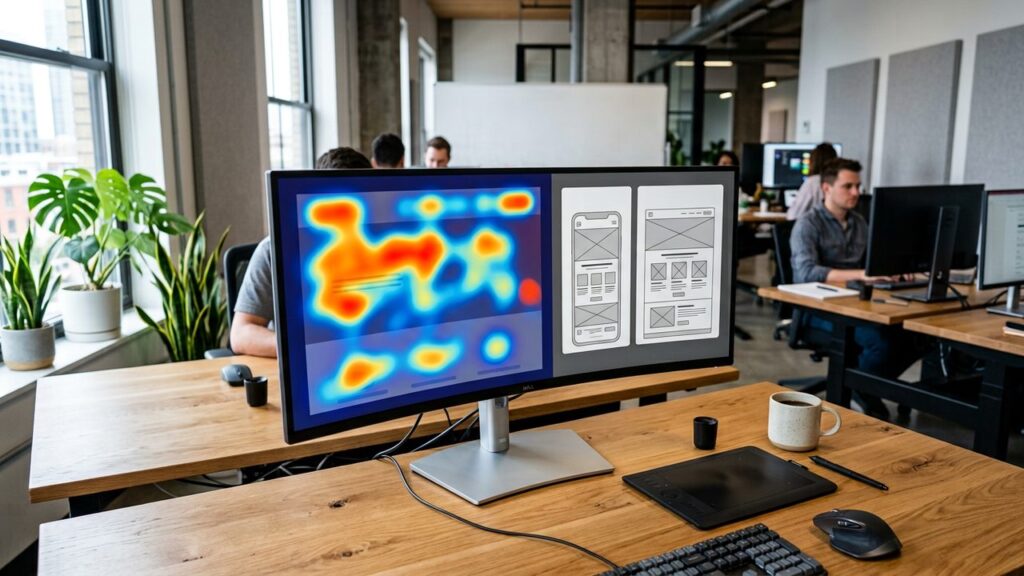
- Behavioral Heatmap and Session Replay Analysis: Reviewing scroll depth, rage clicks, dead clicks, and real anonymized checkout sessions via tools like Hotjar, FullStory, or Microsoft Clarity.
- Voice-of-Customer (VoC) Qualitative Research: Mining on-site exit polls, post-purchase surveys, live chat logs, support tickets, and sales call objections to capture exact buyer doubts in their own words.
- Moderated and Unmoderated Usability Testing: Watching real target buyers attempt core shopping or signup tasks through platforms like UserTesting to expose confusing copy, hidden fees, and trust gaps instantly.
Why Guessing Design Tweaks Without CRO Audits Wastes Months
Copying a competitor’s green checkout button or launching a sweeping visual website redesign without running CRO audits first is pure gambling. Competitors often copy each other’s flawed layouts blindly, and total redesigns frequently break working elements while leaving root conversion blockers untouched.
Rigorous CRO audits isolate exact high-leverage leaks by page type and device category. Fixing a single broken mobile shipping-calculator error or clarifying a confusing SaaS pricing table discovered during CRO audits routinely outperforms months of random aesthetic tweaks.
Building a Prioritized Problem Hierarchy by Page and Device
One hallmark deliverable of agency-grade CRO audits (highlighted in methodologies from firms like Conversionry) is a clean Problem Hierarchy segmented by template (Homepage, Collection, Product Page, Cart, Checkout, Pricing) and device (Mobile vs. Desktop). Separating mobile conversion rate from desktop conversion rate immediately exposes massive revenue gaps hidden inside blended site-wide averages.
Six High-Impact Conversion Leaks CRO Audits Uncover Repeatedly
Across hundreds of e-commerce stores and B2B SaaS funnels, disciplined CRO audits uncover the exact same six profit-draining bottlenecks again and again:
- Weak Above-the-Fold Value Clarity: Visitors land from paid ads and still cannot tell within five seconds what you sell, who it serves, or why it beats cheaper alternatives.
- Surprise Checkout Costs and Forced Account Creation: Hidden shipping charges, unexpected duties, or mandatory pre-checkout registration force high-intent shoppers to flee at the finish line.
- Mobile Ergonomic Friction: Tiny tap targets, slow image sliders, non-numeric keyboards on phone/credit-card fields, and sticky chat widgets covering the “Add to Cart” button on iPhones.
- Unanswered Pre-Purchase Anxiety: Missing sizing guides, vague return warranties, buried security/compliance proof, or absent real customer reviews right beside primary CTAs.
- Message Mismatch Between Ads and Landing Pages: Paid search or social ads promise one specific benefit or offer while the landing page opens with a generic corporate slogan.
- Bloated B2B Lead Forms: Asking cold top-of-funnel prospects for 11 invasive form fields before letting them preview pricing, see a quick interactive walkthrough, or book a discovery slot.
| Diagnostic Research Layer | Primary Tools Used | Core Question Answered | Typical High-Value Discovery |
|---|---|---|---|
| Quantitative Funnel Analytics | GA4, Adobe Analytics, BigQuery | Where and on which device do users drop? | iOS Safari checkout step 2 drops 38% worse than desktop Chrome |
| Click & Scroll Behavior | Hotjar, FullStory, Microsoft Clarity | What distracts or frustrates users on page? | 62% rage-click non-interactive product gallery zoom icons |
| Voice-of-Customer Surveys | On-site polls, post-order surveys, chat | What exact doubts almost stopped purchase? | Buyers unsure about return shipping fees & compatibility specs |
| Live Usability Testing | UserTesting, moderated Zoom sessions | Can real buyers complete core tasks easily? | Navigation labels confuse new shoppers searching flagship SKU |
| Technical QA & Heuristic Review | PageSpeed, BrowserStack, UX rubrics | What bugs or speed delays break trust? | Promo code field throws silent error on mobile autofill |
Turning CRO Audits Into Structured A/B Testing Hypotheses
An audit PDF gathering dust in Google Drive generates zero incremental revenue. The true commercial power of CRO audits lies in converting every verified diagnostic finding into a sharp, ranked Experimentation Roadmap separated cleanly into two lanes:
- Immediate “Just-Do-It” Bug Fixes: Broken links, faulty mobile keyboards, slow uncompressed hero images, tracking errors, and clear typos require zero A/B testing; ship those fixes immediately inside week one for instant conversion lift.
- Ranked A/B Test Hypotheses: Strategic layout, messaging, pricing-display, and social-proof changes get formatted cleanly using structured hypothesis statements (“Because analytics and polls show X friction on mobile product pages, changing Y should increase add-to-cart rate by Z percent”).
Scoring Experiments Objectively With PXL or PIE Frameworks
To keep opinionated executives from hijacking your test queue, mature CRO audits rank every hypothesis objectively across three dimensions: Potential Revenue Impact (traffic volume multiplied by proximity to checkout), Evidence Confidence (backed by analytics + user testing rather than hunches), and Engineering Ease (dev hours required to build cleanly).
Launching high-impact, high-evidence tests on bottom-of-funnel pages (Checkout, Cart, Pricing, Flagship Product Pages) first generates early revenue proof that funds broader top-of-funnel optimization sprints cleanly.
Understanding Statistical Significance and Avoiding Premature Test Calls
One of the fastest ways internal teams sabotage post-audit testing is peeking at an A/B test after 48 hours, seeing Variant B ahead by 18 percent across 22 conversions, and declaring early victory. Disciplined experimentation teams calculate required minimum sample sizes upfront, run every test across at least two full weekly business cycles (14 days minimum) to smooth weekday-vs.-weekend behavior, and validate at least 95 percent statistical confidence before rolling winners live.
Quantifying the Compounding Financial ROI of CRO Audits
Unlike paid advertising where every incremental sale forces higher ongoing media spend, conversion gains unlocked through CRO audits permanently multiply the value of every visitor arriving from SEO, email, social, referral, and PPC simultaneously.
Consider a simple illustration: an e-commerce store generating 50,000 monthly sessions at a 2.0 percent conversion rate and $120 average order value produces $120,000 per month. Lifting conversion rate cleanly from 2.0 percent to just 2.5 percent via disciplined CRO audits adds $30,000 every single month ($360,000 annualized) without spending one additional dollar on Google or Meta ads. Modeling projected conversion lifts and audit fees through an ROI calculator makes the business case unmistakable for finance teams.
| CRO Audit Engagement Tier | Typical Timeline | Core Deliverables Included | Best-Fit Business Stage |
|---|---|---|---|
| Complimentary / Rapid CRO Health Check | 3 to 7 days | High-level heuristic scan + top 5 glaring friction alerts | Early validation before committing full optimization scope |
| Full Standalone Deep-Dive CRO Audit | 2 to 4 weeks | GA4 audit, heatmaps, VoC polls, UserTesting, ranked 90-day roadmap | E-commerce & SaaS sites with 25k+ monthly visits / $1M+ revenue |
| Ongoing Audit + Full-Service A/B Testing Program | Quarterly / 6 to 12 months | Continuous CRO audits, UX design, test dev, QA & statistical reporting | High-traffic DTC, B2B SaaS & enterprise brands scaling ad spend |
When Should a Site Run Qualitative CRO Audits vs. Full A/B Testing?
Smaller websites earning under 10,000 monthly visits or fewer than 300 monthly conversions lack the statistical traffic volume required to reach clean A/B test significance quickly. That does not mean smaller businesses should skip CRO audits!
Low-traffic websites achieve enormous conversion jumps from research-driven CRO audits centered on usability testing, post-purchase customer interviews, session replay reviews, and rapid implementation of unmistakable UX and clarity fixes, saving formal split testing for flagship high-traffic pages once traffic scales.
Aligning CRO Audits Directly With Paid Media and SEO Teams
Never run CRO audits in an isolated UX silo disconnected from acquisition teams. Sharing VoC buyer objections discovered during CRO audits directly with PPC copywriters sharpens ad hooks immediately, while coordinating technical speed and structured content improvements with SEO specialists boosts organic rankings and landing conversion rates together.
Eight Signs Your Website Needs Professional CRO Audits Right Now
Review these eight practical diagnostic triggers to gauge whether investing in CRO audits should jump to the top of your quarterly roadmap:
- Rising Paid Ad CAC: Google and Meta cost per click keep climbing while your site conversion rate stays stubbornly flat.
- Sharp Mobile vs. Desktop Gap: Mobile accounts for 65+ percent of traffic yet converts at less than half your desktop rate.
- High Add-to-Cart With Painful Checkout Drop-Off: Shoppers show clear product interest yet abandon heavily inside cart or shipping steps.
- Recent Redesign Slump: Revenue or lead volume dipped unexpectedly after launching a new theme or platform migration.
- Unclear Funnel Telemetry: Leadership cannot confidently state step-by-step conversion rates by traffic channel or device inside GA4.
- High Sales Call / Support Repetitiveness: Prospects keep asking basic pricing, compatibility, or shipping questions already buried somewhere on your site.
- Internal Design Deadlocks: Stakeholders debate homepage headlines and layouts based on personal taste rather than verified user evidence.
- Preparing for Peak Season Scaling: Launching CRO audits 60 to 90 days before Black Friday, Q4 pushes, or major product launches ensures peak ad spend converts at maximum efficiency.
B2B SaaS vs. E-Commerce Playbooks Inside Modern CRO Audits
Although forensic research principles apply universally, high-converting CRO audits tailor diagnostic focus closely to your exact revenue model. Treating a $40,000 enterprise B2B software funnel identically to a $75 direct-to-consumer skincare store misses the biggest revenue levers in both verticals.
What E-Commerce CRO Audits Prioritize First
For Shopify, WooCommerce, Magento, and custom retail stores, comprehensive CRO audits drill directly into high-velocity shopping friction:
- Collection Filtering and Site Search Accuracy: Measuring conversion differences between shoppers who use search/filters vs. browsers, fixing zero-result search queries exposed during CRO audits.
- Product Detail Page (PDP) Persuasion Architecture: Auditing gallery image clarity, sticky mobile Add-to-Cart visibility, delivery-date transparency, size/fit confidence tools, and verified customer review placement.
- Slide-Out Cart and Cross-Sell Friction: Testing free-shipping progress bars, clean discount-code visibility (so shoppers do not leave your checkout hunting coupon sites), and relevant low-friction add-ons identified via CRO audits.
- Express Checkout and Payment Localization: Ensuring Apple Pay, Shop Pay, Google Pay, PayPal, and regional Buy Now Pay Later options render cleanly without throwing mobile validation bugs.
What B2B SaaS and Lead-Generation CRO Audits Prioritize First
For software trials, consulting agencies, and high-ticket service firms, specialized CRO audits examine trust, clarity, and lead-qualification quality rather than impulse checkouts:
- Above-the-Fold Category Positioning: Testing whether busy enterprise buyers immediately grasp what your software replaces, which vertical it serves, and what measurable business outcome it delivers.
- Pricing Page Psychology and Tier Anchoring: Analyzing hesitation points uncovered by CRO audits on pricing toggles (annual vs. monthly), feature comparison clarity, enterprise “Talk to Sales” friction, and transparent ROI framing.
- Demo Request and Self-Serve Onboarding Funnels: Measuring exact field-by-field drop-off inside lead forms, comparing multi-step interactive forms against single long forms, and accelerating instant calendar scheduling (Chili Piper / Calendly) post-submission.
- Buyer-Committee Social Proof: Verifying whether recognizable client logos, verified G2/Capterra badges, SOC 2 security proof, and vertical case studies appear right beside conversion forms during CRO audits.
How to Vet an Agency Before Commissioning CRO Audits
Not every agency advertising CRO audits delivers genuine behavioral research. Screen candidate partners cleanly with five direct vetting questions before signing off:
- Which exact qualitative and quantitative inputs (GA4/Adobe, heatmaps, session replays, VoC polls, moderated UserTesting) are included inside your CRO audits rather than purely heuristic checklists?
- Will our team receive a raw, actionable Problem Hierarchy segmented by page template and mobile/desktop device alongside ready-to-build A/B test hypotheses?
- Can you share anonymized case studies showing how findings from past CRO audits translated into statistically significant wins and real revenue lifts (not just micro-click increases)?
- Do your CRO audits inspect live GA4 tracking accuracy and site-speed engineering bottlenecks before designing visual mockups?
- Who owns all collected survey transcripts, usability videos, heatmap logs, and experimentation roadmaps once the CRO audits engagement wraps?
Demanding forensic evidence, transparent statistical rigor, and full IP ownership ensures your CRO audits unlock immediate bug-fix revenue gains and fuel months of disciplined, profitable experimentation.
Building a Sustainable Post-Audit Experimentation Culture
One of the biggest secrets separating elite growth teams from frustrated marketers is treating diagnostic conversion research as the opening chapter of a continuous learning loop rather than a one-time checkbox exercise.
Once your initial 90-day test roadmap wraps, archive every winning, neutral, and losing split-test result inside a searchable shared repository alongside screenshots, audience segment breakdowns, and key buyer takeaways. Remarkably, a well-designed experiment that loses cleanly still teaches your product, ad-creative, and merchandising teams priceless truths about what motivates real shoppers.
Quarterly Optimization Rhythm for Growing Teams
Maintain high experimentation momentum across busy seasons using four lightweight recurring rituals:
- Weekly 20-Minute Experiment Standups: Review live test health, QA upcoming variant builds across iOS Safari and Android Chrome, and clear engineering blockers fast.
- Monthly Funnel Telemetry Reviews: Inspect mobile-vs.-desktop conversion trends, checkout step completion, and average order value (AOV) or lead-qualification rate shifts inside GA4.
- Bi-Monthly Fresh Customer Feedback Polls: Rotate one crisp exit-intent or post-purchase micro-question every 60 days so evolving buyer objections never go stale.
- Quarterly Roadmap Refresh Sprints: Re-score your experimentation backlog cleanly as product lines, seasonal promotions, and traffic sources shift throughout the year.
Sustaining this disciplined quarterly operating rhythm keeps revenue efficiency climbing steadily across every marketing channel you invest in.
FAQ’s
What is included in professional CRO audits?
Professional CRO audits combine analytics tracking verification, technical speed and cross-device QA, click/scroll heatmaps, session replay analysis, Voice-of-Customer surveys, moderated user testing, a device-segmented Problem Hierarchy, immediate bug fixes, and a ranked A/B test hypothesis roadmap.
How long do comprehensive CRO audits take to complete?
Lightweight CRO Health Checks typically wrap in 3 to 7 business days, whereas deep multi-method CRO audits involving live user testing, customer polling, analytics deep dives, and prioritized experimentation roadmaps generally take 2 to 4 weeks.
What kind of conversion lift can realistic CRO audits deliver?
Results vary by baseline friction and implementation discipline, yet experienced agencies such as Conversionry document verified lifts ranging from 10 percent on mature sites up to 173 percent on sites with major unaddressed checkout, clarity, or mobile UX bottlenecks.
Do I need massive traffic before investing in CRO audits?
No. While high traffic is necessary for rapid statistical A/B testing, sites at any revenue stage benefit immediately from qualitative CRO audits using session replays, customer surveys, and usability tests to eliminate obvious trust and usability leaks.
Will CRO audits hurt my website’s Google SEO rankings?
Done properly, CRO audits improve SEO metrics. Faster Core Web Vitals, clearer heading hierarchies, better mobile usability, and higher visitor engagement reduce pogo-sticking back to Google search results while keeping canonical URLs and indexable text intact during split tests.
How often should growing brands conduct fresh CRO audits?
Run a comprehensive foundational CRO audit every 12 months (or immediately following major theme redesigns, platform migrations, or new product-line launches), supplemented by quarterly mini-audits reviewing fresh funnel telemetry and seasonal campaign landing pages.
Conclusion
Pouring extra ad budget into a leaky website funnel is the slowest, most expensive way to grow revenue. Structured CRO audits replace internal design guesswork with hard quantitative analytics and authentic human buyer feedback, surfacing exact mobile, messaging, checkout, and trust bottlenecks costing you sales every single day.
Start by auditing measurement hygiene, pairing session replays with Voice-of-Customer surveys, shipping verified bug fixes immediately, and testing high-impact hypotheses cleanly across full weekly cycles. Committed CRO audits turn existing traffic into higher margins, stronger paid-media efficiency, and compounding commercial growth.