
A manual action can wipe out years of organic traffic overnight. Most advice tells you to clean up and file a reconsideration request. Sometimes that...
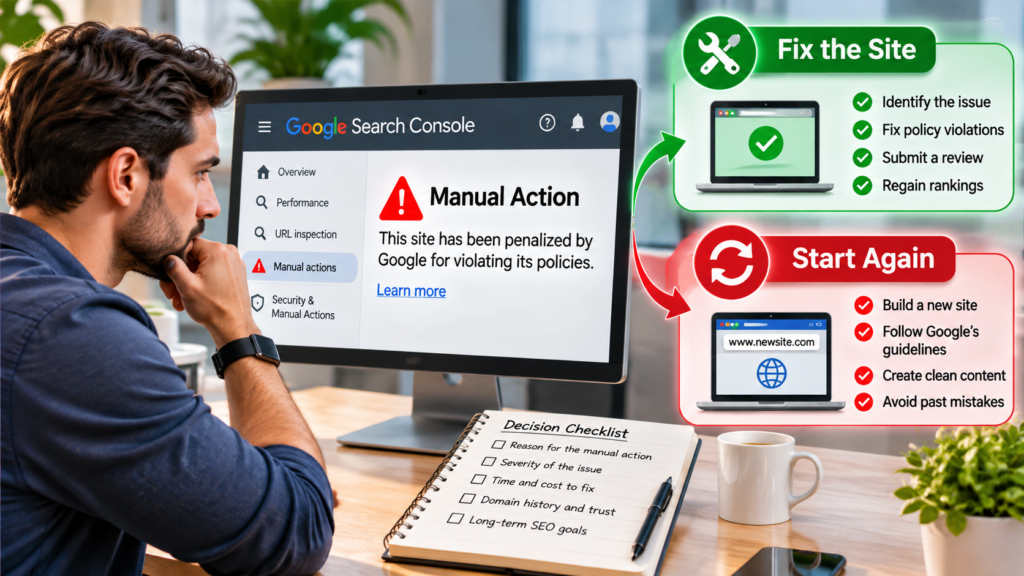
A manual action can wipe out years of organic traffic overnight. Most advice tells you to clean up and file a reconsideration request. Sometimes that is right. Sometimes the faster, safer route to revenue is a clean rebuild. Here is how to tell which one you are dealing with. Few things in SEO feel as brutal as opening Google Search Console and finding a notice in the Manual Actions report. Unlike an algorithm update, where rankings slide and you are left guessing, a manual action means a human reviewer at Google has looked at your site and decided it breaks the spam policies. Rankings for affected pages, or the whole domain, can disappear within days.
The standard playbook is well known: find the problem, fix it, submit a reconsideration request, wait. What nobody talks about enough is the decision that comes before any of that. Is this site worth saving, or will you get back to revenue faster by starting again on a clean foundation?
Step one: confirm it really is a manual action
A surprising number of business owners call a traffic drop a “penalty” when it is nothing of the sort. Before you do anything drastic, open Search Console and go to Security & Manual Actions, then Manual Actions.
If the report says no issues detected, you are dealing with an algorithmic drop, most likely a core update or one of Google’s spam systems. A reconsideration request will do nothing for you, because there is nothing for a reviewer to reconsider. That needs a completely different recovery plan built around content quality and site trust.
If there is a notice, read it carefully. It will tell you two things that shape everything that follows:
- The violation type. Common ones include unnatural links to your site, thin content with little or no added value, pure spam, user generated spam, cloaking or sneaky redirects, and site reputation abuse.
- The scope. A partial match affects specific pages or sections. A site wide match affects the whole domain. Partial matches are almost always worth fixing. Site wide matches are where the real decision lives.
When fixing the existing site is the right call
Repairing the site you already have makes sense when most of these are true:
- The problem is contained. One section of thin pages, a spammy forum, a batch of bad links from one campaign. You can point to it, remove it and prove it is gone.
- The domain has real brand value. People search for your name, other businesses link to you because they want to, and you get traffic from places other than Google.
- You control the cause. If the violation came from a past agency or an old tactic you have since dropped, you can document the cleanup and show the reviewer it will not happen again.
- The link profile is mostly healthy. If 90% of your links are genuine and 10% came from a bad batch, a careful cleanup and disavow is very achievable.
In these cases, do the work properly. For link based actions, try to get bad links removed at the source first, disavow what you cannot remove, and keep a spreadsheet of every outreach attempt. For content based actions, consolidate thin pages into fewer, genuinely useful ones, redirect the weak versions to them, and remove anything that exists only to rank. Then write a reconsideration request that states what went wrong, exactly what you changed, with numbers, and what you have put in place so it does not happen again. Keep it factual. Reviewers are not looking for apologies; they are looking for evidence.
Google says most reviews take several days or weeks, and link related requests can take longer. Do not resubmit while one is pending.
When starting again is the smarter move
This is the option most guides skip, and it is often the one that gets a business back to revenue soonest. A rebuild deserves serious thought when:
- The action is site wide and the history is deep. If the domain spent years on aggressive link building, there may be thousands of linking domains to audit, and you may never find them all.
- You have already been rejected. One rejection is normal. Two or three suggest the problem runs deeper than anyone has mapped out.
- The brand value is low. If almost nobody searches for the business by name and nearly all traffic came from rankings that are now gone, the old domain is not carrying much you cannot rebuild.
- Every month offline costs real money. A lead generation business losing hundreds of enquiries a month cannot always afford to sit through a long cleanup with no guaranteed outcome.
One rule matters more than any other here: do not redirect the penalised domain to the new one. Redirects pass signals, and that includes the signals you are trying to escape. The new site has to stand on its own: new content, an honest link profile, and a strategy built for the long term rather than a quick return to old rankings.
What a rebuild looks like in practice
At actualSEO, we worked with a business in a high competition agency niche that had been hit by a site wide manual action. The old domain had a long history of aggressive tactics, and a full cleanup would have meant months of auditing with no certainty at the end of it.
Instead, we rebuilt on a new domain with no redirect from the old one. The work focused on three things:
- Content written for buyers, not bots. Fewer pages, each answering a real commercial question in more depth than competitors.
- Clean technical foundations. Fast pages, clear internal linking, proper structured data, and nothing that could look like a shortcut to a reviewer.
- Earned authority. Links and mentions from relevant, genuine sources, built steadily instead of all at once.
The new site returned to position one for its core commercial term and now generates close to 200 leads a month. The lesson is not that rebuilding always wins. It is that the decision should be made on numbers, not on attachment to an old domain.
A simple way to decide
If you are staring at a manual action right now, answer these four questions honestly:
- Is the action partial or site wide?
- Can you identify and fix every cause, or only the ones you know about?
- How much of your traffic and revenue comes from people who already know your brand?
- How many months can the business afford to wait for a review outcome?
Partial action, contained cause, strong brand: fix it. Site wide action, messy history, weak brand and urgent revenue pressure: seriously consider starting again.
Preventing the next one
Whichever route you take, the same habits keep you out of trouble. Check Search Console every week, not just when traffic dips. Be wary of anyone selling guaranteed rankings or bulk links. Treat content produced at scale with suspicion if it adds nothing a reader could not find elsewhere. And if you host third party content, make sure it fits your site and serves your audience, because site reputation abuse is now firmly on Google’s radar.
A manual action is not the end of a business. Handled with clear thinking, it can be the moment the business finally gets an SEO strategy built to last.
About the author: Eliot Crossley is the founder of actualSEO, an SEO agency working with businesses in competitive markets on technical SEO, content and penalty recovery. Find out more at actual-seo.com.