
Replacing a damaged or missing appliance power cord may appear straightforward, but selecting a cable based only on plug shape, connector compatibility, or physical appearance...
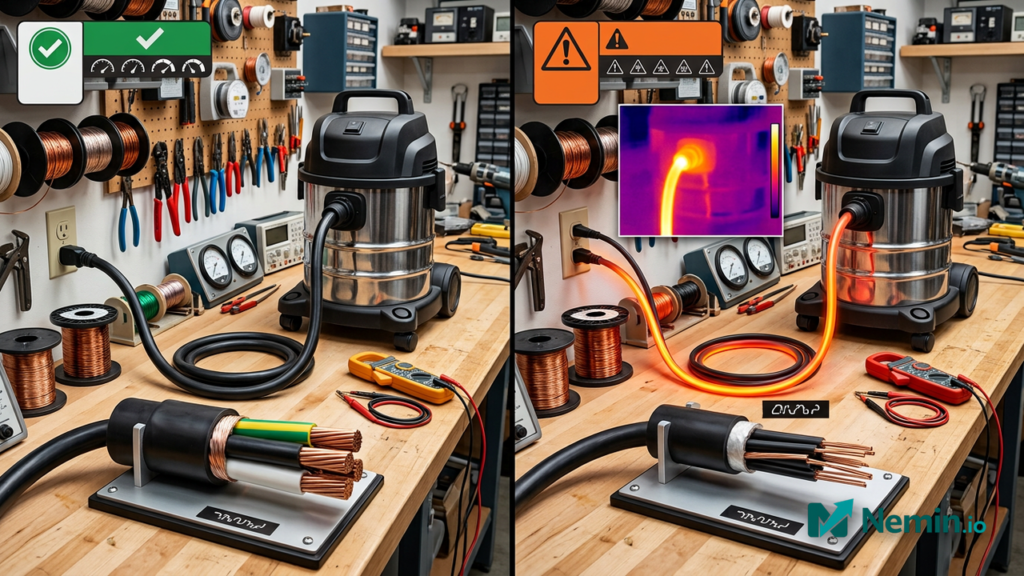
Replacing a damaged or missing appliance power cord may appear straightforward, but selecting a cable based only on plug shape, connector compatibility, or physical appearance can create electrical hazards. Conductor size determines how effectively a cord carries the current required by the connected equipment, making wire thickness directly relevant to the impact on safety of a replacement. A conductor that is too small for the electrical load can experience excessive heating and voltage drop, potentially damaging insulation, plugs, connectors, or the appliance itself.
Correct cord selection also requires consideration of current and voltage ratings, conductor material, cord length, temperature rating, flexibility, insulation type, grounding, environment, and applicable electrical standards. For safety-critical or uncertain replacements, manufacturer specifications and appropriately qualified electrical professionals should take priority over guesswork.
Why Does Wire Thickness Impact on Safety in a Power Cord?
Electrical conductors have resistance. When current passes through that resistance, electrical energy is converted into heat.
Resistance increases when the conductor is longer or has a smaller cross-sectional area, assuming the same conductive material and temperature. This is why conductor size matters when a cable carries substantial electrical current.
The relationship between current and resistive heating is particularly important because power dissipated as heat follows:
P = I²R
Here, P represents power converted to heat, I is current, and R is resistance.
Because current is squared in this relationship, an increase in current can substantially increase heating. A replacement cord therefore needs conductors appropriately rated for the load and application.
Understanding Wire Gauge and Conductor Size
Wire thickness can be expressed using different measurement systems.
In many international applications, conductor area is specified in square millimetres (mm²). In North America, American Wire Gauge (AWG) is common.
AWG can initially be confusing because a smaller gauge number generally represents a larger conductor. For example, 14 AWG is thicker than 18 AWG.
Wire gauge alone should not determine whether a replacement cord is appropriate. Ampacity depends on conductor material, insulation temperature rating, installation conditions, cable construction, ambient temperature, and applicable standards.
Users should therefore rely on the complete cord rating rather than assuming that any cable of a particular gauge is universally suitable.
1. Impact on Safety From Excessive Cord Heating
Impact on Safety When Wire Conductors Are Too Small
An undersized conductor has more resistance than a larger conductor of the same material and length. When an appliance draws substantial current, that resistance can create additional heat.
If operating temperatures exceed what a cable assembly is designed to withstand, insulation can degrade over time.
Heat can also affect plugs, connectors, strain reliefs, and nearby materials. A cord feeling abnormally hot during ordinary operation should not simply be ignored. Disconnect equipment safely where appropriate and investigate the cause according to the manufacturer’s guidance or with qualified assistance.
2. Wire Thickness Influences Voltage Drop
Some voltage is lost along every real conductor because of electrical resistance. For short and correctly sized appliance cords, this drop is normally controlled within appropriate design limits. Longer or undersized conductors can increase it.
An excessive voltage drop means the appliance may receive lower voltage than intended.
Depending on the equipment, this can cause poor performance, unreliable operation, or undesirable stress. Motors and other loads can be particularly sensitive to unsuitable supply conditions.
Using an unnecessarily long replacement or extension cord can therefore create problems even when the conductor would perform adequately over a shorter distance.
3. Current Rating Must Match the Appliance
Impact on Safety From Incorrect Current Ratings
Replacement cords should be rated for the electrical load they are expected to carry.
The equipment nameplate, manual, or manufacturer documentation may specify input voltage, current, power, or replacement-cord requirements.
If equipment specifies power but not current, electrical relationships can help explain the approximate load, but appliance behavior, power factor, startup current, and regulatory requirements can complicate real-world selection.
For that reason, consumers should not improvise safety-critical cord ratings from a simple calculation alone.
A replacement should meet the manufacturer’s specifications and applicable electrical requirements.
4. High-Power Appliances Need Appropriate Cords
Devices such as space heaters, kettles, portable air conditioners, power tools, cooking appliances, and some workshop equipment can draw considerably more current than low-power electronics.
A cord suitable for a small electronic device may therefore be inappropriate for a high-power appliance even if a connector seems mechanically compatible.
Manufacturers choose conductor size and cable construction based on expected operating conditions.
Replacing a heavy-duty cord with a thinner, lighter cable can defeat those design assumptions.
The safest approach is to use an approved replacement with specifications equal to those required by the appliance manufacturer.
5. Conductor Material Also Affects Performance
Thickness is not the only factor that affects electrical resistance.
Copper is widely used in flexible power cords because of its conductivity and mechanical properties. Other conductor constructions can have different electrical and mechanical characteristics.
A consumer should not assume that two cables with similar external dimensions contain equivalent conductors.
The outer diameter includes insulation and jacket material, so a physically thick-looking cable can still contain relatively small conductors.
Electrical markings and certifications are more informative than appearance.
6. Insulation Works Together With Wire Thickness
Impact on Safety From Insulation and Temperature Ratings
A conductor must be surrounded by insulation suitable for its operating voltage, temperature, flexibility requirements, and environment.
Cable jackets can also protect against abrasion, oil, moisture, sunlight, chemicals, or other conditions, depending on the cord type.
This means an adequately sized copper conductor can still be an unsafe replacement when the insulation or jacket is unsuitable for the application.
For example, a cord used in a workshop may face conditions very different from one used with an indoor desktop appliance.
Always consider the complete cable construction.
7. Cord Length Changes Electrical Requirements
Longer conductors have higher resistance than shorter conductors of the same cross-sectional area and material.
As length increases, voltage drop and resistive losses become more important.
This is one reason extension-cord selection requires attention to both current load and length.Daisy-chaining extension cords or using long lightweight cords for high-power appliances can create additional hazards.
Where an extension cord is unavoidable, it should be properly rated for the equipment, environment, and required distance. Manufacturer restrictions on extension-cord use should also be followed.
8. Grounding Must Not Be Compromised
Correct conductor thickness does not make a cord safe if its protective grounding arrangement is wrong.
Equipment designed to use a protective earth or grounding conductor should not have that protection defeated by using an incompatible two-wire cord, unauthorized adapter, or altered plug.
Grounding and Its Impact on Safety
Protective grounding helps provide a controlled path for fault current so appropriate protective devices can operate under certain fault conditions.
Removing or bypassing it can increase electric-shock risk. Conversely, some double-insulated equipment is specifically designed without a protective earth conductor. The replacement cord should match the equipment’s approved electrical design rather than adding or removing grounding arbitrarily.
9. Wire Thickness Is Only One Part of Replacement-Cord Safety
A suitable cord must satisfy multiple requirements simultaneously. These include conductor size, current rating, voltage rating, connector type, polarity where relevant, grounding configuration, insulation, temperature range, environmental suitability, flexibility, strain relief, and regulatory approval.
Evaluating the Impact on Safety Before Replacement
Before Impact on Safety a cord, check:
- Appliance manufacturer instructions
- Equipment nameplate information
- Cord voltage and current ratings
- Conductor size
- Grounding requirements
- Connector configuration
- Cord length
- Temperature rating
- Environmental rating
- Recognized safety markings appropriate to the market
If the original power cord is permanently attached inside the appliance, replacement may require opening equipment and making electrical connections. That work can involve shock, fire, and equipment-damage hazards and may be best performed by an authorized service provider or qualified technician.
Why Plug Compatibility Is Not Enough
Two power cords may fit the same socket while having different electrical ratings.
Mechanical compatibility simply means the components physically connect. It does not verify that the conductor size, current rating, insulation, or environmental characteristics are appropriate.
This issue also applies to adapters.
An adapter can change physical connector compatibility without increasing the electrical capacity of an undersized cord.
Every component in the power path needs to be suitable for the intended load.
Warning Signs of an Unsuitable Power Cord
Potential warning signs include excessive warmth, discoloration, melting, cracking, unusual smells, intermittent power, visible conductor damage, loose connectors, sparking, or damaged strain relief.
If a plug, socket, or cord becomes excessively hot, the problem may not necessarily be conductor thickness. Loose electrical connections can create localized resistance and dangerous heating even when the wire itself is adequately sized.
Damaged electrical equipment should not continue to be used simply because it still powers on.
A qualified technician can identify whether the fault is in the cord, plug, receptacle, appliance, or another part of the electrical system.
Why Fuses and Breakers Do Not Replace Correct Cord Sizing
Some users assume that a circuit breaker or fuse makes any power cord safe.
Protective devices are essential, but they do not remove the need for correctly rated conductors.
A building circuit’s protective device is designed around the electrical installation and may not provide complete protection against every form of localized overheating or poor cord selection.
Certain plugs or appliances may incorporate additional protective devices depending on regional standards.
Correct cable selection and overcurrent protection should work together rather than being treated as substitutes.
Electrical Standards and Certification Matter
Power cords are subject to different standards depending on their country and application.
Recognized certification marks can indicate that a product has been evaluated against specified safety requirements by an appropriate organization, subject to the certification scheme involved.
Consumers should be cautious with unmarked replacement cords from unknown sources, particularly for mains-powered high-current equipment.
Counterfeit certification markings can also exist, so purchasing through reputable suppliers is sensible.
For commercial workplaces, additional occupational safety, equipment inspection, or electrical compliance obligations may apply.
OEM Replacement vs. Third-Party Power Cords
An original equipment manufacturer replacement is often the simplest option because it is intended for a specific appliance model.
A third-party replacement can also be suitable when it genuinely meets the required electrical, mechanical, and safety specifications.
The important point is equivalence of requirements—not merely visual similarity.
A replacement that fits but carries a lower current rating or lacks required grounding is not an appropriate substitute.
When specifications are unclear, contacting the appliance manufacturer or an authorized service provider is safer than guessing.
Frequently Asked Questions
1. What is the impact on safety of using a wire that is too thin?
An undersized conductor can have higher resistance, increasing heat and voltage drop under load and potentially contributing to insulation or connector damage.
2. Does a thicker power cord always mean it is safer?
No. Conductor size is important, but voltage rating, insulation, grounding, connector design, cord length, certifications, and application requirements also matter.
3. Can I use any replacement cord if the plug fits?
No. Physical compatibility does not establish electrical compatibility. The cord must meet the equipment’s required ratings and configuration.
4. Why does a long cord need special consideration?
Resistance increases with conductor length, which can increase voltage drop and heating. Longer cable runs may therefore require different sizing considerations.
5. Is a warm power cord dangerous?
Minor temperature changes can depend on the application, but unusual or excessive heating can indicate overloading, poor connections, damage, or an unsuitable cord and should be investigated.
6. Should I replace a permanently attached appliance cord myself?
Only if you are appropriately qualified and the manufacturer permits the procedure. Internal mains wiring can create serious shock and fire hazards, so professional servicing is often appropriate.
Conclusion
Wire thickness matters because a power cord is an electrical conductor carrying real current, not simply a physical connection between an appliance and a socket. The impact on safety of choosing the wrong replacement can include excessive resistive heating, increased voltage drop, insulation deterioration, connector damage, unreliable equipment operation, electric-shock hazards, and potentially increased fire risk. Conductor gauge, however, is only one element of safe selection. A replacement also needs the correct voltage and current ratings, grounding arrangement, connectors, insulation, length, environmental suitability, and applicable safety approvals.
Consumers should follow the appliance manufacturer’s replacement specifications whenever possible and avoid assuming that a cord is suitable merely because it fits. When mains wiring, ratings, or compatibility are uncertain, qualified electrical or authorized service assistance is the safer option.