
For travellers who like discovering a neighbourhood through food, Leather Lane Market offers a compact but rewarding introduction to the streets between Holborn, Clerkenwell and Farringdon. The...
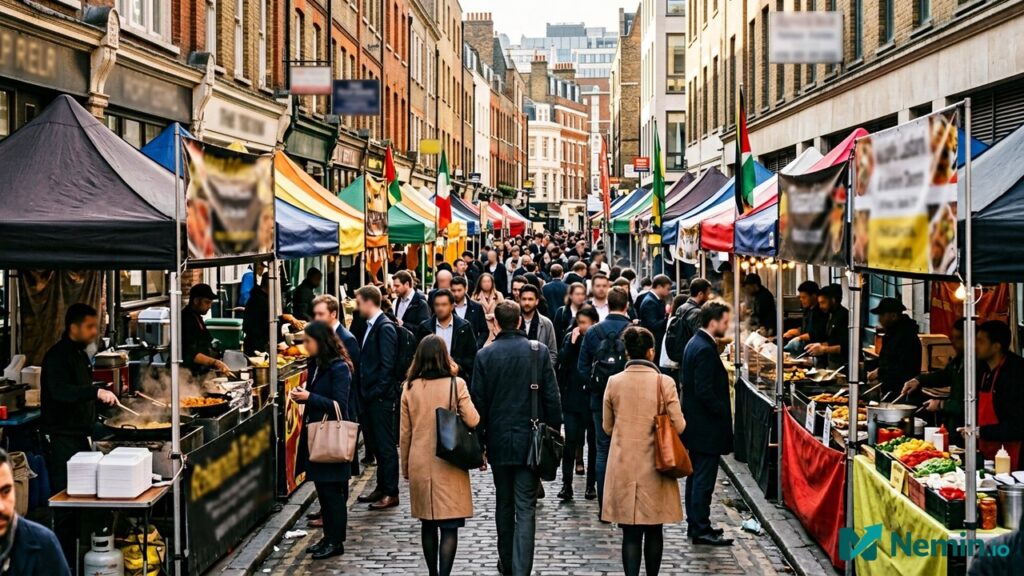
For travellers who like discovering a neighbourhood through food, Leather Lane Market offers a compact but rewarding introduction to the streets between Holborn, Clerkenwell and Farringdon. The long-established market street is particularly associated today with weekday lunchtime food, when stalls and nearby independent businesses serve a changing mixture of international dishes to office workers, residents and visitors. Its appeal comes partly from contrast: historic central London streets and traditional market heritage sit alongside contemporary street-food culture, cafés and modern workplaces. Rather than treating the market as an isolated attraction, the best way to experience it is as part of a wider walk through this distinctive part of London.
Leather Lane itself is not an enormous destination requiring an entire day. That is an advantage for visitors who enjoy slow urban exploration. You can browse the market, choose lunch, continue toward Hatton Garden or Clerkenwell and then reach some of London’s better-known cultural and historical sites on foot or by a short public transport journey.
Food traders can change, and street markets are naturally more variable than permanent restaurants. A stall recommended in an old travel article may no longer operate on the same day, while a completely new vendor may become the most interesting lunch option available.
This guide therefore focuses on how to enjoy Leather Lane Market rather than pretending its vendor lineup is permanently fixed. It covers market character, foods to look for, practical timing, transport and a walking itinerary through the surrounding neighbourhood.
What Is Leather Lane Market?
Leather Lane Market is a street market in central London, located along Leather Lane around the Holborn and Farringdon area. The street has a long association with market trading, while its contemporary identity is strongly connected with weekday food stalls and the surrounding mix of cafés, shops and local businesses.
Today, many visitors arrive specifically around lunch. The nearby working population creates demand for quick, varied food, giving the street an energetic atmosphere during the middle of the day.
Leather Lane Market should be understood as an active neighbourhood market rather than a museum-like recreation of historical London. Its character comes from continuity and change happening together.
Where Is Leather Lane Market in London?
Leather Lane runs north-south through an area between Holborn and Farringdon, within the London Borough of Camden. It is also close to Clerkenwell and Hatton Garden, giving visitors several useful geographic reference points.
Farringdon and Chancery Lane stations can be convenient depending on where you are travelling from, while other nearby stations can also work as part of a wider walking route.
Transport services and station access can change, so Transport for London should be checked for current journey planning.
Why Leather Lane Market Appeals to Food Lovers
The market offers choice within a relatively short street. Instead of committing to one restaurant, visitors can browse several food options before deciding what they want.
International street food is an important part of the contemporary experience. Depending on the traders present, choices can reflect cuisines and influences from different parts of Europe, Asia, the Middle East, the Americas and elsewhere.
Availability varies by day, so variety should be treated as part of the market’s character rather than a fixed menu.
9 Reasons to Visit Leather Lane Market
Leather Lane Market works particularly well for travellers who want to experience everyday London alongside sightseeing. It is busy because people genuinely use it for lunch, not solely because visitors arrive with guidebooks.
Nine qualities make it especially worth considering: diverse food, compact scale, central location, weekday energy, neighbourhood history, nearby independent businesses, easy walking connections, broad budget possibilities and an atmosphere that mixes old London with contemporary city life.
1. Leather Lane Market Is Built Around Real Lunchtime Demand
Street-food markets often feel most convincing when they serve a genuine local audience.
At Leather Lane Market, office workers and people based in surrounding neighbourhoods help create a concentrated lunchtime rush. Vendors therefore need food that is practical to serve while still competing for repeat customers.
For visitors, this produces an experience quite different from a market dominated almost exclusively by tourism.
2. International Food Adds Variety
One person may want a substantial hot lunch while another prefers something lighter.
Street-food variety allows companions with different tastes to browse independently before meeting again. Vegetarian and vegan options are often available among London street-food traders, although specific choices depend on the vendors present.
Anyone with serious food allergies should discuss ingredients and cross-contact directly with the trader rather than relying solely on menu labels.
3. Leather Lane Market Is Easy to Combine With Sightseeing
Central location is one of the market’s practical strengths.
Hatton Garden, Clerkenwell and parts of Holborn are within convenient walking distance, while several major London destinations can be reached from the area.
This means lunch at Leather Lane Market does not need to consume a large section of a sightseeing day.
4. It Shows a Different Side of Central London
Tourists often experience central London through landmarks and major shopping streets.
Leather Lane provides a more everyday urban perspective: workers queuing for lunch, traders preparing food and narrow streets carrying layers of commercial history.
That contrast can make the visit feel more connected with how the city functions.
5. The Market Is Manageable in Size
Some London markets can occupy hours of a visitor’s time.
Leather Lane Market is compact enough to browse without becoming overwhelming. This makes it especially useful for travellers who want a market lunch without dedicating an entire morning or afternoon to one destination.
Allow enough time to inspect several stalls before choosing.
6. Permanent Food Businesses Add Another Layer
The street and surrounding area contain cafés, shops and food businesses beyond temporary stalls.
This provides alternatives when the weather is poor or when a visitor prefers indoor seating.
It also means Leather Lane remains an interesting food street even when the exact market lineup varies.
7. Leather Lane Market Has Historical Character
Markets have operated around London’s commercial streets for centuries, and Leather Lane has longstanding associations with street trading.
Historical details should be approached carefully because popular stories about market origins are sometimes repeated without strong sourcing.
What can be observed directly is the contrast between an established street-market environment and the modern businesses surrounding it.
8. It Works Well for a Casual London Food Walk
A formal food tour is not necessary to enjoy the area.
Visitors can create their own route through Leather Lane Market and nearby neighbourhoods, stopping at places that look interesting rather than following a rigid tasting schedule.
This flexibility is particularly useful when travelling with mixed dietary preferences.
9. Leather Lane Market Can Fit Different Budgets
Street food can offer an alternative to a full sit-down restaurant, but it should not automatically be described as cheap. Central London food prices vary and change over time.
Browse current menus before ordering and compare portion sizes if budget matters.
The strongest value is often variety and convenience rather than simply obtaining the lowest-cost meal.
Leather Lane Market Opening Times
Market operation is primarily associated with weekdays, particularly daytime and lunchtime trading. Exact hours, individual trader schedules and holiday arrangements can vary.
Visitors should check the London Borough of Camden’s current market information or another reliable official source before making a special journey.
A permanent café on the street may naturally operate outside market-trading hours, so market hours and business hours should not be treated as identical.
Best Time to Visit Leather Lane Market
For the fullest food-focused experience, late morning through lunchtime is generally the most logical period.
Arriving slightly before the peak lunch rush can provide more time to browse with shorter queues. Visiting at the busiest point can offer greater atmosphere but may involve waiting at popular stalls.
Late arrival carries the possibility that individual traders have sold out of particular dishes.
Leather Lane Market Timing Guide
| Visit Time | Likely Experience | Best For |
|---|---|---|
| Early morning | Limited lunch-market activity | Walking through the neighbourhood |
| Late morning | Traders preparing or beginning service | Browsing before peak demand |
| Lunchtime | Strongest food-market atmosphere | Full street-food experience |
| Early afternoon | Still useful but some items may sell out | Later lunch |
| Late afternoon | Market activity may reduce | Permanent local businesses |
| Weekend | Different from normal weekday market operation | Check individual businesses instead |
Verify current schedules before travel, particularly around public holidays.
What to Eat at Leather Lane Market
It is better to arrive with categories in mind rather than one specific stall from an old article.
Street-food traders can rotate or change their schedules. If your only goal is finding a vendor recommended several years ago, the visit can become unnecessarily disappointing.
Instead, look for dishes being prepared freshly, compare queues and ask traders about ingredients where necessary.
International Street Food at Leather Lane Market
The contemporary London street-food scene is highly international, and Leather Lane Market reflects that broader culture.
You may encounter rice dishes, grilled meats, wraps, curries, dumplings, sandwiches, vegetarian dishes, baked goods and other quick-service foods depending on the day.
This variety makes the market particularly useful for groups with different preferences.
Vegetarian and Vegan Food
Plant-based street food has become common across London, but daily availability should still be checked on site.
A vegetarian label does not automatically indicate vegan ingredients, while a vegan dish does not automatically mean preparation is suitable for someone with allergies.
Ask the vendor when dietary requirements are medically important.
Leather Lane Market Food Is Best Chosen by Browsing
Walk along the street before making your first purchase.
The first stall may look excellent, but ten metres farther on you might find something you prefer. A short initial circuit also shows where queues are developing and which dishes are being prepared continuously.
Once you understand the day’s selection, return to your preferred option.
Food Allergies at Leather Lane Market
People with allergies need more information than ordinary menu labels provide.
Street-food stalls can work in compact preparation environments where several ingredients are handled close together. Cross-contact risk can therefore require direct discussion with the vendor.
If a trader cannot provide information sufficient for your needs, choose another option.
Questions to Ask About Food
Someone with a serious allergy can ask about ingredients, preparation surfaces, cooking oils, sauces and shared utensils.
Do not assume a dish without an obvious allergen is safe from cross-contact.
For severe allergies, make decisions according to professional medical guidance and your established personal safety plan.
Leather Lane Market for Breakfast
Leather Lane’s market identity is strongest around lunch rather than breakfast.
However, permanent cafés and businesses in the broader Holborn and Farringdon area may provide breakfast options.
If your itinerary brings you to the neighbourhood early, consider breakfast nearby and return toward Leather Lane around lunch if the market itself is your priority.
Coffee Around Leather Lane Market
Central London has numerous independent and chain coffee options, and the streets around Clerkenwell and Farringdon are particularly associated with contemporary café culture.
Specific businesses can open, close or change hours.
Use current maps and recent reviews if a particular coffee stop matters to your itinerary.
Leather Lane Market at Lunchtime
Lunch is when the street becomes particularly animated.
Office workers arrive from surrounding businesses, queues form at popular stalls and the aroma of cooking changes as you move between vendors.
This energy is part of the experience, but visitors who dislike crowds can arrive before the strongest rush.
How Long Should You Spend at Leather Lane Market?
Around an hour can be enough for browsing, choosing food and eating casually, though there is no fixed requirement.
Travellers who want to explore nearby cafés and shops can stay longer. Those using the market as a lunch stop between museums may move through more quickly.
The market works well because it can adapt to the day rather than dominate it.
Leather Lane Market and Holborn
Holborn has a layered identity combining legal London, commercial streets, historic institutions and routes toward both the West End and the City.
Leather Lane sits toward the eastern side of this broader area, close enough to become part of a Holborn walking itinerary.
Visitors who arrive solely for lunch may discover that the surrounding streets deserve additional exploration.
Walk Rather Than Rush Underground
Central London distances can be deceptive on transport maps.
Several nearby neighbourhoods are close enough to explore on foot, and walking reveals architectural details and small streets that disappear when travelling entirely underground.
Check distance and accessibility according to your own mobility needs.
Leather Lane Market and Hatton Garden
Hatton Garden, London’s famous jewellery district, is immediately associated with the area around Leather Lane.
Its concentration of jewellery businesses gives the neighbouring streets a distinct commercial identity.
A walk through Hatton Garden can easily be combined with a Leather Lane Market lunch.
Jewellery Shopping Requires Due Diligence
Visitors purchasing valuable jewellery should research businesses, pricing, warranties and product specifications carefully.
The district’s reputation does not mean every purchase should be made without comparison.
For high-value items, understand exactly what materials, gemstones and certifications are being offered.
Leather Lane Market and Clerkenwell
Clerkenwell lies close to Leather Lane and adds another dimension to the walk.
The neighbourhood is associated with architecture, restaurants, design businesses and layers of London history. Its streets can feel relatively calm compared with major tourist corridors only a short distance away.
Combining the two areas makes a food-focused outing more substantial.
Explore Slowly After Lunch
A heavy street-food lunch is a good reason to continue walking rather than immediately entering another restaurant or café.
Choose a route toward Clerkenwell Green, Smithfield or another nearby destination based on your interests.
Check opening conditions for specific historic sites before travelling.
Leather Lane Market and Smithfield
Smithfield is another historically significant area within walking reach, associated strongly with London’s meat-trading history and major architectural changes over time.
The wider area continues evolving, so visitors should check current access and construction conditions.
It can form part of a route from Leather Lane toward Farringdon and the City.
Respect Working Neighbourhoods
Markets and commercial districts are not theatrical backdrops.
Avoid blocking doorways or business access while taking photographs. Keep pavements clear, particularly during busy lunch hours.
Responsible urban tourism begins with recognising that people work and live in the places being visited.
Getting to Leather Lane Market
The best station depends on your starting point and the rest of your itinerary.
Farringdon and Chancery Lane are useful reference points, while other nearby transport options may also be convenient.
Use Transport for London’s current journey planner for live routes, disruptions and accessibility information.
Leather Lane Market Transport Overview
| Transport Option | Practical Use | What to Check |
|---|---|---|
| Farringdon station | Useful from several rail and Underground routes | Current exits and service status |
| Chancery Lane station | Convenient for the Holborn side | Central line operation |
| Bus | Useful from surrounding central areas | Current routes and diversions |
| Walking | Excellent from nearby neighbourhoods | Distance and weather |
| Cycling | Possible using London’s cycling network | Secure parking and current road conditions |
| Taxi or private hire | Convenient for mobility or luggage needs | Traffic and drop-off point |
Central London traffic can make walking or rail more predictable than driving at busy times.
Accessibility at Leather Lane Market
Street markets present a different accessibility environment from indoor food halls.
The route is outdoors and can become crowded around lunchtime. Temporary stall layouts, queues, street surfaces and weather can affect movement.
Visitors with specific accessibility requirements should research current conditions before travelling.
Plan Seating in Advance
Street food does not always come with guaranteed seating.
If standing while eating is difficult, identify nearby cafés, public seating or another appropriate location beforehand. Never assume every stall provides chairs.
A relaxed Leather Lane Market visit is easier when basic comfort requirements are planned first.
Leather Lane Market in Different Weather
Rain does not necessarily stop market activity, but it can change the experience.
Queues become less comfortable, outdoor eating becomes harder and some traders may alter attendance according to conditions.
Carry appropriate rain protection when the forecast is uncertain.
Sunny Days
Warm weather can make the street particularly enjoyable, but midday sun can also increase heat around busy food stalls.
Carry water during hotter periods and consider eating in shade.
Food hygiene remains the vendor’s responsibility, but customers should not leave purchased perishable food unrefrigerated for unnecessarily long periods.
Leather Lane Market for Solo Travellers
Street markets work particularly well for solo visitors because there is no need to commit to a formal restaurant table.
You can browse at your own pace, eat quickly and continue exploring.
Busy markets still require normal awareness of personal belongings.
Central London Personal Security
Keep phones, wallets and bags secure, especially in crowded areas.
Pickpocketing and opportunistic theft can occur in major cities, so avoid leaving valuables unattended while eating.
Use current Metropolitan Police and Transport for London guidance for broader travel-safety advice.
Leather Lane Market for Couples
For couples, the market can form part of a relaxed daytime date or London exploration route.
Choose different dishes and share where practical if you want to sample more than one cuisine.
Continue toward Clerkenwell, Covent Garden or another nearby area depending on how far you want to walk.
Make the Food Walk Flexible
Do not book every stop.
One of the pleasures of a market-based date is deciding spontaneously whether to stop for coffee, dessert or another dish.
Leave room for the street to influence the itinerary.
Leather Lane Market for Families
Families can enjoy the market, but lunchtime crowds and limited seating deserve consideration.
Young children may find busy queues tiring, so arriving before peak demand can make the visit easier.
Food choices need to account for individual dietary and allergy requirements.
Pushchairs and Busy Streets
A pushchair can navigate central London, but crowded market conditions may slow movement.
Keep routes clear around stalls and queues.
Families needing reliable seating may prefer combining one market purchase with a nearby sit-down stop.
Leather Lane Market for Office Workers
The local working population is central to the market’s contemporary identity.
Lunch needs to be quick enough to fit within a workday while varied enough to encourage repeat visits.
That regular demand contributes to the market’s weekday rhythm.
Avoid the Longest Queues When Time Is Limited
A queue can be a useful sign of popularity but not necessarily the best option when lunch time is short.
Browse several vendors and choose based on the combination of food, waiting time and personal preference.
A quieter stall can still serve an excellent meal.
How Much Does Leather Lane Market Cost?
There is no fixed market meal price because each trader sets its own menu and prices.
Central London food costs also change over time, making rigid price lists unsuitable for an evergreen guide.
Street food can sometimes be less expensive than a full restaurant meal, but it should not be assumed universally budget-priced.
Leather Lane Market Budget Planning
| Spending Category | Budget Consideration |
|---|---|
| Main dish | Compare current vendor menus |
| Drink | Carry water or purchase locally |
| Coffee | Prices vary among nearby cafés |
| Dessert | Optional additional market purchase |
| Transport | Depends on travel zone and method |
| Nearby attractions | Some are free while others charge |
| Shopping | Hatton Garden and local shops vary enormously |
| Sit-down meal | Higher total spend than a simple market lunch in many cases |
Contactless payment is widespread in London, but payment methods remain trader-specific.
How to Choose a Good Stall at Leather Lane Market
Long queues can indicate popularity, but they are not the only quality signal.
Look at food turnover, cleanliness and whether dishes are being prepared in an organised way. Ask concise questions when ingredients or spice levels matter.
Trust your own preferences instead of treating the longest line as an objective ranking.
Look for Clear Information
Professional traders should display relevant business and food information according to applicable requirements.
Food hygiene arrangements are regulated, and local authority food hygiene information may be available for registered businesses.
If something about food handling concerns you, choose another vendor.
Food Hygiene at Leather Lane Market
Street food is subject to food-safety requirements just like other food businesses.
Vendors are responsible for safe storage, preparation and service. Customers do not need to inspect kitchens professionally, but they can make reasonable observations about cleanliness and organisation.
Allergy communication deserves particular attention because market stalls can have compact preparation spaces.
Check Food Hygiene Ratings Where Relevant
The Food Standards Agency provides food hygiene rating information for many UK food businesses.
Not every stall will be easy for a visitor to identify instantly in the database, but the service can provide useful information when researching a specific trader.
Current official data is preferable to assumptions based on appearance.
Leather Lane Market and London’s Street-Food Culture
London’s street food reflects the city’s highly international population and culinary influences.
Markets provide relatively low-footprint environments in which traders can introduce focused menus rather than operate full restaurants.
This can make individual stalls highly specialised.
Small Menus Can Be a Strength
A stall selling only a handful of dishes may be concentrating on food it prepares repeatedly.
A huge menu is not automatically better.
At Leather Lane Market, focused menus can make comparing vendors easier because each stall communicates its speciality quickly.
Leather Lane Market for Vegetarian Visitors
Vegetarian diners can often find several choices in London’s modern street-food scene.
However, daily traders and menus vary.
Walk the market before ordering and ask whether sauces, stocks or toppings contain ingredients relevant to your diet.
Vegan and Plant-Based Choices
Vegan options may also be available, but terminology should be verified when dietary restrictions are strict.
Someone avoiding animal products for personal reasons may accept a different level of cross-contact from someone managing a severe allergy.
Communicate the actual requirement rather than relying on one label to convey everything.
Leather Lane Market and Sustainability
Street food can use reusable infrastructure but may also generate takeaway packaging and food waste.
Individual vendors have different environmental practices.
Avoid assuming market food is automatically more sustainable than restaurant dining.
Reduce Your Own Waste
Use recycling or waste facilities correctly and avoid taking unnecessary napkins, cutlery or condiments.
If bringing a reusable container or cup, first check whether the trader can accommodate it within their hygiene procedures.
Small practical choices are more meaningful than vague sustainable travel claims.
A Leather Lane Market Walking Route
A food-focused itinerary can begin around Holborn or Chancery Lane, continue toward Leather Lane for lunch and then move through Hatton Garden toward Clerkenwell or Farringdon.
This keeps the route geographically coherent without constant backtracking.
Exact attractions should be chosen according to current opening hours.
Half-Day Leather Lane Market Itinerary
| Stage | Suggested Activity | Main Experience |
|---|---|---|
| Morning | Explore Holborn streets | Architecture and central London atmosphere |
| Late morning | Walk toward Leather Lane | Transition into the market district |
| Lunch | Browse Leather Lane Market | Street food |
| Early afternoon | Walk through Hatton Garden | Jewellery district |
| Mid-afternoon | Explore Clerkenwell | Historic streets and cafés |
| Later afternoon | Continue toward Farringdon or Smithfield | Wider neighbourhood exploration |
Adjust the route according to weather and mobility requirements.
Leather Lane Market and Nearby Attractions
The area works well because several different parts of London meet within a relatively compact radius.
Visitors can combine food with history, architecture, jewellery shopping or museums elsewhere in central London.
Walking times vary with route and pace, so check current maps.
Nearby Places to Consider
Depending on interests and current access, a wider itinerary might include Hatton Garden, Clerkenwell, Smithfield, Holborn and other central London cultural destinations.
Do not attempt to visit everything in one afternoon.
Leather Lane Market works best as one meaningful stop within a slower exploration of the neighbourhood.
Photography at Leather Lane Market
Street markets provide lively photography through food preparation, signs, architecture and crowds.
Respect vendors and customers.
A stall being open to the public does not mean every person working there wants a close-up photograph taken without acknowledgment.
Photograph Food Without Blocking Business
Take quick photographs away from ordering queues where possible.
Do not hold up service while arranging elaborate social-media shots during the lunchtime rush.
A market functions better when photography remains secondary to the people actually using it.
Common Leather Lane Market Mistakes
The most common mistake is visiting at the wrong time and expecting the full lunchtime experience.
Another is deciding what to eat before seeing the day’s actual traders. Old blog recommendations can become outdated quickly.
A third is assuming street food automatically means abundant seating.
Avoid These Leather Lane Market Errors
When visiting Leather Lane Market, avoid:
- Arriving outside normal market trading without checking schedules
- Assuming every trader appears every weekday
- Depending entirely on an old vendor list
- Buying from the first stall before browsing
- Ignoring allergy cross-contact questions
- Expecting restaurant-style seating
- Blocking narrow queues while taking photographs
- Treating street-food prices as automatically cheap
- Leaving bags or phones unattended
- Visiting during a public holiday without checking arrangements
- Assuming bad weather has no effect on traders
- Planning an overly rigid food itinerary
A flexible approach suits the market better than a checklist.
Is Leather Lane Market Worth Visiting?
Leather Lane Market is particularly worthwhile for visitors who enjoy food, neighbourhood exploration and seeing a part of central London used heavily by local workers.
Someone seeking a vast weekend destination market with hundreds of stalls may prefer a different London market. Leather Lane’s appeal lies in its manageable scale and weekday urban rhythm.
It is best experienced as part of the neighbourhood rather than an isolated attraction.
Who Will Enjoy Leather Lane Market Most?
Food-focused travellers, solo visitors, couples and people already exploring Holborn or Farringdon are particularly well positioned to enjoy it.
It can also suit repeat London visitors who want to move beyond the most famous sightseeing routes.
The combination of food and surrounding streets is what creates the strongest experience.
Planning a Leather Lane Market Visit
Check current operating information first, then build the visit around lunch.
Choose a transport station according to what you plan to do before and afterwards. If food allergies or mobility needs are significant, research suitable options in advance while retaining backup plans.
Once there, browse before committing to lunch.
Leather Lane Market Planning Checklist
| Planning Stage | What to Do |
|---|---|
| 1. Check the day | Confirm current weekday market operation |
| 2. Check hours | Use current official information |
| 3. Plan transport | Review TfL routes and disruptions |
| 4. Consider accessibility | Account for crowds and seating |
| 5. Arrive before peak | Browse with more space if preferred |
| 6. Walk the market | Compare the day’s actual food |
| 7. Check dietary needs | Speak directly with vendors |
| 8. Choose lunch | Balance preference, queue and budget |
| 9. Explore nearby | Continue through Hatton Garden or Clerkenwell |
| 10. Stay flexible | Allow weather and discoveries to change the route |
This approach gives the market room to be spontaneous without making the day disorganised.
FAQ’s
What is Leather Lane Market known for?
Leather Lane Market is particularly known today for its weekday lunchtime street-food scene, serving a diverse local working population alongside visitors exploring Holborn, Farringdon and Clerkenwell.
When is Leather Lane Market open?
Leather Lane Market is primarily associated with weekday daytime trading, but current hours and holiday arrangements should be checked through official Camden market information before visiting.
What food can I find at Leather Lane Market?
The selection changes, but visitors can encounter a variety of international street foods, hot lunches, vegetarian dishes and other takeaway options depending on the traders operating that day.
Is Leather Lane Market close to Holborn?
Yes. Leather Lane Market sits within the broader Holborn and Farringdon area and can easily be incorporated into a walking route through Holborn, Hatton Garden and Clerkenwell.
Is Leather Lane Market suitable for vegetarians?
Vegetarian and potentially vegan options are often available, although trader lineups change. Visitors with strict dietary or allergy requirements should ask individual vendors about ingredients and preparation.
How long should I spend at Leather Lane Market?
Around an hour can be sufficient for browsing and lunch, while visitors exploring nearby cafés, Hatton Garden or Clerkenwell can comfortably make Leather Lane Market part of a half-day itinerary.
Conclusion
Leather Lane Market offers an appealing combination of long-standing London street-market character and contemporary international food culture. Its strongest moment is usually the weekday lunch period, when stalls serve the surrounding working neighbourhood and visitors can browse a changing selection of dishes before continuing through Holborn, Hatton Garden or Clerkenwell.
Treat Leather Lane Market as a flexible food stop rather than a fixed collection of famous vendors. Check current trading information, arrive around lunch, walk the street before choosing what to eat and leave enough time to explore the surrounding neighbourhood. That combination of everyday city life, historic streets and modern flavour is what gives Leather Lane its distinctive place in central London.