
Finding the right shipping container twist lock for sale requires more than comparing price and appearance. Twist locks are load securing and connection components used with compatible...
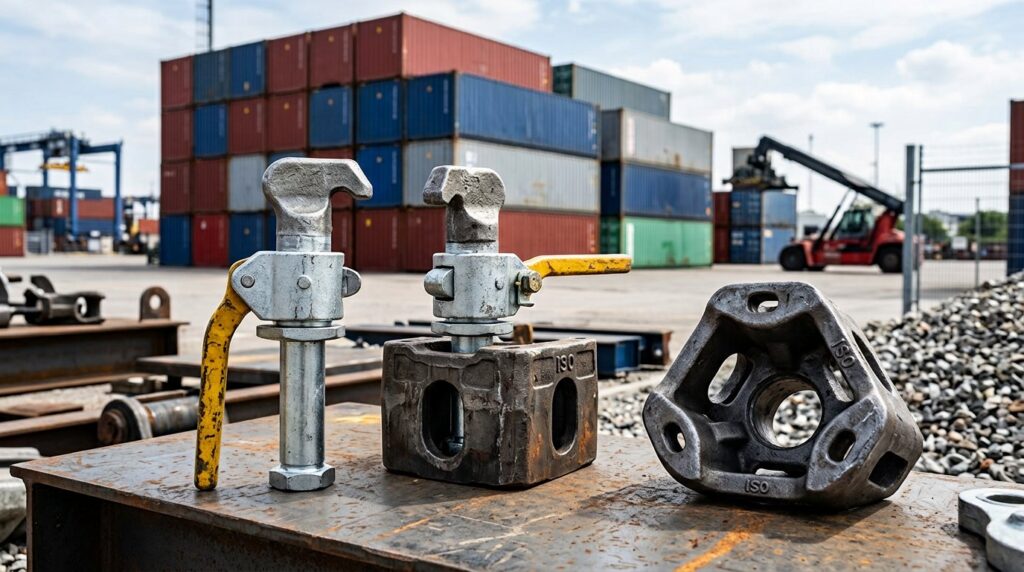
Finding the right shipping container twist lock for sale requires more than comparing price and appearance. Twist locks are load securing and connection components used with compatible freight container corner fittings, trailers, chassis, stacking arrangements, and other engineered applications. Because incorrect selection, damaged hardware, or improper installation can contribute to container movement or load failure, buyers should verify the lock type, rated capacity, dimensions, operating method, material, certification, and intended application before ordering.
Intermodal containers use standardized corner fittings that allow suitable handling and securing equipment to engage with the container. Twist locks use a rotating locking head to engage with these fittings and resist separation when correctly selected and operated.
Not all twist locks perform the same function. A manually operated stacking lock differs from a trailer mounted unit, and equipment intended for transport can have different requirements from hardware used in a stationary engineered container installation.
What Is a Shipping Container Twist Lock?
A shipping container twist lock is a mechanical locking device designed to engage with a compatible container corner fitting, commonly known as a corner casting.
The shaped locking head is inserted into the corner fitting opening and rotated into its locked position.
Depending on the design, a twist lock can help connect:
• A container to a road chassis
• A container to another container
• A container to an engineered foundation
• Containers within certain maritime securing arrangements
• A container to compatible handling or securing equipment
The correct lock must be designed and rated for the specific application.
How Does a Shipping Container Twist Lock Work?
A typical twist lock has a shaped head corresponding to the geometry of a standardized container corner fitting.
When positioned correctly, the head enters the opening in one orientation and rotates so that its geometry prevents withdrawal.
Main Twist Lock Components
Designs vary, but components can include:
• Upper or lower locking head
• Shaft or spindle
• Housing or body
• Operating handle
• Locking mechanism
• Retaining components
• Mounting arrangement
Some types incorporate additional mechanisms for automatic or semi automatic operation.
Locked vs Unlocked Position
Operators need a clear way to determine whether the device is properly engaged.
Handle position or indicators may show lock status depending on the design.
Never Rely on Appearance Alone for Critical Operations
Commercial transport and lifting operations should use the inspection and verification procedures required by the equipment manufacturer, employer, terminal, vessel, and applicable regulations.
A lock that appears engaged may still be incorrectly seated or damaged.
7 Tips When Finding a Shipping Container Twist Lock for Sale
For safety critical hardware, product specification should come before price.
1. Identify the Exact Application
First determine what the lock will do.
A unit intended to secure a container to a trailer should not automatically be substituted for one intended to connect vertically stacked containers.
Tell the supplier whether the hardware will be used for:
• Truck or trailer transport
• Container stacking
• Marine securing
• Stationary container mounting
• Fabricated structures
• Another engineered application
This immediately narrows the appropriate product category.
2. Verify the Rated Capacity
Twist locks can carry forces in different directions.
Do not use physical size or product weight as a substitute for verified load ratings.
Request Technical Documentation
For critical applications, obtain manufacturer data identifying relevant capacities, design standards, material specifications, and limitations.
If a supplier cannot provide meaningful technical information for load bearing equipment, consider another source.
3. Confirm Corner Fitting Compatibility
Freight container corner fittings and their interface geometry are covered by international standards, including ISO 1161 for Series 1 freight container corner and intermediate fittings.
The lock itself must be compatible with the corner fitting and intended connection.
Check dimensional drawings rather than assuming universal compatibility.
4. Choose the Correct Twist Lock Type
Manual, semi automatic, automatic, weld on, bolt on, trailer, and stacking hardware can have fundamentally different designs.
Select according to the actual operational requirement.
5. Evaluate Material and Corrosion Protection
Twist locks operate in demanding environments involving rain, humidity, salt, dirt, impacts, and repeated mechanical loading.
Review material grade, protective finish, maintenance requirements, and suitability for the operating environment.
6. Verify Certification Requirements
Container transport and marine operations may be governed by regulatory, classification, carrier, port, employer, or equipment specific requirements.
Determine what documentation is required before purchase.
7. Buy From a Traceable Supplier
Load securing equipment should have a clear manufacturer or supplier identity.
Traceability makes it easier to obtain specifications, replacement information, inspection criteria, and technical support.
Types of Shipping Container Twist Locks
Understanding the major product categories prevents specification mistakes.
Manual Twist Locks
Manual twist locks require an operator to place or actuate the locking mechanism directly.
They are used in various container connection applications depending on their particular design.
Advantages of Manual Designs
Potential advantages include mechanical simplicity and straightforward visual operation.
However, manual operation requires access to the device and correct engagement by trained personnel.
Semi Automatic Twist Locks
Semi automatic twist locks incorporate mechanisms intended to simplify selected parts of securing or release operations.
Their exact behavior differs by product.
Where Are They Used?
Semi automatic equipment is commonly associated with container handling and maritime operations.
Users must follow manufacturer and site specific procedures because mechanisms are not necessarily interchangeable.
Automatic Twist Locks
Automatic systems are designed to perform locking functions with reduced manual intervention under specified operating conditions.
This can support efficient container handling.
Automatic Does Not Mean Maintenance Free
Moving components still require inspection and maintenance.
Contamination, wear, corrosion, deformation, or mechanical failure can affect operation.
Shipping Container Stacking Twist Locks
Stacking twist locks connect compatible container corner fittings vertically.
They are placed between container corners as part of an appropriate stacking arrangement.
Stacking Requires More Than Four Locks
A complete stacking design must consider wind loads, container condition, stack height, foundation, occupancy, seismic conditions where relevant, and other structural forces.
Four twist locks alone do not prove that a multi container arrangement is structurally safe.
Seek Engineering Advice for Permanent Stacks
Containers used as buildings or permanent structures can be subject to building regulations and engineering requirements.
A qualified structural engineer should evaluate critical connections.
Trailer Twist Locks
Trailer and chassis twist locks secure containers during road transport.
They are integrated into or mounted to appropriately designed vehicle structures.
Road Transport Safety
A trailer lock must be suitable for the chassis design and applicable road transport requirements.
Improvised modifications can compromise both vehicle and cargo safety.
Installation or replacement should follow vehicle and component manufacturer instructions.
Weld On Twist Locks
Some container twist lock assemblies are intended to be welded to compatible steel structures.
Welding Is a Structural Process
Welding a load bearing twist lock requires appropriate material compatibility, joint design, weld procedure, and competent workmanship.
Heat from incorrect welding can damage components or change material properties.
Use manufacturer approved welding instructions and qualified personnel where required.
Bolt On Twist Locks
Bolt mounted designs can simplify installation or replacement when the supporting structure is engineered for the connection.
Check Fastener Specifications
Bolts are part of the load path.
Use the specified grade, diameter, tightening procedure, and mounting arrangement rather than substituting ordinary hardware.
Shipping Container Twist Lock Dimensions
The interface between twist locks and container corner fittings relies on controlled geometry.
ISO Container Corner Fittings
ISO 1161 specifies key requirements for Series 1 freight container corner and intermediate fittings.
Other standards can also be relevant to container dimensions, strength, testing, and safe transport.
Why Dimensions Matter
Small geometric differences can influence:
• Engagement
• Rotation
• Clearance
• Load transfer
• Mounting
• Operation
Always compare manufacturer drawings when replacing an existing unit.
Shipping Container Twist Lock Load Capacity
There is no universal load capacity applicable to every twist lock.
Ratings depend on design, material, installation, load direction, and applicable standard.
Tension Loads
Tension attempts to separate the connected components along the relevant axis.
The lock and corner fitting must transfer these forces appropriately.
Shear Loads
Shear forces act across the connection.
Transport acceleration, wind, and structural applications can create substantial horizontal loads.
Do Not Confuse Breaking Load With Working Capacity
A failure or ultimate load is not automatically an allowable working load.
Design factors, standards, fatigue, service conditions, and load combinations must be considered.
Use the manufacturer’s stated ratings in the manner intended.
Materials Used for Container Twist Locks
Heavy duty locks commonly use high strength steel or cast and forged steel components depending on the design.
Forged Components
Forging can produce strong components with favorable material characteristics when correctly designed and manufactured.
Do not assume a product is forged without technical documentation.
Cast Components
Appropriately engineered cast components can also be used in container hardware.
Material grade and quality control are more meaningful than broad claims about one manufacturing process being universally superior.
Corrosion Protection
Marine and outdoor environments can expose container hardware to aggressive corrosion.
Possible protection systems include:
• Galvanizing
• Zinc rich coatings
• Paint systems
• Other engineered finishes
The appropriate coating depends on the component and application.
Inspect Beneath Surface Corrosion
Light superficial corrosion and severe section loss are not the same.
Safety critical hardware showing deep pitting, cracking, deformation, excessive wear, or uncertain condition should be removed from service and assessed according to applicable procedures.
Shipping Container Twist Locks for Transport
Road, rail, and marine transport can subject containers to acceleration, vibration, impacts, and environmental loads.
Securing systems need to function as complete engineered arrangements.
Pre Trip Checks
Commercial vehicle operators should perform inspections required by applicable transport regulations and company procedures.
Twist lock engagement may form part of those checks.
Never Travel With Improperly Secured Containers
Container movement can create catastrophic hazards.
Suspected lock failure or incomplete engagement should be resolved before movement begins.
Twist Locks for Container Homes and Buildings
Shipping containers are increasingly reused as offices, storage facilities, homes, workshops, and modular structures.
Twist locks may form part of the connection strategy.
Permanent Structures Need Engineering
Container modification can alter structural behavior.
Cutting large openings, removing wall sections, adding roofs, joining containers, or creating multi story configurations can require reinforcement and engineered foundations.
Foundation Connections
A twist lock can connect a corner fitting to a compatible foundation attachment.
The foundation and connection still need to resist applicable loads.
Local Building Codes Apply
Planning permission, building permits, structural design, insulation, fire safety, utilities, and occupancy rules depend on location.
A container’s original suitability for freight transport does not automatically make it compliant as a building.
Shipping Container Twist Locks for Marine Use
Marine container securing can involve twist locks, lashing rods, turnbuckles, foundations, and other specialized equipment.
Marine Forces Are Complex
Ships experience roll, pitch, heave, acceleration, wind, and dynamic loads.
Container securing plans therefore rely on engineered systems rather than individual fastener selection alone.
Use Approved Equipment
Commercial maritime operations should follow applicable vessel, flag state, classification, cargo securing, and regulatory requirements.
Generic unverified hardware should not be substituted into approved securing arrangements.
How to Inspect a Shipping Container Twist Lock
Inspection requirements depend on equipment type and applicable procedure.
General visible conditions worth monitoring can include:
• Cracks
• Deformation
• Severe corrosion
• Excessive wear
• Damaged handles
• Restricted rotation
• Missing components
• Damaged threads or fasteners
• Improper seating
• Unauthorized repairs
Never repair critical hardware by welding or grinding unless an approved procedure specifically permits it.
Shipping Container Twist Lock Maintenance
Maintenance should follow manufacturer instructions.
Keep Mechanisms Functional
Dirt, corrosion, salt, and debris can restrict movement.
Use only approved cleaning and lubrication procedures because unsuitable lubricants can attract contamination or interfere with operation.
Record Inspections
Commercial organizations may benefit from documented inspection and maintenance systems.
Traceability helps identify recurring failures and equipment requiring replacement.
New vs Used Shipping Container Twist Locks
Used equipment can cost less, but its service history may be uncertain.
Risks of Used Twist Locks
Potential concerns include:
• Fatigue
• Hidden cracking
• Overloading history
• Corrosion
• Unauthorized repair
• Deformation
• Missing documentation
These concerns become more important as failure consequences increase.
When New Equipment Makes Sense
New traceable hardware from an established manufacturer or supplier is generally easier to specify and document for critical applications.
It can also provide clearer warranty and technical support.
Shipping Container Twist Lock Prices
Prices vary by design, rating, material, finish, quantity, certification, supplier, and destination.
A simple manual lock and a specialized automatic marine unit should not be expected to cost the same.
What Influences Price?
Factors include:
• Lock type
• Material
• Load rating
• Manufacturing process
• Corrosion protection
• Certification
• Order quantity
• Freight costs
• Custom requirements
Request quotations using an identical specification when comparing suppliers.
Buying Shipping Container Twist Locks Wholesale
Bulk purchasing can reduce unit costs for container operators, manufacturers, repair businesses, and logistics companies.
Request Samples and Documentation
Before committing to a large order, verify technical drawings, material data, certifications where relevant, and manufacturing traceability.
Physical samples can be useful for compatibility assessment.
Quality Control
For high volume or critical procurement, establish clear acceptance criteria.
These can include dimensions, materials, coatings, documentation, and inspection requirements.
Where to Find a Shipping Container Twist Lock for Sale
Twist locks are available through container parts suppliers, transport equipment companies, marine suppliers, industrial fastener distributors, and specialized manufacturers.
Local Suppliers
Local stock can offer faster delivery and easier returns.
It may also simplify technical support.
Online Suppliers
Online purchasing provides broad access but requires more careful verification.
Check:
• Manufacturer
• Part number
• Dimensions
• Rating
• Certification
• Intended use
• Shipping cost
• Returns
• Technical support
Do not buy safety critical hardware from a listing that provides only generic photographs and no meaningful specification.
Questions to Ask Before Purchasing
A supplier should be able to answer technical questions appropriate to the product.
Consider asking:
• What application is this lock designed for?
• Which corner fitting standard is it compatible with?
• What are its rated loads?
• Is it manual, semi automatic, or automatic?
• What material is used?
• What corrosion protection is applied?
• Which technical drawings are available?
• What certification or test documentation is supplied?
• What installation method is required?
• What inspection criteria apply?
• Are replacement parts available?
Clear answers make product comparison safer and easier.
Common Buying Mistakes
A low cost component can become extremely expensive if it is unsuitable for the application.
Avoid:
• Buying by appearance alone
• Assuming all twist locks are interchangeable
• Ignoring load ratings
• Confusing stacking and trailer locks
• Using undocumented secondhand equipment
• Ignoring corrosion exposure
• Installing weld on hardware without an approved procedure
• Substituting mounting bolts
• Assuming every product advertised as ISO is independently certified
• Using damaged components
Specification and traceability are particularly important for safety related connections.
Frequently Asked Questions
What is a shipping container twist lock?
A shipping container twist lock is a mechanical securing device that engages with a compatible freight container corner fitting through a rotating locking head.
Are all container twist locks the same size?
No. Although container corner interfaces are standardized for relevant ISO applications, twist locks vary by function, dimensions, mounting arrangement, capacity, and operating mechanism.
Can twist locks be used to stack shipping containers?
Specific stacking twist locks can connect compatible container corners, but overall stack safety also depends on structural loads, foundations, container condition, and engineering requirements.
What is the load capacity of a container twist lock?
Capacity varies by model and load direction. Use manufacturer supplied technical ratings rather than assuming a universal capacity from the component’s size.
Can I use a used shipping container twist lock?
Potentially, but condition, wear, corrosion, service history, rating, and documentation need careful evaluation. Critical applications favor traceable equipment with verified specifications.
Where can I find a shipping container twist lock for sale?
Specialized container parts suppliers, trailer equipment distributors, marine suppliers, and industrial manufacturers sell twist locks. Choose based on documented specifications and intended application rather than price alone.
Conclusion
Finding the correct shipping container twist lock for sale begins with identifying the exact connection, whether it involves a trailer, stacking arrangement, marine securing system, or engineered stationary structure. Buyers should verify compatibility, load ratings, materials, corrosion protection, mounting requirements, and technical documentation before ordering. Safety critical applications also require appropriate inspection, installation, and maintenance rather than relying on visual similarity between components. Choosing traceable hardware from a reputable supplier helps ensure the twist lock matches both the container interface and the demands of its intended service.