
SQL for finance is the practice of using Structured Query Language to store, retrieve, and analyze financial data. Banks, insurers, and investment firms use SQL...
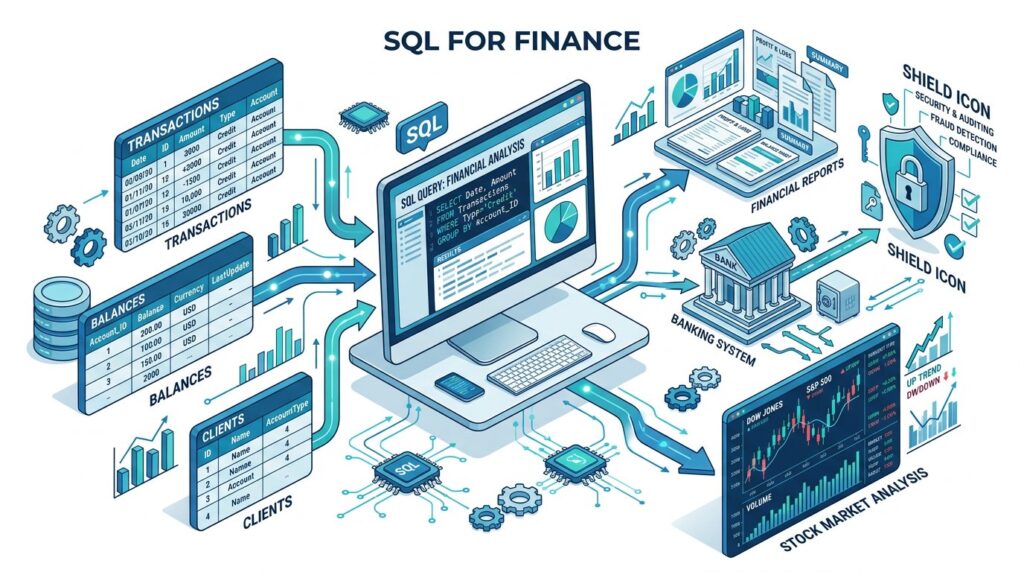
SQL for finance is the practice of using Structured Query Language to store, retrieve, and analyze financial data. Banks, insurers, and investment firms use SQL for finance to process transactions, detect fraud, manage risk, and produce regulatory reports. SQL is one of the most valuable skills in finance, with SQL finance roles in the United States paying roughly 83,000 to 154,000 dollars a year, and SQL is the quiet engine behind modern banking.

Every time you check a balance, pay a bill, or receive a fraud alert, SQL is running in the background. SQL for finance is the practice of using Structured Query Language to manage and analyze the data that powers the financial world, and it is a skill that finance professionals, analysts, and business leaders increasingly cannot afford to ignore.
This guide explains SQL for finance in practical terms, with real SQL for finance query examples, the skills that matter, salary data, common mistakes, and a clear learning path, so you can understand SQL for finance and put it to work.
SQL for Finance Explained: What It Really Means
SQL for finance explained simply is using Structured Query Language to work with financial databases. SQL stands for Structured Query Language, and it is the standard way to ask a database for data, such as a customer balance, yesterday’s transactions, or accounts with suspicious activity.
Think of a bank’s records as a giant filing system. Without a query language, finding one number means hunting through thousands of files by hand. SQL is the trained librarian who finds any record instantly, combines records from different files, and spots patterns in seconds, which is how the language works in everyday terms.
What makes SQL for finance different from generic SQL is the domain. Finance data is sensitive, regulated, and time critical, so the practice emphasizes accuracy, auditability, security, and speed. A query that works for a marketing report may not be safe for a financial report, and getting it right is the discipline.
Why SQL for Finance Is the Language of the Financial Industry
SQL for finance has become the standard because financial data is everywhere, and several forces explain why SQL for finance matters so much today.
Transaction volume. Banks process millions of transactions every day. Visa alone processes more than 800 million transactions daily, and each one leaves data that SQL helps analyze.
Fraud pressure. Fraud attempts have risen sharply in recent years, and financial firms use SQL to flag suspicious patterns in real time, protecting both institutions and consumers.
Regulatory demands. US financial firms report under rules like SOX, SEC requirements, and anti money laundering laws, and SQL produces the accurate, auditable reports regulators expect.
Data driven decisions. Credit scoring, risk management, and investment strategy all run on analytics, and SQL supplies the data behind those decisions.
Career value. SQL is listed in about 43 percent of data science job postings, and finance roles that include SQL pay more, which makes it a smart investment for professionals.
The result is that SQL is the quiet engine of the financial industry, and understanding it helps professionals, consumers, and businesses alike.
SQL for Finance in Action: Real Use Cases
The best way to understand the practice is to see it working, and finance teams use SQL across nearly every function.
Use Case 1: SQL for Finance in Daily Transactions
Banks store every transaction in a database, and SQL retrieves balances, posts payments, and reconciles accounts. When you check your balance, a query returns the exact number in a second.
A simple query to pull a customer’s recent transactions looks like this.
SELECT TransactionDate, Amount, Description FROM Transactions WHERE AccountID = 1001 AND TransactionDate >= CURRENT_DATE - 30 ORDER BY TransactionDate DESC
This query returns the last month of activity for one account, which is the same logic running behind your banking app.
Use Case 2: SQL for Finance in Fraud Detection
Analysts use SQL to flag unusual activity, such as many large transactions in a short time, duplicate payments, or logins from different locations. One financial services case study reported that SQL based fraud detection reduced fraudulent transactions by 30 percent within three months.
A fraud detection query groups transactions and flags accounts with suspicious totals.
SELECT AccountID, COUNT(*) AS TransactionCount, SUM(Amount) AS TotalSpent FROM Transactions WHERE TransactionDate >= CURRENT_DATE - 7 GROUP BY AccountID HAVING COUNT(*) > 50 OR SUM(Amount) > 10000
This query finds accounts with excessive transaction counts or unusually high spending in a week, which are classic fraud signals.

Use Case 3: SQL for Finance in Risk and Reporting
Banks use SQL to measure exposure, score credit, and stress test portfolios, and compliance teams use SQL to generate the reports regulators require, with every number traceable to its source. Automation can cut manual reporting effort dramatically and reduce compliance risk.
The Core SQL for Finance Skills Every Analyst Needs
Mastering the practice starts with a small set of core skills that cover most real world queries.
SELECT and WHERE
The foundation is retrieving the right data. SELECT chooses the columns, and WHERE filters the rows. An analyst uses these to pull balances, transactions, or customer records with precise conditions.
JOIN
Finance data lives in many tables, and JOIN combines them. A JOIN brings together customers, accounts, and transactions into one view, which is how analysts connect the dots across the business.
GROUP BY and Aggregate Functions
COUNT, SUM, and AVG summarize thousands of records in seconds, and GROUP BY organizes them by category. These functions total daily revenue, average balances, and count transactions by product or region.
Window Functions
Window functions rank rows and compute running totals without collapsing the data, which is useful for trends, period over period comparisons, and rankings like top customers by month.
Subqueries and CTEs
Subqueries and common table expressions break complex problems into readable steps, which keeps queries accurate and maintainable.
Data Validation
A skill that separates good work from risky work is validation. Checking row counts, testing totals against known figures, and reviewing NULLs prevent expensive errors, because wrong financial data can trigger wrong decisions.
SQL for Finance Careers: Salary and Demand in the US
SQL sits at the center of strong demand for data skills, and the numbers show why it pays to learn.
| Metric | Figure |
|---|---|
| SQL listed in data science job postings | About 42.7 percent |
| US companies relying on SQL Server for internal ERP | About 90 percent of Fortune 500 |
| Financial services adoption of Oracle SQL | About 85 percent usage |
| SQL developers worldwide | About 48.66 percent of developers |
| Average SQL developer salary in the US | About 95,000 dollars a year |
| Average SQL analyst salary in the US | About 109,000 dollars a year |
| Average financial data analyst salary in the US | About 99,000 dollars a year |
| SQL finance job salary range in the US | About 83,000 to 154,000 dollars |
The salary picture explains why professionals invest in the skill. A financial data analyst earns around 99,000 dollars a year on average, a SQL analyst earns about 109,000 dollars, and senior data engineers with SQL expertise earn significantly more, which makes it one of the highest value skills a finance professional can add.
What SQL for Finance Means for US Consumers
For consumers in the United States, SQL is the invisible engine behind everyday banking.

When you check your balance, a query returns your exact total in a second. When you pay a bill, SQL records and reconciles the transaction. When you get a fraud alert about an unusual purchase, SQL flagged the pattern. When you apply for a loan or a card, SQL supports the credit decision.
SQL also protects consumers. Fraud detection queries catch suspicious activity before it becomes a loss, and accurate reporting keeps the financial system sound. For US consumers, this simply means banking that is fast, accurate, and safe, and that reliability works for you every day.
What SQL for Finance Means for US Businesses
For businesses in the United States, SQL delivers advantages that touch revenue, compliance, and decisions.

Finance teams use SQL to close the books faster, reconcile accounts, and build management reports. Risk teams use SQL to monitor exposure and score credit. Compliance teams use SQL to generate regulator ready reports with auditable numbers. Treasury teams use SQL to manage cash flow and forecast liquidity.
A small business using SQL for finance can automate reporting and understand its customers, while a large enterprise uses SQL for finance across data warehouses, business intelligence, and machine learning. Because SQL for finance works on almost any database, from open source PostgreSQL to commercial systems, it is an accessible skill for every finance team, and the market data shows the investment pays off.
Common SQL for Finance Mistakes and How to Avoid Them
Even experienced analysts make mistakes, and avoiding them is a core part of SQL for finance, which is SQL for finance explained with honesty.
Selecting everything. Using SELECT without filters can pull millions of rows and slow the database, so write precise WHERE clauses in SQL for finance.
Forgetting WHERE in updates and deletes. A missing WHERE clause can change every row, which is a disaster in financial data. Always test updates on a copy first when working with SQL for finance.
Ignoring joins. Joining tables without the right keys creates duplicate or missing rows, which corrupts financial totals, so verify join keys carefully in SQL for finance.
Skipping data validation. A query can run without errors and still return wrong numbers, so check totals against known figures, which is the discipline of SQL for finance.
Overlooking NULLs. NULL values behave differently in aggregations and can silently change sums, so handle them explicitly in SQL for finance.
Sharing data carelessly. Financial databases hold sensitive information, so respect access controls and never expose data in SQL for finance work.
Avoiding these mistakes keeps SQL for finance accurate, fast, and safe, which is what the financial industry expects.
How to Start Learning SQL for Finance
For a professional ready to learn SQL for finance, a clear path works best, and that path is SQL for finance explained as a roadmap.
Start with the fundamentals. Learn SELECT, WHERE, JOIN, GROUP BY, and aggregate functions, because these core skills of SQL for finance cover most everyday queries, and practice on real financial datasets using free interactive tutorials.
Apply SQL for finance to real problems. Build a monthly revenue report, write a fraud detection query, or analyze a transactions table, because hands on practice is how SQL for finance skills stick, and learn your organization’s data model, because knowing the tables is half of SQL for finance success.
Follow security and quality practices. Use read only access where possible, never expose sensitive data, and validate results against known figures, and automate recurring reports with SQL for finance to save time.
For businesses, invest in training, standardize SQL for finance practices, and pair analysts with finance domain experts, because SQL for finance is most powerful when technical skill meets financial understanding.
SQL for Finance vs Spreadsheets: When to Upgrade
Many finance teams start with spreadsheets and wonder when they need SQL instead, and the honest answer is that it depends on the size and complexity of the data.
Spreadsheets are excellent for small datasets, one off analysis, and quick calculations, and every analyst should know them. But spreadsheets slow down with thousands of rows, break when multiple people edit the same file, and make it hard to enforce rules about data accuracy. When reports take hours to refresh or errors creep in from manual copying, it is time to move the work into a database queried with SQL.
SQL and spreadsheets are not rivals. The strongest finance teams use both, with SQL handling the heavy lifting of extracting and aggregating data from the source, and spreadsheets handling the final presentation and modeling. Understanding when to use each tool saves time and prevents mistakes.
The practical rule for finance teams is simple. If your analysis fits on one screen and updates rarely, a spreadsheet is fine. If you query millions of rows, need live reports, or must guarantee accuracy, SQL is the better choice, and building that skill pays off across a career.
Frequently Asked Questions
These are the questions people ask most about SQL for finance.
- What is SQL for finance? SQL for finance is using Structured Query Language to store, retrieve, and analyze financial data, from transactions to risk reports.
- Why is SQL important in finance? SQL is important because it queries large financial datasets fast, powers fraud detection, supports reporting, and is a high demand, well paid skill.
- Do I need to know SQL for a finance job? SQL is increasingly expected for financial analysts, data analysts, and many finance roles, and it boosts salary and opportunities.
- What can SQL for finance do? SQL for finance can retrieve balances, total revenue, segment customers, flag fraud, automate reports, and support credit and risk decisions.
- Is SQL hard to learn for finance? SQL is one of the easier languages to learn, and the core skills of SQL for finance can be picked up in weeks with practice.
- How much do SQL finance jobs pay? SQL finance roles in the US pay about 83,000 to 154,000 dollars a year, with financial data analysts averaging near 99,000 dollars.
- Which databases do financial firms use with SQL? Financial firms commonly use Microsoft SQL Server, Oracle, PostgreSQL, and MySQL, and SQL for finance works across all of them.
- Does SQL for finance protect consumers? Yes, SQL for finance powers fraud detection and accurate reporting, which protects accounts and keeps the financial system safe.
Conclusion
SQL for finance is the quiet engine of the modern financial world, and the data confirms its importance. SQL is listed in a large share of data science job postings, about 90 percent of Fortune 500 companies rely on SQL Server for internal systems, and financial analysts who know SQL earn strong salaries, which is SQL for finance explained at market scale.
For consumers in the United States, SQL for finance means balances that load instantly, fraud alerts that catch suspicious activity, and a financial system that runs accurately, and for US businesses, SQL for finance means faster reporting, lower costs, better fraud protection, and sounder decisions.
The practical skills matter too, because SQL for finance is about writing precise queries, joining data correctly, validating results, and protecting sensitive information, and the professionals who master those skills are the ones who advance. Whether you are a consumer wondering why your banking app is so reliable or a professional considering a career move, understanding SQL for finance is valuable, because SQL for finance is how the financial industry manages its data, and this guide gives you the foundation to use it well.