
Walk into a hospital records department, a law office, or a county clerk's counter, and you will likely hear a sound most people assume vanished...
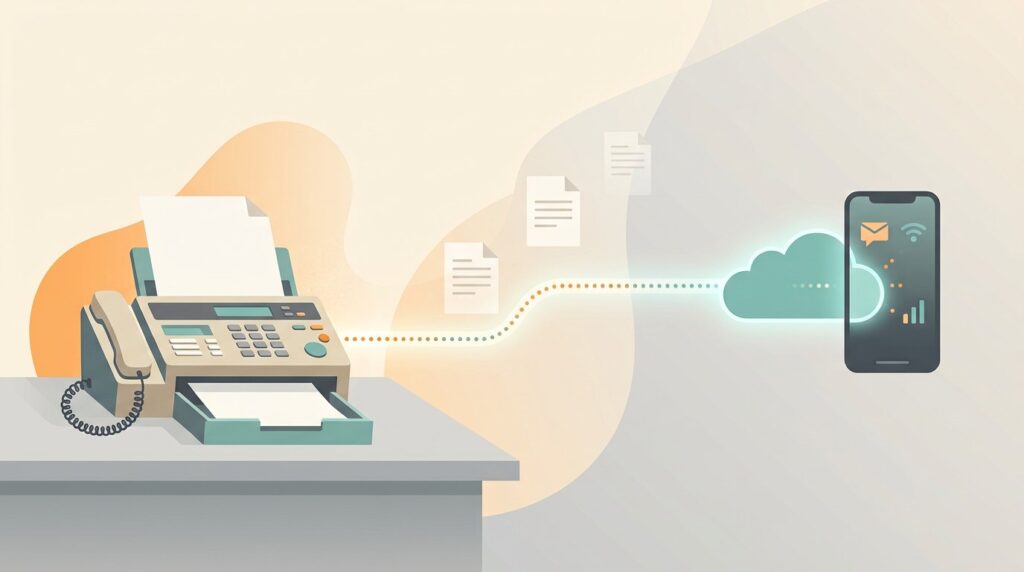
Walk into a hospital records department, a law office, or a county clerk’s counter, and you will likely hear a sound most people assume vanished decades ago. Traditional fax machines are still humming away, pulling paper through a scanner and pushing documents down a copper line. Critics have declared traditional fax machines obsolete for thirty years running, yet it keeps handling millions of transmissions daily across regulated industries.
This guide explains how the machines actually work, why entire sectors continue to depend on them, and what happens when the analog phone network they were built for finally goes away. Moreover, it covers the practical options available to any organisation caught between old hardware and new infrastructure.
How Traditional Fax Machines Actually Work
The underlying process is elegantly simple, which partly explains its longevity. A document is fed into the scanner, where a sensor array reads each line and converts it into a pattern of black and white pixels. That pattern is then compressed and modulated into audible tones. Those tones travel across an ordinary telephone circuit exactly as a voice call would. At the far end, a receiving unit demodulates the tones, reconstructs the pixel data, and prints the page.
Two documents govern this exchange. The first defines the image encoding and compression scheme, while the second, known as the T.30 recommendation, controls the conversation between the two devices. Before any page data moves, the machines perform a handshake. They negotiate resolution, compression method, page size, and transmission speed, then agree on the fastest settings both sides can support.
That negotiation is why every fax begins with the familiar screech. Those tones are two modems introducing themselves. Consequently, when a fax fails, the fault usually lies in the handshake rather than the paper handling.
The Group 3 Standard and Transmission Speeds
Almost every one of the traditional fax machines in service today follows the Group 3 standard, ratified in 1980. Group 3 replaced slower analog predecessors and set the template that persists to this day, including standard resolution of roughly 200 by 100 dots per inch and fine resolution at 200 by 200.
Early Group 3 units transmitted at 9,600 bits per second. Later revisions raised that ceiling to 14,400, and the Super G3 generation pushed it to 33,600 bits per second. In practical terms, a Super G3 device can move a typical text page in a handful of seconds rather than the better part of a minute.
Error Correction Mode deserves particular attention. When enabled, it groups image data into frames and requests retransmission of any frame that arrives damaged. As a result, pages arrive clean instead of streaked with the horizontal black bands that plagued earlier equipment. Notably, this same feature behaves unpredictably on packet networks, a complication addressed later in this guide.
Why Regulated Industries Still Rely on Fax
The persistence of traditional fax machines is not nostalgia. It reflects a specific combination of regulation, liability, and interoperability that newer channels have struggled to match.
Healthcare leads the list. In the United States, faxing is widely used to transmit protected health information because it fits within established privacy rules, and the transmission travels point to point without sitting in a third-party inbox. Hospitals, clinics, pharmacies, and insurers all maintain fax endpoints for referrals, prescriptions, and records requests.
Legal and judicial systems follow closely. Many jurisdictions still accept or explicitly require faxed filings, and a fax confirmation page functions as a timestamped delivery record that courts recognise.
Financial services use fax for signed instructions. Loan documents, transaction confirmations, and compliance submissions frequently move this way, partly because the audit trail is straightforward to produce during an examination.
Government agencies remain heavy users. Numerous public processes, from benefit applications to permit submissions, still list a fax number as an accepted channel.
Beyond regulation, one practical advantage keeps the technology alive: universal interoperability. Any machine can send to any other machine anywhere in the world without shared software, accounts, compatible file formats, or prior arrangement. Few modern systems can honestly make that claim.
The Security Argument, Examined Honestly
Traditional fax machines are often described as inherently secure. That characterisation deserves nuance rather than blanket acceptance.
The genuine advantages are real. A transmission over a dedicated circuit does not pass through mail servers or cloud storage, so the document is not sitting in a database waiting to be breached. There is no attachment to open, which removes a common malware delivery route. Additionally, the delivery confirmation provides evidence that a specific number received a specific page count at a specific time.
However, the limitations matter just as much. Analog fax transmission is not encrypted in the way modern messaging is; its protection comes largely from the dedicated nature of the circuit rather than from cryptography. Furthermore, the biggest practical risk is entirely human. A single mistyped digit sends confidential records to a stranger, and pages left sitting in an output tray are visible to anyone walking past.
Therefore, the honest assessment is this: fax offers a different risk profile rather than a strictly superior one. Organisations that treat it as secure by default, without controlling misdials and physical access, are relying on an assumption that does not hold.
What the Copper Network Shutdown Means
The most serious threat to traditional fax machines is infrastructural. Telecommunications carriers across North America and Europe have been retiring legacy copper networks and analog voice services, replacing them with fibre and internet-based alternatives. Regulators have generally permitted these transitions as long as customers receive adequate notice and replacement options.
For fax, this creates a genuine problem. The equipment assumes a continuous, low-latency, uncompressed audio path. Packet networks provide none of those guarantees. They tolerate small gaps in a voice call because the human ear compensates, but a fax modem cannot. A dropped packet in the middle of a page corrupts the data stream, and the transmission fails.
Consequently, businesses that simply move an existing machine onto a standard internet phone line often find that faxes that worked reliably for years start failing intermittently.
Bridging Analog Hardware to Modern Networks
Fortunately, several approaches keep traditional fax machines operational. Each carries distinct trade-offs.
T.38 fax relay is the purpose-built solution. Published by the International Telecommunication Union, this standard works by intercepting the fax signal at a gateway, demodulating the tones back into structured data, transmitting that data as packets with built-in redundancy, and re-modulating it into tones at the destination. Because the content travels as data rather than audio, packet loss that would destroy an audio stream is absorbed by the redundancy mechanism. The machines at either end never know anything unusual happened.
Audio passthrough sends the fax tones over the internet connection as though they were ordinary speech, using an uncompressed voice codec. It requires far less configuration, yet it is fragile. On a pristine local network it can work acceptably; across the open internet, even modest packet loss causes failures.
Cloud fax services remove the hardware question entirely by handling transmission on the provider’s infrastructure and delivering documents as email attachments or through a web portal. Staff can send from a computer or phone, and the provider manages protocol compatibility. The trade-off is that documents pass through and are typically stored on a third-party system, which introduces a vendor relationship that compliance teams must evaluate.
Analog telephone adapters offer a middle path, connecting an existing machine to an internet-based service through a small hardware bridge that speaks the relay protocol on the network side.
Practical Guidance for Choosing an Approach
Selecting sensibly starts with honest measurement rather than vendor comparison.
First, count your actual volume. Organisations frequently discover they send a fraction of what they assumed, which changes the economics considerably. Second, identify which counterparties genuinely require fax, since some may accept a secure portal or encrypted email instead. Third, determine whether inbound faxes must reach a physical device or can be delivered digitally, because inbound-only requirements are far simpler to satisfy.
Next, confirm what your telephone provider actually supports. Relay support varies significantly, and a provider that handles internal transmissions may still fail on calls that break out to the public network. Additionally, if you operate in a regulated sector, verify that any prospective vendor will sign the compliance agreements your obligations require, and ask directly how long they retain document content.
Finally, test before committing. Send multi-page documents to real destinations at realistic times of day. A configuration that works perfectly at nine in the morning may struggle when the network is congested at two in the afternoon.
Keeping Existing Equipment Reliable
Organisations retaining traditional fax machines can improve reliability with a few straightforward habits. Clean the scanner glass and rollers regularly, since streaks and misfeeds usually trace back to dust rather than electronics. Keep confirmation reports enabled so failed transmissions surface immediately instead of being discovered weeks later.
Meanwhile, place machines where output trays are not visible to visitors, and establish a routine for clearing received pages promptly. Maintain a verified contact list to reduce misdials, and consider lowering the transmission speed on lines that fail repeatedly, because a slower, completed fax beats a fast one that never arrives.
Frequently Asked Questions
Are traditional fax machines obsolete?
Not in practice. Adoption has declined sharply in general business use, yet healthcare, legal, financial, and government sectors continue to rely on fax because regulations recognise it and because it works between any two devices without shared software.
Can a fax machine work without a landline?
Yes, with an intermediary. An analog telephone adapter connected to an internet-based service allows existing hardware to keep functioning, though the service must support a fax-aware relay protocol for reliable results.
Why do faxes fail over internet phone lines?
Because fax modems require continuous, precisely timed audio. Internet connections introduce compression, jitter, and occasional packet loss, all of which corrupt the signal. A dedicated fax relay protocol solves this by carrying the content as data instead of audio.
Is faxing more secure than email?
It has a different risk profile. Fax avoids mail servers and cloud inboxes, but analog transmission is not encrypted in the modern sense, and misdialled numbers or unattended output trays create real exposure. Neither channel is secure without proper handling.
How fast can a fax machine transmit?
Standard Group 3 devices operate at 9,600 or 14,400 bits per second, while Super G3 units reach 33,600. A typical text page therefore takes anywhere from several seconds to roughly a minute, depending on resolution and line quality.
What happens when carriers switch off copper lines?
Existing machines lose their native connection and need a bridge, whether that is an adapter paired with a fax-aware internet service or a full move to a cloud-based provider. Planning ahead avoids an unexpected outage.
Conclusion
Traditional fax machines occupy an unusual position in modern offices. The technology is genuinely old, the hardware is unglamorous, and the tones are unmistakably dated. Nevertheless, the combination of regulatory acceptance, universal interoperability, and a clear delivery record keeps the format firmly in place across sectors where those qualities matter more than novelty.
The realistic question is not whether fax survives, but how it survives. As carriers retire the analog networks these devices were designed around, organisations face a straightforward choice: bridge the existing hardware with a fax-aware relay protocol, move to a cloud service and drop the physical machines, or eliminate the requirement altogether where counterparties will accept an alternative.
Whichever path fits, the sensible sequence is the same. Measure your real volume, confirm which relationships genuinely demand fax, verify what your provider actually supports, and test thoroughly before you switch. Handled that way, the transition is a manageable project rather than the morning a critical channel stops working without warning.