
Effective youth basketball skill development is about much more than teaching a young player how to shoot a basketball. A complete development program builds ball-handling...
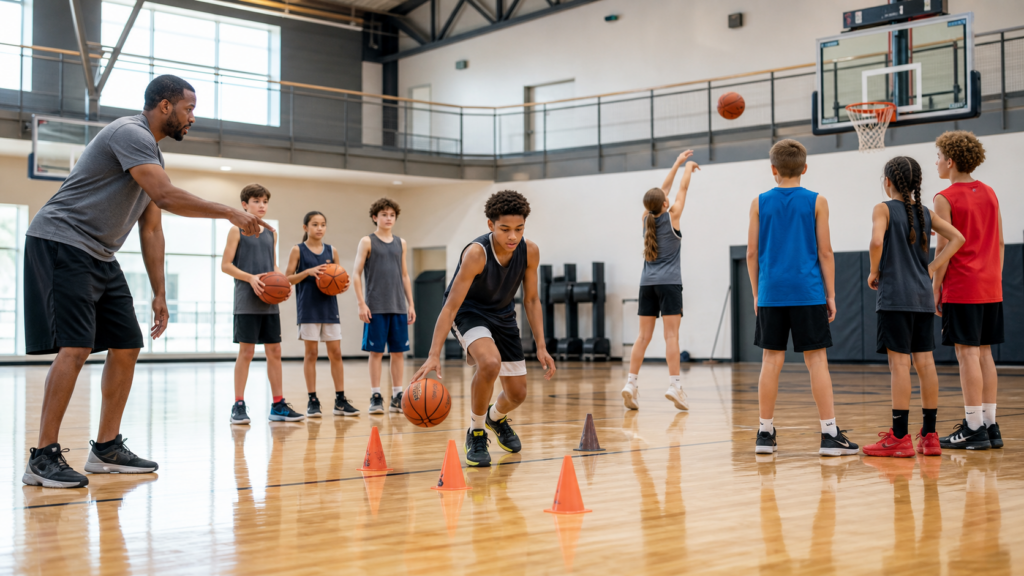
Effective youth basketball skill development is about much more than teaching a young player how to shoot a basketball. A complete development program builds ball-handling ability, passing, footwork, shooting technique, defense, movement, decision-making, confidence, and an understanding of how the game works. Young athletes improve best when they learn strong fundamentals first and then gradually apply those skills at faster speeds and in realistic game situations.
Basketball can look simple from the stands, but every possession requires several skills working together. A player may need to dribble under pressure, see an open teammate, change direction, control their balance, make a pass, relocate, and prepare to defend within only a few seconds.
This is why youth training should not focus only on highlight moves or scoring.
The most productive training builds a foundation that young players can continue using as they grow physically and mentally.
What Is Youth Basketball Skill Development?
Youth basketball skill development is a structured process of helping young players improve the technical, physical, mental, and tactical abilities needed to play basketball effectively.
It commonly includes training in:
- Ball handling
- Dribbling
- Passing
- Shooting
- Finishing
- Footwork
- Defense
- Rebounding
- Court awareness
- Decision-making
- Coordination
- Communication
- Confidence
The goal is not simply to make a player perform one drill well.
A good development program helps the athlete use those skills naturally during games.
For example, dribbling around cones may improve control, but the player must eventually learn how to use the same control against a defender.
That progression from technique to game application is a major part of basketball development.
Why Fundamentals Matter for Young Basketball Players
Fundamentals are the building blocks of basketball.
Young players sometimes want to learn advanced crossovers, long-range shots, or difficult finishing moves before mastering basic movement and control.
That approach can slow development.
A player who understands basic footwork, balance, ball control, and shooting mechanics has a much stronger base for learning advanced skills later.
Strong fundamentals also help players adjust as competition becomes faster.
At younger ages, an athlete may succeed because of speed or size. As players get older, opponents become stronger, quicker, and more skilled.
Technical ability becomes increasingly important.
Ball Handling: Building Control and Confidence
Ball handling is one of the first areas many youth players need to develop.
Players should become comfortable controlling the ball with either hand.
Good ball handling helps a player:
- Move around defenders
- Protect possession
- Change direction
- Attack open space
- Create passing angles
- Maintain control under pressure
Young athletes should begin with simple stationary drills before moving into more difficult exercises.
Basic Ball-Handling Drills
Useful beginner exercises include:
- Right-hand dribbles
- Left-hand dribbles
- Low dribbles
- High controlled dribbles
- Crossover dribbles
- Between-the-leg movements
- Behind-the-back control
- Figure-eight ball movements
The goal should be control first.
Speed comes later.
A player who performs a crossover slowly with balance and proper technique is developing a better foundation than someone who performs it quickly while constantly losing the ball.
Learning to Use Both Hands
Many young basketball players naturally rely on their dominant hand.
A right-handed athlete may avoid dribbling or finishing with the left hand whenever possible.
This creates a weakness that defenders can eventually exploit.
Training should regularly include the weaker hand.
Players can practice:
- Weak-hand stationary dribbling
- Weak-hand layups
- Weak-hand passing
- Change-of-direction moves
- Driving from different sides of the court
At first, the movement may feel uncomfortable.
That is normal.
Improvement comes through consistent repetition.
Dribbling With Purpose
Basketball players should not dribble simply because they have the ball.
Every dribble should help achieve something.
A player might dribble to:
- Advance the ball
- Escape pressure
- Create space
- Attack the basket
- Improve a passing angle
- Move into a scoring position
Teaching purposeful dribbling helps young athletes develop better decision-making.
Too much unnecessary dribbling can slow the offense and make it easier for defenders to recover.
Passing Skills for Young Players
Passing is one of the most important team skills in basketball.
A good pass moves the ball faster than a player can dribble.
Young athletes should learn several basic passing techniques.
Chest Pass
The chest pass is useful for quick passes between teammates when a defender is not blocking the passing lane.
Players should step toward the target and finish with their hands pointing toward the receiver.
Bounce Pass
A bounce pass can help move the ball around or underneath a defender’s hands.
The ball should reach the teammate at a comfortable catching height.
Overhead Pass
An overhead pass can be useful when passing over pressure or delivering the ball across a longer distance.
Players should maintain control rather than throwing the ball without a clear target.
One-Hand Passing
As players become more advanced, one-hand passes become useful for making quick decisions while dribbling.
These passes require strong control and awareness.
Teaching Players to See the Court
Passing technique alone is not enough.
Players must learn when and where to pass.
Court vision develops by encouraging young athletes to play with their eyes up.
During ball-handling drills, coaches can ask players to identify:
- Teammates
- Defenders
- Open space
- The basket
- Passing lanes
Players who constantly stare at the basketball may miss important information around them.
Improving awareness is a major part of youth basketball skill development because better decisions often separate skilled players from players who simply have good physical ability.
Shooting Fundamentals
Young players often judge their performance by how many shots they make.
However, proper shooting development focuses first on repeatable mechanics.
Key shooting principles may include:
- Balanced feet
- Controlled body position
- Proper hand placement
- Eyes focused on the target
- Smooth upward motion
- Consistent release
- Follow-through
The exact shooting style may vary slightly between athletes, but unnecessary movement should be reduced.
Start Shooting Close to the Basket
One common mistake is allowing young players to shoot from too far away before they have enough strength.
When the basket is outside a player’s comfortable range, the athlete may develop poor habits such as:
- Throwing the ball from the chest
- Using excessive body movement
- Losing balance
- Pushing the ball with both hands
- Changing shooting mechanics every attempt
Young players should begin closer to the basket.
As their technique and strength improve, they can gradually increase distance.
Form Shooting
Form shooting is a simple but valuable training method.
Players stand close to the basket and concentrate on proper mechanics rather than distance.
The goal is consistency.
A player might make several shots from one location before moving slightly farther away.
This allows the athlete to feel the correct shooting motion without needing excessive strength.
Catch-and-Shoot Development
Players rarely receive unlimited time to prepare a shot during a game.
Therefore, shooting practice should eventually include receiving passes.
Important skills include:
- Preparing the hands before the pass arrives
- Maintaining balanced feet
- Catching in a shooting-ready position
- Moving smoothly into the shot
Players can practice receiving passes from different angles to simulate real possessions.
Shooting Off the Dribble
Once basic shooting is consistent, players can practice shooting after dribbling.
This may include:
- One-dribble pull-ups
- Two-dribble pull-ups
- Crossover into a shot
- Side dribble into a shot
Balance remains critical.
Young athletes should avoid practicing difficult off-balance shots before mastering simple controlled attempts.
Finishing Around the Basket
Scoring close to the basket requires touch, footwork, timing, and the ability to use either hand.
Young players should first become comfortable with basic layups.
Right-Hand Layup
Players learn the correct steps and finish using the right hand on the appropriate side.
Left-Hand Layup
The same process should be practiced on the opposite side.
Many young players avoid their weaker hand, so regular repetition is necessary.
Finishing From Different Angles
As players improve, training can include:
- Layups from the wing
- Finishes from the baseline
- Reverse layups
- Inside-hand finishes
- Controlled power finishes
These options help players adjust when defenders protect the most direct route to the basket.
Importance of Footwork
Footwork affects nearly every basketball skill.
Good footwork can improve:
- Shooting balance
- Defense
- Driving
- Passing
- Rebounding
- Finishing
- Direction changes
Players with strong footwork often look more controlled because their body remains balanced during fast movements.
Jump Stops and Pivoting
Jump stops help players come to a controlled stop after moving with the ball.
After stopping, players can use a pivot foot to protect the ball and find passing or shooting options.
Pivoting teaches athletes how to create space without unnecessary dribbling.
Players should practice:
- Front pivots
- Reverse pivots
- Passing after pivoting
- Shooting after pivoting
These simple skills become extremely useful when defenders apply pressure.
Triple-Threat Position
The triple-threat position prepares a player to:
- Shoot
- Pass
- Dribble
A player receives the basketball in a balanced stance while protecting it from the defender.
Teaching young athletes to enter a strong triple-threat position after receiving a pass can improve their ability to make quicker decisions.
Defensive Skill Development
Youth basketball training should give defense as much attention as offense.
Good defense begins with effort, positioning, balance, and awareness.
Young defenders should learn how to stay between their opponent and the basket without constantly reaching for the ball.
Defensive Stance
A basic defensive stance includes:
- Bent knees
- Balanced feet
- Upright chest
- Active hands
- Eyes focused on the offensive player’s body
Players should avoid standing too tall.
A lower stance makes it easier to move quickly in either direction.
Defensive Slides
Defensive sliding helps players move laterally while remaining balanced.
A defender should avoid repeatedly crossing their feet when guarding the ball.
Training can include short slide drills in both directions.
The focus should remain on:
- Quick first movement
- Balance
- Controlled spacing
- Proper stance
Closeouts
A closeout happens when a defender moves toward an offensive player who receives the ball.
The defender must arrive under control.
Running too aggressively can allow the offensive player to drive past.
Young players should practice approaching quickly and then slowing into a balanced defensive stance.
Help Defense and Team Awareness
Defense is not only about guarding one player.
As athletes develop, they should learn to understand where the ball and other players are located.
Important ideas include:
- Seeing both the ball and assigned player
- Moving toward help positions
- Communicating with teammates
- Recovering after helping
These habits introduce young players to team defense.
Rebounding Fundamentals
A possession does not always end when a shot is taken.
Players must compete for rebounds.
Rebounding requires more than jumping ability.
Good rebounders learn how to:
- Find an opponent.
- Establish position.
- Make contact safely.
- Locate the ball.
- Jump strongly.
- Secure the rebound with both hands.
Players should also protect the ball after securing it.
Athletic Movement and Coordination
Basketball development includes general movement skills.
Young athletes benefit from exercises that improve:
- Balance
- Coordination
- Body control
- Quickness
- Change of direction
- Reaction time
These abilities support technical basketball skills.
For example, better balance can improve both shooting and defense.
Age-Appropriate Basketball Training
Training should match the age and experience of the player.
A beginner should not be expected to perform the same drills as an experienced teenager.
Younger Beginners
Training may focus on:
- Basic dribbling
- Passing
- Layups
- Balance
- Simple shooting
- Understanding court areas
- Enjoying the game
Intermediate Players
Training can add:
- Change-of-direction moves
- Weak-hand skills
- Shooting off passes
- Basic defense
- Decision-making
- Small-sided games
Advanced Youth Players
More experienced athletes may work on:
- Game-speed execution
- Advanced finishing
- Reading defenders
- Shot creation
- Position-specific skills
- Team concepts
- Pressure decision-making
Progression should remain gradual.
Why Game-Speed Training Matters
A player may look excellent during a slow drill and struggle during a real game.
This happens because games involve:
- Defenders
- Time pressure
- Fatigue
- Movement
- Noise
- Decisions
- Physical contact
Once a skill becomes technically sound, practice should gradually become faster and more realistic.
For example, a player can progress from:
- Stationary crossover
- Moving crossover
- Crossover around a cone
- Crossover against light defense
- Crossover against live defense
This progression teaches the athlete how to transfer practice skills into competition.
Small-Sided Games for Skill Development
One-on-one, two-on-two, and three-on-three games can be extremely useful.
With fewer players on the court, each athlete receives more opportunities to:
- Touch the ball
- Make decisions
- Defend
- Pass
- Drive
- Shoot
Small-sided games can also expose weaknesses quickly.
A player who avoids using the left hand, for example, may become easier to defend in one-on-one situations.
Decision-Making Is a Basketball Skill
Technical training gets a lot of attention, but basketball is also a decision-making game.
Players constantly choose between options.
Should they:
- Shoot?
- Pass?
- Drive?
- Cut?
- Hold the ball?
- Help on defense?
Good training creates situations where players must make these decisions themselves.
Coaches should not provide every answer before the play happens.
Young athletes need opportunities to read the situation and learn from mistakes.
Building Basketball Confidence
Confidence often improves when players feel prepared.
A young athlete who has practiced a skill many times is more likely to use it during competition.
Confidence can also grow through achievable goals.
Instead of telling a player to “become a great shooter,” create smaller targets such as:
- Improve shooting balance
- Make a set number of close-range shots
- Complete weak-hand dribbles without losing control
- Execute proper footwork several times
Progress becomes easier to recognize.
Why Mistakes Are Important
Players cannot develop without making mistakes.
Missing shots, losing the ball, making poor passes, and getting beaten defensively are all part of learning.
Training environments should encourage athletes to identify what went wrong and try again.
Fear of mistakes can cause young players to become passive.
They may stop attacking, experimenting, or making decisions.
Constructive coaching should correct errors without making players afraid to participate.
Consistency Beats Occasional Intense Training
Basketball improvement usually comes from regular practice rather than one extremely long training session.
A player who practices focused skills several times per week can build better habits than someone who trains for hours only occasionally.
Short sessions can be valuable when they have a clear purpose.
For example:
- 10 minutes of ball handling
- 10 minutes of finishing
- 15 minutes of shooting
- 10 minutes of footwork
The quality of repetition matters more than simply counting minutes.
Creating a Youth Basketball Practice Routine
A balanced individual training session might follow this structure:
Warm-Up
Begin with light movement and dynamic exercises.
Include simple ball control to prepare the body and mind.
Ball Handling
Practice both hands using stationary and moving drills.
Finishing
Work on layups and controlled finishes from both sides.
Shooting
Begin close to the basket before increasing distance.
Game Moves
Practice one or two specific moves rather than trying to learn everything at once.
Defense or Footwork
Include movement, closeouts, or defensive slides.
Competitive Finish
End with a small challenge, shooting goal, or controlled game situation.
This creates a clear beginning, middle, and end.
Role of Coaches in Skill Development
Coaches play an important role in helping young athletes develop correctly.
Good instruction should explain not only what to do but why it matters.
Effective coaches often:
- Demonstrate techniques clearly
- Correct major errors
- Encourage effort
- Adjust drills to player ability
- Provide useful feedback
- Increase difficulty gradually
- Create game-like situations
Too much information at once can confuse young athletes.
Simple coaching points are usually easier to apply.
Role of Parents
Parents can support basketball development without turning every practice or game into an evaluation.
Useful support includes:
- Encouraging consistent practice
- Helping players arrive prepared
- Supporting healthy routines
- Celebrating effort and learning
- Allowing coaches to coach
- Keeping results in perspective
Young players often improve more comfortably when they do not feel that every missed shot is being judged.
Private Training vs Group Training
Both individual and group sessions can contribute to youth basketball skill development.
Individual Training
Individual instruction can provide:
- Focused feedback
- Personalized drills
- More repetitions
- Direct attention to weaknesses
Group Training
Group sessions can provide:
- Competition
- Communication
- Passing opportunities
- Live decision-making
- Defensive situations
A combination of both can be useful.
Individual work develops technique, while group environments help apply those skills against other players.
Measuring Basketball Improvement
Improvement should not be judged only by points scored in games.
A player may be progressing even before scoring increases.
Signs of development can include:
- Better weak-hand control
- Fewer turnovers
- Improved passing decisions
- Stronger defensive positioning
- Better shooting balance
- Increased confidence
- Improved communication
- Better movement without the ball
- More consistent effort
Tracking these areas gives a more complete picture of progress.
Common Youth Basketball Training Mistakes
Several mistakes can slow improvement.
Focusing Only on Scoring
Basketball includes many important skills beyond shooting.
Ignoring the Weak Hand
Players should develop both sides of the body.
Practicing Too Fast Too Early
Speed without control can create poor habits.
Taking Too Many Difficult Shots
Young players should build range gradually.
Avoiding Defense
Complete players must develop on both ends of the court.
Copying Advanced Moves Without Understanding Them
A move is useful only when the player knows when and why to use it.
Doing Drills Without Game Application
Skills eventually need to be practiced against pressure.
Rest and Recovery for Young Athletes
More training is not always better.
Young athletes need enough rest to recover physically and mentally.
Constant high-intensity training without recovery can reduce the quality of practice.
Rest also allows players to return with better focus.
A balanced schedule should consider:
- Basketball practice
- Games
- School
- Sleep
- Other sports
- General activity
Development should support the athlete rather than overwhelm them.
Keeping Basketball Training Enjoyable
Young players are more likely to stay committed when training is challenging but enjoyable.
Not every drill needs to feel like a test.
Coaches can include:
- Skill competitions
- Partner challenges
- Timed drills
- Small-sided games
- Shooting games
Fun and serious development can exist together.
The goal is to create an environment where athletes want to improve.
Long-Term Development Matters More Than Early Results
Some young athletes develop faster than others.
One player may be taller, stronger, or more coordinated at an early age.
That does not guarantee future success.
Long-term development focuses on skills that remain useful as competition improves.
These include:
- Ball control
- Shooting technique
- Footwork
- Passing
- Defense
- Decision-making
- Work habits
Players who build these areas patiently give themselves a stronger foundation for future basketball.
Conclusion
Youth basketball skill development works best when young athletes build strong fundamentals before rushing toward advanced moves or game results. Ball handling, passing, shooting, finishing, footwork, defense, rebounding, coordination, and decision-making should develop together through consistent and age-appropriate practice. Players need repetition, but they also need opportunities to use their skills against pressure and make their own decisions. Coaches can support improvement with clear instruction and gradual progression, while parents can encourage effort without creating unnecessary pressure. When training remains structured, challenging, and enjoyable, young players can build confidence, understand the game more deeply, and develop basketball skills that continue helping them as the level of competition increases.
Frequently Asked Questions
What is youth basketball skill development?
Youth basketball skill development is the process of improving fundamental abilities such as dribbling, passing, shooting, finishing, footwork, defense, rebounding, court awareness, and decision-making.
What basketball skills should young players learn first?
Young players should begin with ball control, basic dribbling, passing, layups, shooting form, footwork, defensive stance, and understanding how to move on the court.
How often should youth basketball players practice?
The right frequency depends on age, experience, games, school demands, and other activities. Consistent focused sessions are generally more useful than occasional very long practices.
Why is ball handling important in youth basketball skill development?
Strong ball handling helps players maintain possession, attack open space, escape defensive pressure, improve passing angles, and become more confident using both hands.
Should young basketball players practice with both hands?
Yes. Developing both hands makes players less predictable and improves dribbling, passing, and finishing options on either side of the court.
How can a young basketball player improve shooting?
Start close to the basket, focus on balance and repeatable shooting mechanics, practice form shooting, and gradually increase distance as technique and strength improve.
Is private basketball training better than group training?
Neither is automatically better. Private training can provide focused individual feedback, while group training provides competition, passing, defense, and live decision-making. Using both can create a balanced development plan.
How can parents support youth basketball development?
Parents can encourage consistent practice, positive effort, good rest, and patience. They can also allow players to learn from mistakes instead of judging development only by points scored or game results.