
Routine gutter cleaning is one of the most effective ways to protect a home from preventable roof leaks, rotted fascia boards, and costly foundation movement....
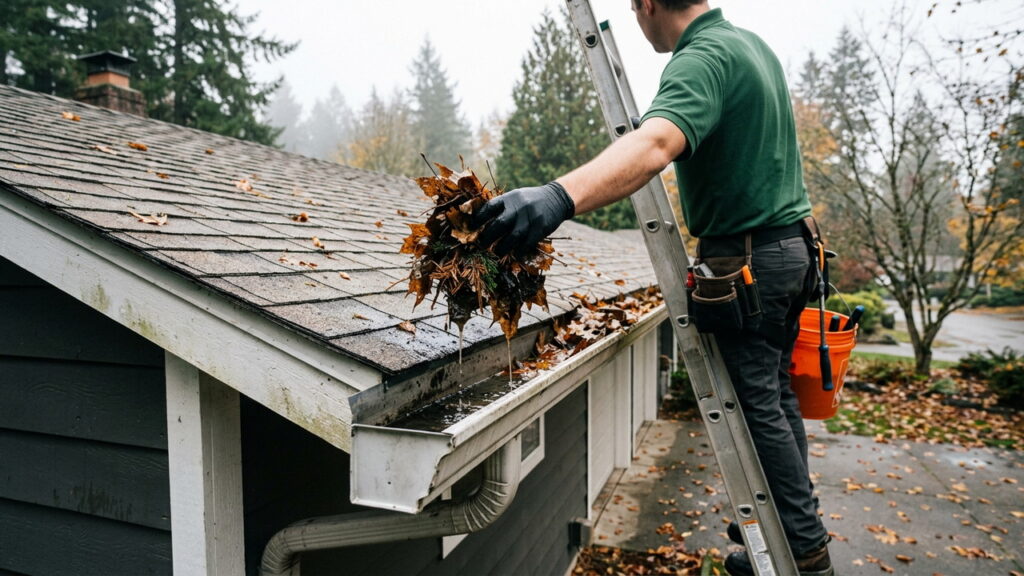
Routine gutter cleaning is one of the most effective ways to protect a home from preventable roof leaks, rotted fascia boards, and costly foundation movement. When leaves, twigs, shingle grit, and windblown dirt block your roofline channels, rainwater cannot reach the downspouts and instead spills over the eaves or backs up under the roof edge.
Planning a reliable gutter cleaning routine depends on your surrounding tree cover, roof pitch, building height, and comfort with ladder safety. This guide explains how rainwater drainage works, how often to clear your channels, which tools and ground-level methods work best, and how to compare DIY upkeep with professional service quotes.
Quick Summary of Safe Gutter Cleaning
Effective gutter cleaning clears both the horizontal roofline troughs and the vertical downspouts so rainwater flows freely away from the building perimeter. Simply scooping visible leaves out of the open channels is only half the job, because a single packed plug of wet pine needles inside a downspout elbow can back up an entire roof section during a heavy storm.
Homeowners can handle basic single-story gutter cleaning with a stabilized ladder, heavy work gloves, a plastic scoop, and a garden hose, or use ground-based vacuum and telescopic tools where appropriate. On multi-story properties, steep roofs, or homes near overhead utility lines, hiring an insured specialist is safer than climbing high extension ladders without fall protection.
Use this checklist before starting any gutter cleaning work
- Inspect the roofline and ground drainage paths from the yard before setting up any equipment.
- Check weather forecasts and schedule gutter cleaning only on dry, calm days with no wind or lightning risk.
- Use a sturdy fiberglass or aluminum ladder equipped with a standoff stabilizer bar so the rails never crush the metal trough.
- Clear coarse dry debris by hand or vacuum first, then flush the channels and test every downspout from top to bottom.
- Inspect hanger brackets, mitered corner seams, end caps, and downspout straps for loose fasteners or standing water.
- Direct downspout extensions or splash blocks so discharged water flows safely away from the house foundation.
Why Regular Gutter Cleaning Protects Your Entire Property
Rainwater roof drainage systems are designed to collect thousands of gallons of runoff from a wide roof surface and channel it to safe discharge points. When you postpone gutter cleaning, decomposing organic matter turns into a heavy, waterlogged sludge that traps moisture against metal, wood, and masonry for weeks after rain stops.
The cost of routine gutter cleaning is minor compared with the structural repairs caused by uncontrolled water overflow. Understanding how clogged channels affect each level of your home makes it easier to prioritize seasonal maintenance before winter freezes or heavy spring storms arrive.
Preventing Roof Rot, Fascia Damage, and Ice Dams
Water that cannot exit through a blocked downspout fills the horizontal trough until it crests over the back and front edges. Without timely gutter cleaning, water spilling over the rear edge soaks directly into the wooden fascia board, the sub-fascia framing, and the ventilated soffit panels beneath the roof overhang.
Repeated wetting and drying cycles cause exterior paint to peel and allow wood-rot fungi to soften the structural boards holding the gutter spikes or hidden hangers. Once the wood weakens, the heavy weight of wet debris and trapped rainwater can pull the entire metal channel away from the eaves, turning a simple gutter cleaning task into a full carpentry and gutter replacement job.
In colder climates, neglecting autumn gutter cleaning contributes to destructive winter ice dams along the lower roof edge. When clogged channels remain packed with frozen leaves and ice, melting snow from the upper roof has nowhere to drain and pools behind the frozen lip, forcing liquid water backward under roof shingles and into attic insulation and interior ceilings.
Protecting Foundations, Basements, and Landscaping
At ground level, clogged roof channels allow sheets of water to waterfall straight down alongside the exterior walls of the house. Consistent gutter cleaning prevents this concentrated runoff from trenching through flowerbeds, washing away decorative mulch, and eroding the graded soil that slopes away from the building.
When roof water pools repeatedly in the soil right next to a basement wall or crawlspace footing, it creates hydrostatic pressure against the foundation masonry. Over time, skipping gutter cleaning can contribute to damp basement walls, efflorescence staining, cracked concrete walkways, and soil settlement beneath driveways or patio slabs.
Standing water trapped inside uncleaned roof troughs also creates a sheltered breeding ground for mosquitoes and attracts carpenter ants, wasps, birds, and rodents looking for moisture and nesting material. Keeping channels clear and dry through scheduled gutter cleaning removes that stagnant water source right outside your upper windows.
How Often to Schedule Gutter Cleaning Throughout the Year
For many standard homes with moderate yard landscaping, performing gutter cleaning twice a year—once in late spring and once in late autumn—provides dependable year-round drainage. Spring cleaning removes oak tassels, maple seeds, blossoms, and bird nests, while late-fall service clears fallen leaves right before winter rain and freezing temperatures set in.
However, a twice-yearly calendar is only a baseline rather than a universal rule for every property. Your ideal gutter cleaning frequency depends on overhanging foliage, conifer needles, roof design, and regional storm patterns.
| Property Environment | Recommended Cleaning Frequency | Primary Debris Type | Key Inspection Focus |
|---|---|---|---|
| Open Yard With Few Nearby Trees | Once to twice per year in spring and late fall | Windblown dust, asphalt shingle granules, and bird droppings | Check downspout elbows and trough pitch for slow silt buildup |
| Mature Deciduous Trees Nearby | Twice to three times per year during spring seed drop and autumn leaf fall | Broad leaves, twigs, acorns, and winged seed pods | Clear valleys and outlet strainers after major autumn windstorms |
| Pine, Fir, or Cedar Trees Overhanging | Every three months or up to four times per year | Fine conifer needles, pine cones, and sticky sap residue | Flush narrow seams and underground drain inlets where needles mat together |
| Heavy Storm, Monsoon, or Wildfire Ash Zones | Seasonal schedule plus post-storm spot checks | Windblown branches, heavy roof grit, dust, and airborne ash | Verify full downspout capacity before forecasted torrential rainfall |
Adjusting for Trees, Roof Pitch, and Local Weather
Homes surrounded by tall pine, spruce, cedar, or fir trees usually require gutter cleaning three to four times a year because evergreen needles shed continuously across all four seasons. Unlike broad maple or oak leaves that bridge across the top of a trough, slender pine needles slip flat into the bottom of the channel and interweave with shingle grit to form a dense, cement-like mat.
Roof geometry also changes how quickly debris collects between gutter cleaning visits. Complex roofs with multiple intersecting valleys funnel high-velocity water and leaves from two roof planes directly into a single short corner section of gutter, requiring extra attention at valley splash guards and nearby downspouts.
Even a newly built home in an open subdivision with zero trees still needs periodic gutter cleaning and inspection. Asphalt composition shingles gradually shed fine mineral granules as they weather under sunlight, and that heavy grit settles into the low spots of the trough, weighing down hangers and restricting smooth water flow.
Warning Signs That Your Channels Need Immediate Clearing
You do not have to wait for a calendar date if your roofline shows clear visual signs of a blockage during a rainstorm. Recognizing early symptoms from the ground lets you arrange gutter cleaning before water penetrates the exterior envelope of the house.
- Water cascading over the front rim of the trough like a waterfall while virtually nothing exits the bottom of the downspout.
- Dark dirty water streaks, green algae stripes, or peeling paint appearing along the underside of the fascia board and soffits.
- Visible sagging, bowing, or gaps pulling open between the back of the gutter trough and the wooden fascia trim.
- Green weeds, grass sprouts, or small tree seedlings growing visibly out of the decomposed compost inside the channel.
- Birds, squirrels, or wasps gathering repeatedly along one specific section of the roof edge during dry weather.
Comparing DIY and Professional Gutter Cleaning Methods
Homeowners and exterior maintenance contractors use several different techniques for gutter cleaning depending on building height, debris wetness, and equipment access. Comparing how each method works helps you decide which approach suits your property and physical comfort level.
| Cleaning Method | Best Debris Condition | Safety Profile | Main Operational Limitation |
|---|---|---|---|
| Hand Scooping From a Stabilized Ladder | Wet, compacted sludge, mud, and heavy matted leaves | Moderate risk; requires strict single-story ladder safety habits | Time-consuming because the ladder must be repositioned every few feet |
| High-Reach Wet/Dry Gutter Vacuum | Both dry leaves and damp organic muck on one- or two-story homes | High safety; operator remains standing on firm ground | Rigid carbon or aluminum poles become heavy to maneuver over long sessions |
| Telescopic Water-Fed Garden Hose Wand | Loose dirt, shingle grit, and light residue after bulk leaf removal | High safety from the ground, though overspray can be messy | Low garden hose pressure cannot dislodge tightly packed downspout plugs |
| Leaf Blower With Curved Tube Attachment | Bone-dry autumn leaves and loose surface twigs | Moderate risk on ladders or ground poles; creates airborne dust | Scatters messy wet mud across siding, windows, and landscaping if channels are damp |
| Professional Full-Service Crew | All debris types, steep roofs, three-story heights, and minor repairs | Highest homeowner safety; trained crew uses commercial stabilization gear | Carries a service fee, though often cheaper than buying tall ladders and specialty tools |
Traditional Hand Scooping From a Stabilized Ladder
Manual scooping from a properly positioned ladder remains the most thorough DIY method for single-story gutter cleaning because you can see directly into the trough and feel hidden obstructions. Working by hand with a narrow plastic gutter trowel allows you to lift out heavy wet mud, rotting oak leaves, and shingle grit directly into a bucket without splattering dirty water across clean house siding.
Direct visual access during ladder-based gutter cleaning also lets you inspect the hardware up close. While scooping each section, you can spot rusted fastener screws, cracked seam sealant at mitered corners, or loose outlet tubes that would never be visible from the lawn below.
The main drawback of ladder-based gutter cleaning is the time and care required to descend and move the ladder every one to one and a half meters along the roofline. Overreaching to the left or right to clear just one more handful of leaves is the leading cause of ladder instability, so patience is essential.
Ground-Level Vacuum Systems, Blower Attachments, and Telescopic Wands
Many homeowners prefer to keep both feet on the ground during gutter cleaning by using extended pole attachments connected to a high-powered wet-and-dry shop vacuum, a leaf blower, or a garden hose. Interlocking rigid tubes fitted with a 180-degree gooseneck nozzle reach up and hook over the front lip of the gutter.
Among ground-level tools, a commercial-style wet-and-dry gutter vacuum offers the cleanest result for gutter cleaning because it sucks both dry leaves and wet decaying sludge down into a collection drum on the patio. Some operators clip a small wireless inspection camera to the top bend of the vacuum pole, viewing a live feed on a smartphone screen to verify that the trough is completely clean.
Blower attachments and curved water wands have narrower use cases during gutter cleaning. Air blowers work quickly on crisp, dry autumn leaves, but they blow smelly black mud all over windows and walls if the bottom of the trough is damp; similarly, curved garden hose wands are helpful for final rinsing, yet they often push whole leaves directly into the downspout opening and cause a deeper clog.
What Professional Technicians Include in a Full Service
Hiring a professional exterior cleaning company shifts the physical labor and height risk of gutter cleaning to trained technicians who carry commercial ladders, stabilizers, and high-capacity vacuums. A reputable crew does much more than blow leaves onto your lawn and drive away.
Comprehensive professional gutter cleaning typically includes removing all solid debris from the troughs, bagging and hauling away the waste, flushing or air-clearing every downspout from the roofline to the ground outlet, and rinsing any stray mud off exterior siding or walkways. Many technicians also take before-and-after photos of the cleared channels so homeowners can verify the work from the ground.
During a professional gutter cleaning appointment, experienced technicians also perform a basic mechanical check of the system. They can tighten loose hanger screws, tap backing-out gutter spikes back into solid rafters, reseal minor pinhole drips at corner seams, and alert you if a section has lost its proper drainage slope toward the downspout.
Essential Tools and Ladder Safety Rules for Gutter Cleaning
Falls from ladders represent one of the most common causes of serious home maintenance injuries. If you choose to perform DIY gutter cleaning on a single-story roofline, setting up the right personal protective equipment and ladder stabilization gear is mandatory before climbing a single rung.
Never use an unstable step stool, a wooden chair, or an old ladder with bent rails for gutter cleaning. Choose a heavy-duty extension ladder or multi-position ladder with a verified load rating—such as Type I or Type IA—that comfortably supports your body weight plus the weight of your tools and a filled debris bucket.
Selecting the Right Ladder, Standoff Brackets, and Protective Gear
The single most valuable accessory for ladder-based gutter cleaning is a clip-on or bolt-on ladder standoff stabilizer. Instead of leaning the top ladder rails directly against the thin aluminum gutter lip—which easily dents the metal and loosens the hangers—a standoff bracket spans wide across the roof tiles or rests against the solid wall siding below the eaves.
Using a standoff stabilizer during gutter cleaning holds the ladder several inches away from the channel, giving your arms comfortable working space directly in front of your chest. Always set the ladder base at the standard four-to-one angle (one foot out from the wall for every four feet of vertical height) on firm, level ground, and use adjustable leg levelers rather than stacking loose boards under one leg on sloped turf.
Equip yourself with proper hand and eye protection before starting gutter cleaning. Troughs contain sharp sheet-metal edges, rusted screws, wasp stingers, animal droppings, and bacteria-laden organic sludge, so wear thick, water-resistant work gloves, wrap-around safety glasses, and slip-resistant rubber-soled boots.
Hang two five-gallon buckets from the ladder top or standoff arms using heavy metal S-hooks so both hands remain completely free while climbing up and down. Use one bucket to hold your plastic gutter scoop, stiff nylon brush, and hose nozzle, and use the second bucket to collect scooped debris during gutter cleaning so wet muck does not mat down your lawn or stain concrete walkways.
Working Around Overhead Power Lines and Steep Roofs
Before raising any ladder or extending any telescopic pole for gutter cleaning, scan the entire perimeter of your house for overhead electrical service drops and utility cables. Aluminum ladders and wet carbon-fiber vacuum poles conduct electricity, and contacting or coming too close to an overhead service line can be fatal.
Keep all ladders, tools, and body parts at least ten feet (three meters) away from overhead electrical wires at all times during gutter cleaning. If the electrical service mast attaches to your roofline near a section of clogged trough, leave that area strictly to a qualified professional with insulated equipment.
Similarly, never walk out onto a wet, moss-covered, or steeply pitched roof to perform gutter cleaning from above. Leaf slime, morning dew, and loose shingle granules make roof surfaces remarkably slippery, and leaning forward over the eaves shifts your center of gravity directly toward the drop edge.
Step-by-Step Process for Thorough Gutter Cleaning
Following a methodical order prevents you from washing loose leaves down into the vertical pipes and creating a stubborn underground blockage. Use this seven-step sequence to complete a thorough DIY gutter cleaning on a safe, accessible roofline.
- Walk the perimeter of the house on a dry, calm day to locate all downspouts, check for overhead power lines, and clear toys, hoses, or patio furniture from ladder setup zones.
- Attach a standoff stabilizer to your ladder, set the base firmly on level ground at a four-to-one angle, and start your gutter cleaning right next to a downspout outlet while working away from it.
- Plug or cover the top of the downspout outlet opening with an old rag or tennis ball before scooping so loose muck cannot fall down into the vertical pipe while you work.
- Scoop out large leaves, twigs, and compacted sludge using a narrow plastic gutter trowel, placing all solid waste directly into a bucket hooked to your ladder rather than dropping it into flowerbeds.
- Remove the rag from the downspout opening and test the vertical pipe with a garden hose; if water backs up, disconnect the bottom elbow or feed a flexible plumbing auger up from the bottom until the plug breaks free.
- Rinse the length of the horizontal trough from the high end toward the downspout using a standard garden hose spray nozzle, brushing away stubborn mud and checking that no standing pools remain.
- Inspect all hanger brackets, end caps, and corner seams for leaks while water is flowing, then confirm that the ground-level downspout extension discharges water cleanly away from the foundation wall.
Once you finish the last section of gutter cleaning, empty your debris buckets into yard waste bins or a compost pile (provided the waste does not contain heavy asphalt shingle grit). Rinse down any dirty splashes on windows or siding before they dry in the sun.
Understanding Gutter Cleaning Costs and Service Quotes
When homeowners decide to hire out their gutter cleaning, service quotes vary based on the total linear footage of trough, the number of stories, roof pitch, and the severity of the buildup. Knowing how contractors calculate their rates helps you compare local estimates fairly and understand what is included in the base price.
| Property Type and Height | Typical Job Complexity | Equipment Commonly Used | Key Pricing Variables to Confirm |
|---|---|---|---|
| Single-Story Ranch or Bungalow | Low complexity; easy ladder and ground vacuum reach | Step or short extension ladders, hand tools, or ground vacs | Total linear feet of gutter and whether waste hauling is included |
| Two-Story Colonial or Suburban Home | Moderate complexity; requires tall extension ladders and stabilizers | 24-foot to 28-foot stabilized ladders or multi-stage commercial vacuums | Steepness of the roof pitch and presence of conservatory or porch roofs |
| Three-Story Townhouse or Steep Custom Home | High complexity; requires specialized safety harnesses or high-reach gear | 32-foot to 40-foot ladders, roof anchors, or aerial lift access | Height surcharges, two-person safety crew requirements, and street access |
| Homes With Installed Gutter Guards | Variable; depends on whether screens snap out or are screwed under shingles | Screwdrivers, brushes, high-volume flush hoses, and hand tools | Extra labor time to remove, clean beneath, and reinstall mesh or solid covers |
How Home Height, Linear Footage, and Guards Affect Pricing
Contractors usually base a standard gutter cleaning quote on the total linear feet (or linear meters) of gutter attached to the home, multiplied by a tier rate for first-story, second-story, or third-story height. A two-story house with the exact same roof footprint as a single-story ranch costs more to service because tall extension ladders are heavier to move and require stricter safety positioning.
Ironically, having leaf guards or mesh screens already installed on your troughs often increases the cost of a professional gutter cleaning visit. While guards block large leaves, fine pine needles, shingle grit, and decomposing sludge still filter through the perforations over several years, requiring the technician to unscrew or unclip every four-foot guard panel, clean the trough underneath, and fasten the panels back down.
When requesting a gutter cleaning estimate, ask whether downspouts, underground drain flushing, debris bagging, and minor bracket tightening are included in the quoted figure. Clarify whether additional charges apply if the technician discovers a packed blockage inside a buried perimeter drain pipe connected to the downspout.
Always verify that your chosen gutter cleaning provider carries active general liability insurance and workers’ compensation coverage where applicable. Hiring an uninsured casual laborer may look cheaper upfront, but it can expose the property owner to liability if an accident or property damage occurs on site.
Pros and Cons of DIY Versus Professional Gutter Cleaning
Deciding between doing your own gutter cleaning and booking a local service comes down to building height, tool ownership, physical agility, and budget. Weighing the pros and cons of each option helps you make a practical choice each season.
Pros of DIY gutter cleaning
- Saves the recurring labor cost of hiring an exterior maintenance crew twice or three times a year.
- Allows you to clear channels immediately before an approaching rainstorm without waiting for a contractor’s open schedule.
- Gives you a direct, close-up view of roof edge shingles, flashing, fascia paint, and hanger condition.
- Ground-level vacuum kits and hose attachments let owners of single-story homes maintain clean troughs without climbing.
Cons of DIY gutter cleaning
- Working from ladders carries a real risk of serious injury if ground surfaces are uneven or ladders are improperly stabilized.
- Scooping wet, decaying organic sludge by hand is messy, physically tiring, and time-consuming across a full roofline.
- Purchasing a quality extension ladder, standoff bracket, wet/dry vacuum, and pole kit requires upfront expense and garage storage space.
- Clearing deeply impacted clogs inside high two-story downspouts or underground drain lines is difficult without commercial augers or pressure jetters.
How Gutter Guards and Roof Care Reduce Future Buildup
Many homeowners ask whether installing gutter guards eliminates the need for gutter cleaning altogether. In reality, no cover, screen, or foam insert makes a roof drainage system completely maintenance-free, though a well-matched guard can reduce how often you need to scoop out large autumn leaves.
Micro-mesh stainless steel guards tend to keep out both broad leaves and pine needles better than wide plastic grates or porous foam inserts, which often trap seeds and sprout weeds directly on top of the cover. Even with micro-mesh installed, you should still plan a lighter gutter cleaning inspection every year or two to brush off surface debris on roof valleys and rinse fine silt out of the trough below.
You can also cut down on the workload of gutter cleaning by trimming back overhanging tree branches so they remain at least six to ten feet away from the roof edge. Keeping branches pruned back reduces the volume of leaves dropping straight into the troughs, allows sunlight and wind to dry out the roof surface faster, and stops squirrels from using branches as a highway onto your soffits.
FAQ’s
How often should I schedule gutter cleaning for my home?
Most homes need gutter cleaning at least twice a year—once in late spring and once in late autumn after leaves fall. If you have overhanging pine trees or heavy foliage around your roof, inspect and clean your gutters every three months.
Can I perform gutter cleaning safely from the ground without a ladder?
Yes, on single-story and many two-story homes, you can handle routine gutter cleaning from the ground using a wet-and-dry vacuum with interlocking high-reach poles. However, heavily compacted mud or blocked downspout elbows may still require direct hand access.
What happens if I skip gutter cleaning before winter?
Skipping autumn gutter cleaning leaves wet debris trapped in the troughs, which freezes into heavy ice blocks during winter. This blockage prevents melting snow from draining, leading to roof-damaging ice dams, bent gutter hangers, and water leaks inside walls.
Why is water overflowing my gutter even after gutter cleaning?
If water still overflows after you clear the horizontal trough, the vertical downspout or its bottom elbow is likely clogged, or the gutter has lost its gentle downward slope toward the outlet. Test the downspout with a hose and check the trough pitch with a level.
Do gutter guards eliminate the need for gutter cleaning?
No, gutter guards block large leaves and reduce cleaning frequency, but fine shingle grit, pine needles, and roof dust still wash through or collect on top of the guards. Guarded systems still require periodic brushing and flushing every one to two years.
Should I use a pressure washer for residential gutter cleaning?
High-pressure washers are generally not recommended for DIY gutter cleaning from a ladder because the strong kickback creates a fall hazard and the jet stream can strip paint, tear seam sealant, and blast wet muck under roof shingles. A standard garden hose nozzle after hand scooping is much safer.
Conclusion
Consistent gutter cleaning is a straightforward maintenance habit that shields your roof framing, exterior siding, and foundation walls from expensive water damage. Whether you maintain a single-story bungalow yourself with a stabilized ladder and gutter scoop or use ground-level vacuum poles, clearing both the horizontal troughs and the vertical downspouts ensures rainwater always has a clear path away from your home.
Adjust your seasonal gutter cleaning schedule to match your surrounding trees, never compromise on ladder stabilization or electrical line clearance, and hire an insured professional whenever building height or steep roof pitches create a fall risk. A few hours of timely care each spring and autumn will keep your drainage system flowing smoothly through every storm.