
Look around the room you are sitting in and count the objects that started life as a liquid poured or forced into a shaped cavity....
Look around the room you are sitting in and count the objects that started life as a liquid poured or forced into a shaped cavity. The keyboard keys, the bottle cap, the chair base, the light switch, the housing around every appliance. Understanding how modern manufacturing works begins with understanding molding, because this single family of processes produces a staggering share of the physical goods that surround us.
This guide walks through the major molding methods, explains the economics that determine which one a company selects, and covers the design decisions that separate a profitable part from an expensive mistake. Moreover, it addresses the question buyers ask most often, namely how to know when tooling investment actually pays for itself.
The Core Principle Behind Every Molding Process
Anyone studying how modern manufacturing works quickly finds that molding reduces to one idea. A material is brought to a workable state, introduced into a cavity that carries the negative shape of the desired object, held until it hardens, and then released.
What changes between processes is how the material enters the cavity and what forces act on it. Some methods push molten polymer under enormous pressure. Others rely on air to inflate a soft tube against the mold walls. Still others use gravity and rotation, or simple compression between two heated halves. Consequently, each variation suits a different combination of geometry, volume, and budget.
The cavity itself, known as the tool or mold, is where most of the engineering effort concentrates. It must survive thousands or millions of cycles, release the part cleanly, and hold dimensions within specification while the material shrinks as it cools. Therefore, tooling represents both the largest upfront cost and the principal determinant of part quality.
Injection Molding: The Workhorse Method
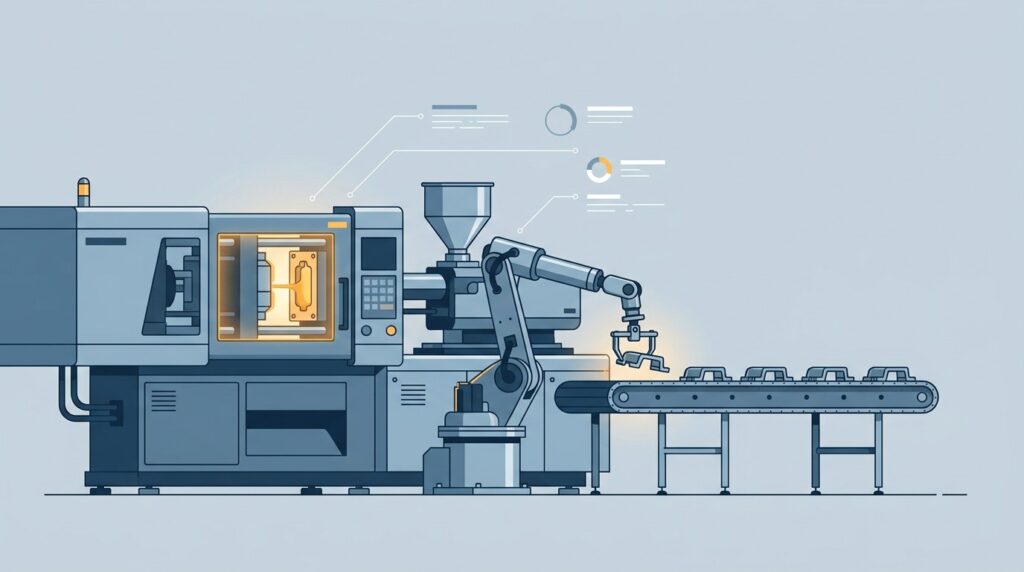
Injection molding dominates plastic production, and it is the process most people picture when they ask how modern manufacturing works. Polymer pellets are fed into a heated barrel, melted, and forced under high pressure into a steel or aluminium cavity. After a cooling interval, ejector pins push the finished part out and the cycle repeats.
Cycle times vary predictably with wall thickness. Thin-walled packaging can complete in a few seconds, consumer electronics housings typically take fifteen to thirty seconds, automotive interior components run thirty to sixty seconds, and thick-walled industrial parts can exceed two minutes. Because cooling dominates the cycle, wall thickness is the single most influential design variable an engineer controls.
The process delivers excellent dimensional accuracy, complex geometry with ribs and bosses, and superb surface finish. However, it demands substantial tooling investment. Prototype aluminium tools generally fall in the low thousands of dollars, mid-volume steel tools run into the tens of thousands, and high-cavitation hardened steel tools for million-unit programmes can reach six figures. Lead times commonly span four to twelve weeks before the first sample parts appear.
Blow Molding for Hollow Containers
When the object is hollow, thin-walled, and produced in large numbers, blow molding is how modern manufacturing works most economically. A softened tube of plastic is captured between mold halves, then compressed air inflates it against the cavity walls until it takes shape and cools.
Three variants divide the field. Extrusion blow molding accounts for the large majority of production and handles bottles, tanks, and automotive ducts at comparatively low tooling cost. Injection blow molding produces precise neck finishes for pharmaceutical and cosmetic containers. Stretch blow molding, meanwhile, delivers the clarity and strength that beverage bottles require.
The trade-off is dimensional control. Blow molded parts hold looser tolerances than injection molded ones, and material scrap from flash and pinch-off can run considerably higher. Nevertheless, for a one-piece hollow article with relaxed tolerances, no other process comes close on tooling cost.
Compression, Rotational, and Thermoforming Methods
Understanding how modern manufacturing works requires knowing the alternatives that fill the gaps injection molding leaves.
Compression molding places a measured charge of material into an open heated cavity, then closes the mold under pressure. Cycles run considerably longer, typically minutes rather than seconds, yet tooling costs a fraction of an injection tool because there are no runners, gates, or high-pressure requirements. It suits thermoset materials, rubber components, large thick-walled parts, and production runs in the hundreds to low thousands.
Rotational molding loads powder into a hollow mold that rotates on two axes inside an oven, coating the interior surface evenly as the material fuses. Cycles are slow, often twenty minutes or more, but tooling is inexpensive and the process excels at very large hollow items such as tanks and playground equipment at low volumes.
Thermoforming heats a flat sheet until pliable, then draws it over a single-sided mold using vacuum or pressure. Because only one mold half is needed, tooling is cheap and lead times are short. Trays, panels, and simple housings are natural fits, though geometry must remain relatively shallow.
The Economics That Drive Process Selection
Here is where theoretical comparison meets the commercial reality of how modern manufacturing works. Every molding decision balances two figures against each other: the one-time tooling investment and the recurring cost per part.
Injection molding carries high tooling cost and very low unit cost. Compression and rotational molding carry low tooling cost and higher unit cost. Consequently, there exists a crossover volume at which the expensive tool becomes the cheaper total. Below that point, the simpler process wins; above it, the fast cycle wins decisively.
Published figures suggest injection molding generally becomes economically sensible somewhere around a thousand parts per year, with the crossover against compression molding often landing near five thousand units. However, treat these as orientation rather than gospel. The actual crossover depends heavily on part size, resin choice, cavity count, cycle time, and regional tooling rates, which vary substantially between suppliers and geographies.
A practical approach is to calculate total cost of ownership rather than comparing quotes line by line. Add the tooling investment to the unit cost multiplied by your realistic lifetime volume, then divide by that volume. Additionally, factor in scrap rates, secondary operations, and tool maintenance, since these quietly reshape the comparison.
Many molders now trim those hidden costs by adopting robotic industrial automation for part removal, inline inspection and packing.
Design Decisions That Determine Cost
Experienced buyers understand a hard truth about how modern manufacturing works: most of a part’s cost is locked in during design, long before a quotation arrives. Accordingly, a handful of principles carry outsized weight.
Keep walls uniform and as thin as function allows. Thick sections cool slowly, extending cycle time, and they shrink unevenly, producing sink marks on visible surfaces. Where a rib meets a wall, keeping the rib meaningfully thinner than the wall it joins reduces this risk substantially.
Add draft to vertical faces. Without a slight taper, parts resist ejection and drag against the tool, causing cosmetic defects and accelerating wear.
Avoid undercuts where possible. Features that trap the part in the mold require side actions or lifters, each adding mechanism, cost, and potential failure points to the tool.
Design tolerances honestly. Every tightened tolerance raises tool precision requirements and inspection burden. Specify tight only where function genuinely demands it.
Leave material for adjustment. Removing steel from a cavity is straightforward machining, whereas adding it requires welding and refinishing. Therefore, designing initial dimensions slightly conservative allows tuning after first-article samples without rebuilding the tool.
How Digital Tools Have Changed the Shop Floor
The mechanical principles behind how modern manufacturing works have not changed much in decades, yet the surrounding practice has transformed considerably.
Flow simulation now allows engineers to predict how molten material will fill a cavity before any steel is cut, identifying weld lines, air traps, and short shots at the design stage. Meanwhile, sensors embedded in tools monitor cavity pressure and temperature in real time, letting operators detect drift before defective parts accumulate.
Automation handles part removal, trimming, and inspection on many lines, improving consistency and reducing the labour component of unit cost. Furthermore, rapid tooling methods produce functional prototype molds in days rather than weeks, letting teams validate a design in real production material before committing to expensive hardened steel.
These developments have not eliminated the fundamental trade-offs. Rather, they have shortened the feedback loop between a design decision and its consequences, which is precisely where costly mistakes used to hide.
Materials and Sustainability Considerations
Material choice cascades through everything. Commodity resins such as polypropylene and high-density polyethylene remain inexpensive and easy to process. Engineering polymers including polycarbonate and glass-filled nylon deliver mechanical performance at higher cost. High-performance materials sit far above both, reserved for applications that genuinely require their properties.
Sustainability pressure has reshaped priorities in recent years. Runner waste can be reduced through hot runner systems that keep material molten between cycles, and regrind programmes reintroduce sprues and rejects back into production where specifications permit. Additionally, lightweighting through thinner walls cuts both material consumption and cycle time simultaneously, which aligns environmental and commercial interests unusually well.
Claims about recycled content and recyclability deserve scrutiny rather than acceptance, because material performance and regulatory acceptance vary considerably by application and region. Verify with your supplier and relevant standards rather than relying on general assurances.
Frequently Asked Questions
Which molding process should I choose for my part?
Start with geometry and volume, since that is how modern manufacturing works in practice. Hollow containers in high volume point to blow molding. Complex precision parts in volume point to injection molding. Large hollow items at low volume suit rotational molding, while thick thermoset parts in modest quantities suit compression molding.
How much does a mold cost?
It varies enormously with complexity, size, cavity count, steel grade, and supplier region. Prototype aluminium tools sit at the low end, while multi-cavity hardened steel production tools reach six figures. Request quotes against a finished design rather than a concept, since estimates on incomplete drawings are rarely reliable.
How long before I receive production parts?
Tooling typically dominates the timeline. Simple tools may be ready in a few weeks, while complex multi-cavity tools often take considerably longer, and each round of sample corrections adds further time.
Is injection molding better than 3D printing?
They serve different purposes. Printing has no tooling cost and suits prototypes and very low volumes. Molding requires tooling investment but produces parts in seconds at low unit cost, which makes it the economical choice once volumes climb.
What causes defects like sink marks and warping?
Usually thick or uneven wall sections, insufficient packing pressure, or uneven cooling. Most are addressed through design corrections to wall thickness and rib proportions rather than by adjusting machine settings alone.
Can an existing mold be modified?
Often yes, within limits. Enlarging a cavity by removing material is routine, whereas adding material back requires welding inserts and is significantly more expensive.
Conclusion
Molding sits at the centre of how modern manufacturing works, converting raw polymer into finished goods at a scale and unit cost that few alternatives approach. The processes themselves are conceptually simple, yet the decisions surrounding them are anything but.
The pattern that emerges across every method reveals how modern manufacturing works at its core. Tooling cost and unit cost pull in opposite directions, and the right choice depends on where your realistic volume falls relative to the crossover between them. Meanwhile, the design of the part itself determines far more of the final cost than most buyers expect, which means engaging manufacturing expertise early pays for itself repeatedly.
For anyone specifying a molded component, the sensible sequence is straightforward. Define the geometry and functional requirements clearly, estimate lifetime volume honestly, review the design for manufacturability before requesting quotes, and validate with prototype tooling where the investment justifies it. Handled that way, molding delivers exactly what it promises: consistent parts, produced quickly, at a cost that improves with every unit.