
A tired living room does not automatically need demolished walls, replacement flooring or an expensive construction project. Transforming Your Living Area can begin with comparatively simple changes...
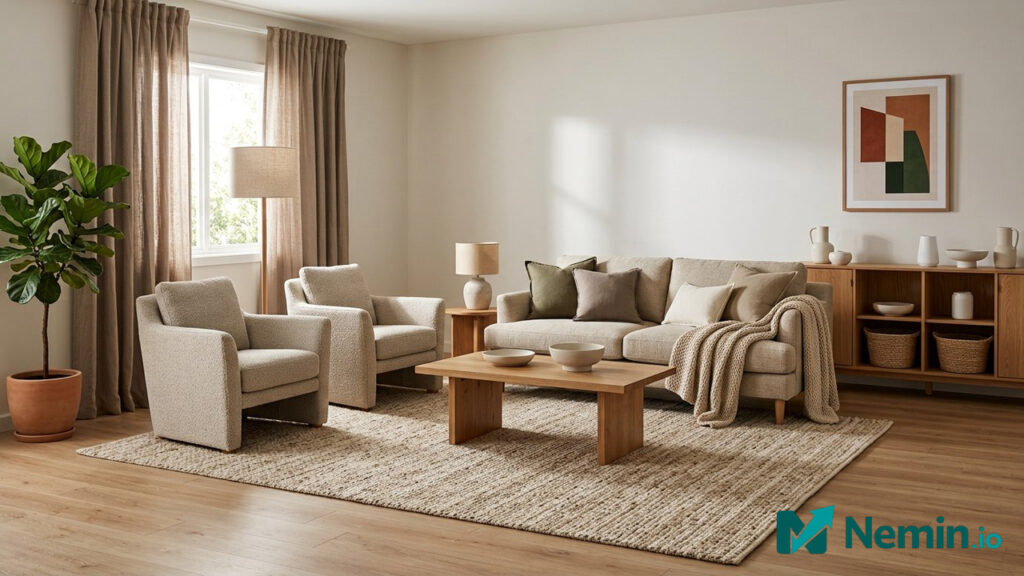
A tired living room does not automatically need demolished walls, replacement flooring or an expensive construction project. Transforming Your Living Area can begin with comparatively simple changes to furniture placement, lighting, colour, curtains, rugs, storage and decorative details, many of which can be completed without altering the structure of your home. The most successful refreshes start by identifying what currently feels wrong rather than buying new furniture immediately. A room that feels cramped may need a better layout, a dark room may benefit from improved lighting and reflective surfaces, while a visually chaotic room may simply need more effective storage and a clearer colour palette.
Living rooms often accumulate gradually. A sofa arrives first, followed by occasional chairs, a television, side tables, inherited furniture, children’s belongings and decorative objects bought over many years. Individual pieces may work perfectly well, yet the room as a whole can lose cohesion.
That is why a non-renovation makeover should begin with editing and planning. Understanding circulation, focal points and how the household actually uses the room makes it easier to decide what needs to move, what should disappear and which new purchases would genuinely improve the space.
Transforming Your Living Area is therefore less about copying a showroom and more about making existing square footage work harder. This guide covers nine high-impact strategies, from furniture arrangement and lighting to renter-friendly upgrades and practical storage.
What Does Transforming Your Living Area Without Renovation Mean?
Transforming Your Living Area without major renovation means improving appearance, comfort and functionality while leaving the fundamental architecture largely unchanged. Instead of moving walls, replacing windows or reconstructing floors, the focus moves toward reversible or relatively straightforward interior changes.
These projects can include painting, repositioning furniture, changing window treatments, installing suitable light fittings, introducing rugs, updating hardware, improving storage and restyling artwork. The exact scope depends on whether you own or rent and whether electrical or installation work requires professional assistance.
Some seemingly minor projects still need skilled tradespeople. Electrical work, heavy wall-mounted objects and modifications affecting building services should be handled appropriately rather than treated as casual DIY.
Start With the Problem, Not the Shopping List
Before purchasing anything, identify why the room currently feels unsatisfactory.
Is seating arranged awkwardly? Does the room become dark in the evening? Are toys and cables continually visible? Does oversized furniture make circulation difficult? Is everything the same colour and texture?
Each problem has a different solution. Buying another decorative chair will not improve poor lighting, and purchasing storage baskets will not solve a layout that blocks the main walkway.
Transforming Your Living Area Through a Clear Plan
A useful plan separates functional problems from aesthetic preferences.
| Current Problem | Possible Low-Renovation Solution | What to Check First |
|---|---|---|
| Room feels cramped | Rearrange or remove furniture | Main circulation routes |
| Room feels dark | Layer lighting and use lighter finishes | Natural light and fixture positions |
| Space feels unfinished | Add appropriately sized rug and curtains | Room dimensions |
| Too much clutter | Introduce closed storage | What genuinely needs storing |
| Room lacks personality | Add artwork and meaningful objects | Existing colour palette |
| Furniture feels disconnected | Create conversation zones | How the room is actually used |
| Ceiling appears low | Adjust curtain placement and vertical emphasis | Safe fixing positions |
| Room feels cold visually | Add texture and warmer lighting | Existing materials and colours |
| Rental feels generic | Use reversible styling | Tenancy agreement |
Having a clear reason for each change reduces unnecessary purchases.
9 Ways Transforming Your Living Area Can Create a Big Impact
A successful refresh often comes from several coordinated changes rather than one expensive statement item. Furniture layout may create more space, lighting can change the evening atmosphere and textiles can connect existing colours.
The following nine strategies are useful because they can work independently or together. They also allow homeowners and renters to prioritise according to budget.
1. Transforming Your Living Area Starts With Furniture Placement
Furniture arrangement costs nothing if you already own the pieces, yet it can produce one of the largest visual changes.
Many living rooms default to pushing every item against a wall. That can work in compact rooms, but larger spaces may benefit from bringing seating inward to create a more intentional conversation area.
Begin with the largest item, usually the sofa, and determine the room’s natural focal point. Then arrange secondary seating so people can communicate comfortably without obstructing movement.
2. Remove Furniture Before Adding More
A room can feel outdated simply because too many pieces compete for attention.
Try temporarily removing one occasional table, chair or storage unit. If the room immediately feels calmer and easier to navigate, additional purchases may not be necessary.
Transforming Your Living Area sometimes means owning less rather than decorating more.
3. Layer the Lighting
One central ceiling light rarely produces every type of illumination a living room needs.
Layering can combine general ambient light with task lighting for activities such as reading and accent lighting for atmosphere. Floor lamps and table lamps make this possible without major electrical work.
Where new wiring or fixed electrical fittings are required, use appropriately qualified professionals according to local requirements.
4. Use Textiles to Change Colour and Texture
Curtains, cushions, throws and rugs can introduce colour without committing to permanent architectural finishes.
These items also add texture, which can make a room with many hard surfaces feel visually softer.
Rather than buying numerous unrelated cushions, choose a small palette and repeat colours deliberately across several elements.
5. Create Better Storage
Visible clutter makes even attractive rooms feel disorganised.
Closed cabinets, drawers, baskets and storage ottomans can hide practical items, while open shelving works better for objects you intentionally want to display.
The best storage strategy starts by reducing unnecessary possessions. Otherwise, storage furniture simply creates more places for clutter.
6. Transform Walls Without Structural Work
Paint can change a living room dramatically without becoming a renovation-scale project.
Artwork, framed photography and mirrors can also alter visual balance. Renters may have access to removable solutions, but these should be used only where compatible with wall surfaces and tenancy rules.
Large walls often benefit from fewer, better-scaled items rather than many small decorations scattered without alignment.
7. Introduce an Area Rug
An area rug can visually connect seating and define a zone within an open room.
Sizing matters considerably. A rug that is too small may make furniture appear disconnected rather than unified.
Measure before buying and consider door clearance, furniture legs and cleaning requirements.
8. Improve Window Treatments
Curtains and blinds occupy a substantial visual area and influence privacy, light and thermal comfort.
Replacing dated or poorly fitted treatments can make the entire room feel more considered. Full-length curtains can create strong vertical lines, while simpler blinds may suit interiors where floor space around windows is limited.
Never block required ventilation openings or place fabrics unsafely around heat sources.
9. Finish With Personal Details
A living room should reflect the people using it.
Books, family photographs, travel objects, art and handmade pieces can prevent a carefully styled space from feeling anonymous.
The key is editing. Displaying fewer meaningful items often gives each one more visual importance.
Transforming Your Living Area With Furniture Layout
Before moving heavy furniture, measure the room and key pieces.
A simple hand-drawn floor plan can reveal arrangements that are difficult to imagine while standing in the space. Digital room-planning tools can also help, but measurements need to be accurate.
Keep doors, walkways, windows and heating equipment in mind.
Find the Primary Focal Point
A focal point gives furniture a visual direction.
It might be a fireplace, large window, artwork, built-in feature or television. Some rooms contain several competing focal points, so decide which matters most for everyday use.
If television viewing is central to the household, pretending the screen does not influence furniture placement usually creates an impractical layout.
Create Conversation Rather Than a Furniture Perimeter
Seating should ideally allow people to interact without shouting across the room.
In a large space, two smaller zones may work better than one enormous arrangement. A reading chair by a window can exist separately from the main sofa area.
Transforming Your Living Area successfully means designing for behaviour, not simply symmetry.
Transforming Your Living Area in a Small Room
Compact rooms need particularly careful furniture scale.
A huge sectional sofa can dominate limited floor area even if it technically fits. More compact seating with exposed legs can create a lighter visual impression, though comfort should remain a priority.
Avoid filling every empty corner merely because there is room for another object.
Transforming Your Living Area With Colour
Colour can change perceived atmosphere quickly.
Warm neutrals can create a softer backdrop, while cool tones may produce a calmer or crisper impression. Deep colours can feel dramatic and intimate, and lighter colours can help maximise reflected daylight.
No colour universally makes every room appear larger because natural light, furniture and architecture all influence the result.
Build a Simple Colour Palette
Choose one dominant base colour, one or two supporting shades and a limited number of accents.
The palette does not need to follow a mathematical formula. Its purpose is simply to reduce random decisions.
Repeat colours across the room so each element feels connected to something else.
Use Paint Strategically
Painting every wall is not always necessary.
A single architectural feature, shelving unit or selected wall may provide enough contrast. Alternatively, painting all walls in one cohesive shade can sometimes look more sophisticated than creating a conventional accent wall.
Test paint samples in the actual room because daylight and artificial lighting can change their appearance substantially.
Transforming Your Living Area With Better Lighting
Lighting affects how colours, textures and furniture appear after dark.
A beautifully decorated room can feel flat when illuminated only by one bright overhead source. Multiple lower-level lights can create greater depth.
Think about what happens in the room during morning, afternoon and evening.
Three Useful Lighting Layers
| Lighting Layer | Purpose | Examples |
|---|---|---|
| Ambient | General room illumination | Ceiling fixtures, broad floor lamps |
| Task | Supports specific activities | Reading lamps, desk lamps |
| Accent | Highlights atmosphere or features | Picture lights, discreet decorative lamps |
| Natural | Daytime illumination | Windows and glazed doors |
Not every room requires every fixture type, but several sources usually provide more flexibility than one.
Pay Attention to Light Temperature
Light sources can have different colour appearances, commonly described using colour temperature.
Very cool and very warm sources mixed randomly within one small room can look inconsistent. Selecting compatible lighting can create a more cohesive atmosphere.
Brightness should also suit the task, particularly for reading or other visually demanding activities.
Transforming Your Living Area With Curtains and Blinds
Window treatments influence more than decoration.
They can control privacy, reduce glare, filter sunlight and add a textile layer to the room. Thermal or lined curtains may also contribute to comfort around windows, although they are not substitutes for repairing defective glazing or insulation.
Measure carefully before ordering.
Use Curtain Placement to Emphasise Height
Where appropriate, placing curtain hardware above the window frame can create a longer vertical line.
Extending curtains beyond the sides of the window can also allow panels to stack away from more of the glazing when open.
Actual placement depends on wall construction, room proportions and safe fixing locations.
Choose Full-Length Curtains Carefully
Floor-length curtains can create an elegant finish, but they should not create trip hazards or interfere with doors, radiators or other heating equipment.
If curtains sit directly over a radiator, they may interfere with how warm air circulates into the room.
Consider the entire window area rather than appearance alone.
Transforming Your Living Area With an Area Rug
A rug can connect furniture that otherwise appears to float independently.
In open-plan spaces, rugs also help define where the living zone begins and ends without building a wall.
The most common problem is choosing a rug based on price without considering scale.
How to Choose Rug Size
There is no universal rug measurement because furniture arrangements differ.
As a general design principle, the rug should feel visually connected to the seating rather than sitting like a small island in the centre.
Use painter’s tape to mark proposed dimensions on the floor before ordering. This provides a much clearer sense of scale than looking at online product photographs.
Consider Maintenance
A pale high-pile rug may look beautiful but prove impractical in a household with pets, young children or frequent entertaining.
Material, pile height, cleaning requirements and stain visibility should influence the decision.
Transforming Your Living Area should improve daily life rather than create constant maintenance anxiety.
Transforming Your Living Area With Storage
Storage works best when each category of item has a logical home.
Remote controls need only a small container, while games, children’s toys and office materials may need closed cabinetry. Books and decorative objects can use open shelving.
Avoid purchasing storage before sorting what needs to go inside.
Closed Storage Versus Open Shelving
| Storage Type | Best For | Main Consideration |
|---|---|---|
| Closed cabinet | Electronics, toys and visual clutter | Requires floor or wall space |
| Open shelving | Books and intentional displays | Can look cluttered if overfilled |
| Storage ottoman | Blankets and occasional items | Check usable internal volume |
| Baskets | Quick-access everyday items | Need consistent organisation |
| Media unit | Devices, cables and entertainment | Ventilation may be required |
| Sideboard | Mixed household storage | Can provide useful display surface |
| Floating shelf | Small displays | Requires suitable wall fixing |
| Built-in storage | Maximum integration | More permanent and potentially costly |
A combination usually works better than relying entirely on open or closed storage.
Transforming Your Living Area by Decluttering
Decluttering is often presented as a complete solution to interior design, which can be unrealistic. People need possessions, and family homes are supposed to function.
The useful principle is visibility. Not everything you own needs to be visible simultaneously.
Edit surfaces so decorative items have room around them.
Start With One Category
Trying to reorganise the entire living room at once can become overwhelming.
Begin with books, children’s items, paperwork, cables or decorative objects. Decide what stays in the room before choosing where it belongs.
Only then determine whether additional storage is actually necessary.
Transforming Your Living Area With Wall Art
Artwork gives walls scale and personality.
A common mistake is hanging a small picture alone on a very large wall. The object may be attractive but visually disconnected from the furniture beneath it.
Larger art or a carefully planned grouping can create stronger balance.
Gallery Walls
Gallery walls can combine photographs, prints and artwork with different sizes.
Plan the arrangement on the floor before fixing anything to the wall. Maintaining some consistent element, such as spacing, frame colour or subject matter, can keep the collection cohesive.
Renters should follow tenancy rules before making holes or using adhesives.
Mirrors
Mirrors can reflect daylight and views, which may make a room feel brighter.
Place them intentionally rather than simply assuming any mirror will visually enlarge a space.
Consider what the mirror reflects. A carefully positioned mirror reflecting a window or artwork can contribute more than one facing clutter.
Transforming Your Living Area on a Small Budget
A limited budget encourages prioritisation.
Begin with free changes: remove clutter, rearrange furniture, move artwork from another room and experiment with accessories you already own.
Then spend where the visual or functional benefit is greatest.
Budget Priorities
| Budget Level | Possible Changes | Main Goal |
|---|---|---|
| No-cost refresh | Rearrange, declutter and restyle | Improve layout |
| Very low budget | Cushion covers, plants and small accessories | Add colour and personality |
| Low budget | Paint, lighting and simple storage | Change atmosphere |
| Moderate budget | Rug, curtains or key furniture replacement | Improve cohesion |
| Higher non-renovation budget | Quality sofa, substantial storage or premium lighting | Long-term function |
Prices vary greatly, so establish a total budget rather than buying small items impulsively.
Transforming Your Living Area Without Buying New Furniture
Existing furniture may look completely different after being repositioned.
A side table from a bedroom might work in the living room, while a chair that blocks circulation could be moved elsewhere. Swapping lamps, art and accessories between rooms costs nothing.
Furniture covers or professional reupholstery can also change appearance, although reupholstery can be expensive depending on the piece.
Restyle Before Replacing
Remove every small decorative object from the room temporarily.
Return only the items that improve the space. This editing exercise often reveals that the furniture itself was not the primary problem.
Transforming Your Living Area becomes less expensive when you understand what genuinely needs replacement.
Renter-Friendly Ideas for Transforming Your Living Area
Renters have additional constraints because permanent modifications may require landlord permission.
That still leaves substantial scope for styling through movable furniture, rugs, lamps, curtains where permitted, plants and artwork.
Always check the tenancy agreement before painting, drilling or making alterations.
Reversible Changes
Useful renter-friendly options can include freestanding shelves, floor lamps, oversized artwork resting safely on suitable furniture, removable textiles and temporary décor products approved for the relevant surface.
“Removable” products can still damage certain paints or wallpapers.
Test cautiously in an inconspicuous area where appropriate and follow product instructions.
Transforming Your Living Area With Plants
Houseplants add organic shape, texture and colour.
Select plants according to actual light conditions rather than choosing solely for appearance. Some species require bright indirect light, while others tolerate lower-light environments.
Plant care also needs to suit the household.
Consider Pets and Children
Some common houseplants can be harmful if ingested.
Households with pets or young children should verify plant safety through reputable veterinary, poison-control or horticultural sources before purchase.
Placement should also prevent heavy pots from being easily pulled or knocked over.
Transforming Your Living Area Around the Television
Many interior images hide televisions even though they are central to everyday living.
A practical room should acknowledge how frequently the household watches the screen.
Arrange seating around comfortable viewing while allowing the television to coexist with other focal points.
Hide Visual Cable Clutter
Cable management can make a media area appear considerably cleaner.
Use appropriate cable-management products and avoid creating unsafe electrical arrangements. Power strips and extension products should be used according to manufacturer guidance and applicable electrical safety recommendations.
Never cover equipment ventilation merely to hide devices.
Transforming Your Living Area for Families
A family living room needs to accommodate several activities.
Adults may watch television while children play, someone may read and another person may occasionally work. Flexible furniture and accessible storage can help the room change throughout the day.
Design around real family behaviour rather than an idealised photograph.
Make Children’s Storage Easy to Use
A storage solution works only when children can reasonably return items to it.
Low baskets and clearly defined categories can make tidying simpler. Avoid unstable furniture and secure items appropriately where tip-over risks exist.
Safety should always take priority over decorative styling.
Transforming Your Living Area for Small Spaces
Small rooms benefit from careful scale, clear circulation and furniture that performs a useful function.
Multifunctional pieces such as storage ottomans can help, but not every item needs multiple mechanisms. Sometimes a simple compact table is better than bulky transformational furniture.
Measure every major purchase.
Use Visual Breathing Space
Leaving some floor and wall space visible can prevent a small room from feeling overloaded.
Not every wall needs furniture and not every shelf needs decoration.
Transforming Your Living Area successfully often requires resisting the urge to fill every available surface.
Transforming Your Living Area in an Open-Plan Home
Open-plan spaces need visual definition because walls no longer separate activities.
Rugs, lighting and furniture placement can create zones without construction.
A sofa can act as a boundary between living and dining areas, while pendant or floor lighting can reinforce separate functions.
Keep the Zones Related
Different zones do not need identical furniture, but some visual connection helps.
Repeat a colour, timber tone, metal finish or textile across the room.
This creates cohesion without making every piece part of a matching furniture set.
Transforming Your Living Area With Texture
Rooms built around one neutral colour can still feel rich when several textures are present.
Wood, wool, cotton, linen-look fabrics, metal, glass and ceramics reflect light differently and add visual depth.
Texture is especially useful when you do not want strong colour.
Avoid Texture Overload
Bouclé, velvet, chunky knits, patterned rugs and heavily textured walls all competing in one small room can become visually busy.
Choose a few textures and allow quieter surfaces between them.
The same editing principle that applies to colour also applies to material.
Transforming Your Living Area Seasonally
A room does not need a complete redesign every season.
Small textile and lighting changes can adjust atmosphere as daylight and temperature shift. A heavier throw may feel appropriate in winter, while lighter fabrics can suit warmer months.
Store seasonal décor carefully rather than continually buying replacements.
Create a Small Rotation
Keep a limited selection of cushion covers, throws and decorative items that work with the permanent palette.
Changing only a few pieces produces freshness without redesigning the room four times per year.
This approach can also reduce unnecessary consumption.
Common Mistakes When Transforming Your Living Area
The first common mistake is buying before measuring. Furniture and rugs often appear smaller online than they feel inside a real room.
Another is changing too many unrelated elements at once. The result can feel more chaotic than the original space.
A third mistake is choosing aesthetics while ignoring daily function.
Avoid These Living Room Errors
When Transforming Your Living Area, avoid:
- Buying furniture without measuring
- Choosing an undersized rug
- Depending on one harsh ceiling light
- Blocking natural circulation
- Filling every wall with décor
- Purchasing storage before decluttering
- Blocking radiators or ventilation
- Hanging heavy items with unsuitable fixings
- Copying trends that conflict with your lifestyle
- Using too many unrelated colours
- Ignoring cable management
- Replacing functional furniture without a clear reason
Planning prevents many expensive corrections.
Creating a Cohesive Style
A cohesive room does not mean every item must come from one collection.
Matching furniture sets can sometimes make a space feel less personal. Instead, repeat selected colours, materials, shapes and finishes.
A black lamp can connect visually with a black picture frame, while a cushion can repeat a colour found in artwork.
Use an Inspiration Image Carefully
Choose two or three interiors that represent the atmosphere you like.
Instead of copying products, identify recurring characteristics. Perhaps the rooms all use warm neutrals, dark timber, large rugs and layered lighting.
Those principles are more transferable than purchasing an exact sofa seen online.
Sustainable Approaches to Transforming Your Living Area
The most sustainable purchase can sometimes be the one you do not make.
Reusing furniture, repairing quality pieces and purchasing second-hand items can reduce unnecessary replacement.
Sustainability claims for specific products should be evaluated carefully rather than accepted solely from marketing language.
Buy Fewer, Better-Fitting Items
A cheap chair that never fits the room is poor value regardless of its initial cost.
Take time to identify dimensions and actual needs before purchasing.
Transforming Your Living Area gradually can create better decisions than completing everything over one weekend.
A Practical Plan for Transforming Your Living Area
Breaking the process into stages prevents the project from becoming an uncontrolled shopping exercise.
Begin with measurement and function, make free changes first and introduce purchases only where they solve identified problems.
Finish with styling rather than starting there.
| Stage | Main Action | Goal |
|---|---|---|
| 1. Assess | Identify functional and visual problems | Establish priorities |
| 2. Measure | Record room and furniture dimensions | Prevent unsuitable purchases |
| 3. Edit | Declutter and remove unnecessary pieces | Create breathing space |
| 4. Rearrange | Test furniture layouts | Improve circulation |
| 5. Light | Add appropriate lighting layers | Improve atmosphere and function |
| 6. Colour | Refine paint and accessory palette | Create cohesion |
| 7. Textile | Add rug, curtains and cushions | Introduce softness and texture |
| 8. Store | Organise remaining possessions | Reduce visible clutter |
| 9. Personalise | Add art, books and meaningful objects | Give the room identity |
| 10. Review | Live with the changes before buying more | Avoid unnecessary spending |
This sequence works for both complete room refreshes and gradual updates.
How Long Does Transforming Your Living Area Take?
A simple refresh can happen over a weekend, but there is no need to finish quickly.
Living with a new furniture layout for several days can reveal whether circulation genuinely works. Paint samples also benefit from being viewed under different lighting conditions.
A slower process often leads to fewer purchasing mistakes.
Finish in Layers
Complete the major layout first, then lighting and large textiles.
Small décor should come last.
If the room already feels complete before every planned purchase is made, stop. A checklist is not a requirement to fill the space.
How to Know When the Transformation Works
A successful living area should be easier to use, not merely more photogenic.
You should be able to move through it comfortably, access necessary storage, use appropriate lighting and sit where the household naturally wants to sit.
Visual improvement should support these functions.
Ask Functional Questions
After Transforming Your Living Area, consider whether:
- Main walkways are unobstructed
- Seating supports normal activities
- Lighting works at different times of day
- Everyday possessions have storage
- Window treatments function properly
- The room reflects household personality
- Cleaning remains manageable
- Furniture scale suits the room
- The space works for regular users rather than photographs
If the answer is yes, major construction may never have been necessary.
FAQ’s
Can Transforming Your Living Area be done without renovation?
Yes. Transforming Your Living Area can involve furniture rearrangement, paint, lighting, rugs, curtains, storage, artwork and accessories without changing the room’s fundamental structure.
What is the cheapest way of Transforming Your Living Area?
Start by decluttering and rearranging existing furniture because both can be free. Restyling existing art and accessories can also change the room before new purchases become necessary.
How can Transforming Your Living Area make a small room feel better?
Use appropriately scaled furniture, clear walkways, effective storage, layered lighting and a deliberate colour palette. Leaving some visible floor and wall space can also reduce visual crowding.
Does Transforming Your Living Area require buying a new sofa?
No. If the existing sofa is comfortable and appropriately sized, changing its position, surrounding lighting, rug, cushions and nearby furniture can significantly alter how it looks.
What should I buy first when Transforming Your Living Area?
Buy nothing until you have measured, decluttered and tested the existing layout. When purchasing starts, prioritise the item that solves the largest identified functional or visual problem.
Can renters try Transforming Your Living Area ideas?
Yes. Freestanding furniture, rugs, lamps, textiles, plants and other reversible changes can have substantial impact. Check tenancy terms before painting, drilling or modifying fixed elements.
Conclusion
Transforming Your Living Area does not require knocking down walls or committing to an expensive renovation. Rearranging existing furniture, improving lighting, refining the colour palette, adding correctly sized textiles and creating better storage can change both how the room looks and how comfortably it functions. The most effective projects begin with the room’s problems rather than a shopping basket.
Approach Transforming Your Living Area gradually and measure before making significant purchases. Prioritise circulation and everyday function, then layer in colour, texture, artwork and personal objects that give the room identity. When each change has a clear purpose, even a modest budget can produce a living area that feels significantly more considered, comfortable and personal.
Pingback: Dorchester Nursing Care Home: 7 Powerful Daily Rituals